Pacific security agreements: lessons from the Iran-US-Israel conflict

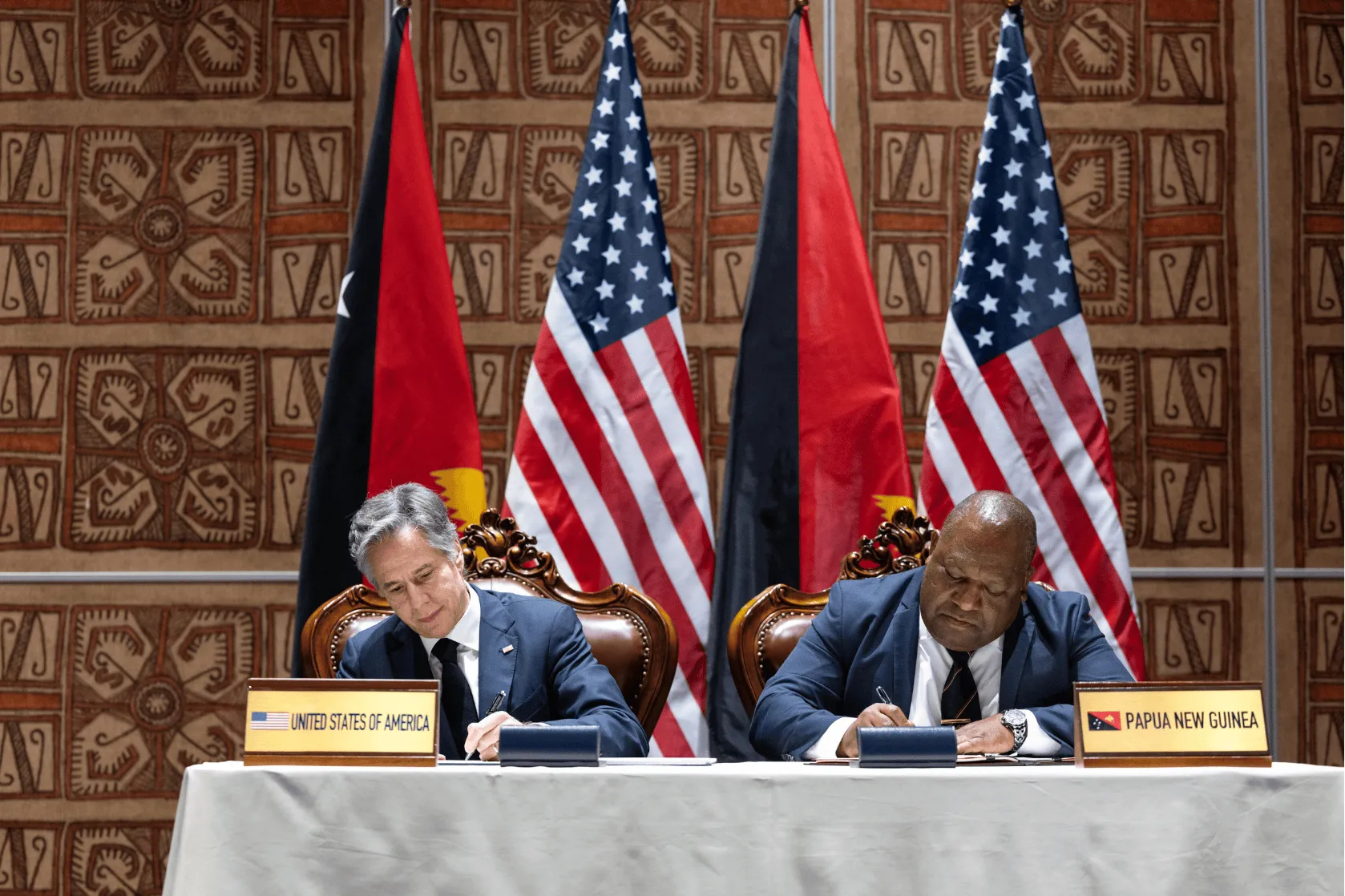
Papua New Guinea signs the Defence Cooperation Agreement with the United States, May 2023. Photo: U.S State Department/Flickr
The escalating conflict involving Iran, the United States (US) and Israel might seem distant from the Pacific, yet its strategic implications reach deep into the region.
When Iran retaliated, it didn’t just strike Israel or US warships. It struck ten other countries in the region such as Bahrain, the United Arab Emirates (UAE), Qatar and Jordan.
Not because those countries fired a shot. Not because they declared war. But because they hosted foreign military installations through security agreements they had signed in peacetime.
Countries in the Pacific including Papua New Guinea, Solomon Islands, Vanuatu, Fiji and Kiribati have either signed, are considering, or are being courted into security partnerships with Australia, the United States and China. The Iran-US-Israel conflict exposes important realities about modern warfare, alliance politics and the risks that accompany security partnerships.
Three key lessons emerge for Pacific states.
Before examining these lessons, it is necessary to understand the broader legal and geopolitical context.
International law scholars have widely questioned the legality of the US and Israeli strikes on Iran. Under Article 51 of the UN Charter, force is permitted only in cases of self-defence against an actual or imminent attack. Critics argue that this threshold was not clearly met, raising concerns that the strikes could violate international law.
Australia has not directly joined combat operations and has maintained strategic silence on the legality of the conflict — unlike other Western countries, particularly Spain and Norway, which have publicly criticised the strikes as unlawful. Yet Australia remains deeply integrated with US military structures. Reports that Australian submariners were aboard the USS Minnesota during operations against the Iranian frigate IRIS Dena, along with Australia’s deployment of surveillance aircraft and personnel to the UAE, illustrate this integration.
Against this backdrop, the characteristics of the Iran-US-Israel war bear three important lessons for the Pacific.
First, security agreements might unintentionally make smaller states potential targets.
Iran’s retaliatory strikes on countries hosting US military assets — such as Bahrain, the UAE and Kuwait — demonstrate that states can become targets not because they initiate conflict, but because they are perceived as supporting allied operations.
Long-range weapons have eroded the protective value of geography. Modern warfare relies on drones, cruise missiles and ballistic missiles capable of striking thousands of kilometres away.
For Pacific countries considering deeper security cooperation with Australia, the US or China, this raises legitimate concerns. In a major Indo-Pacific conflict, states hosting or facilitating foreign military assets or intelligence facilities could become strategic targets.
This concern has been recently echoed by the former PNG Defence Force commander Brigadier General Jerry Singirok, who warned that foreign-linked military facilities could place PNG in a vulnerable position.
Security cooperation brings benefits — training, maritime surveillance, disaster response and capacity-building — but the Iran conflict shows that such arrangements also carry real risks.
A second lesson is that security partnerships do not guarantee protection during conflict.
The Middle East crisis highlights the limits of even the strongest alliances. Despite extensive US security partnerships in the Gulf, Washington cannot fully shield partner states from missile and drone attacks.
Modern warfare has lowered the barriers to projecting destructive power. Even limited capabilities can inflict significant damage through missiles and drones, cyber operations or economic disruption.
For Pacific states, this means that security agreements with powerful partners do not eliminate vulnerability. In a major Indo-Pacific conflict, the ability of external powers to sustain operations across the vast Pacific would be constrained by logistics, geography and operational capacity.
The same applies to any hypothetical Chinese military presence. Even if China were to establish facilities in the Pacific, sustaining operations across such distances would be difficult.
No major power can provide absolute security guarantees in the Pacific. This underscores the need for carefully designed agreements that protect sovereignty and avoid unnecessary strategic exposure.
The third lesson is about trust in Australia’s regional leadership. For many Pacific countries, security agreements with Australia are grounded not only in capability but in trust. Australia’s long-standing presence through development assistance, disaster response and institutional cooperation has fostered a sense of “Pacific family“.
But that trust is not unconditional.
Pacific states want Australia to act not merely as an extension of US power but as an independent regional leader capable of exercising its own judgement, especially when international law and regional stability are at stake. This resonates with the position of some of Australia’s leading Prime Ministers such as Malcolm Fraser and Paul Keating.
In the current Iran-US-Israel conflict, several Western allies have distanced themselves from US or Israeli positions when legal or strategic concerns arise. Australia faces a similar test.
The Iran-US-Israel conflict shows that security agreements are no longer abstract diplomatic instruments. In an era of geopolitical competition and long-range military technologies, they carry real consequences.
Pacific nations cannot avoid these dynamics. Hard-power considerations — often regarded in the region, and rightly so, as secondary to development and climate priorities — are nevertheless becoming increasingly central to the region’s evolving strategic environment.
This does not mean Pacific states should avoid partnerships, as strategic alignment may be necessary for some in the region. However, such agreements must be carefully reassessed or structured to safeguard against unnecessary and costly entanglements.
As for Australia, the Iran conflict is a test of how it balances alliance loyalty, international law and regional leadership. How Canberra navigates this moment may impact on the future credibility of its security partnerships across the Pacific.
Dr Bal Kama is Director of Kamana Legal and Advisory, a firm specialising in law, governance and development in the Australia–Pacific region.
This article was first published on DevPolicy blog.
Views expressed via the Pacific Wayfinder blog are not necessarily those of the Pacific Security College.