Pacific security in 2026: key challenges shaping the Blue Pacific




The Pacific enters 2026 navigating a rapidly changing security environment. Photo: Seiji Seiji/Unsplash
With global tensions sharpening, climate impacts intensifying, and new security pressures emerging across the region, Pacific leaders and communities are navigating an increasingly complex environment.
As we consider the year ahead, several areas emerge as central to the Pacific’s security landscape in 2026.
A shifting global dynamic
When we look at the global dynamics shaping 2026, it becomes clear how deeply these affect the Pacific’s own security landscape.
‘Tau a’e ika ta’ane’, a Tongan proverb that refers to the undercurrents of the actions of the big fish on our Blue Ocean continent, now and in the future has reverberating effects we must carefully navigate.
Decisions by major powers – such as the United States withdrawing from the Paris Agreement or moving to pressure Vanuatu about its draft resolution to the United Nations (UN) – aren’t just geopolitical shifts; they impact our way of life.
For the Pacific, they roll back decades of hard‑won progress and force countries to work even harder to keep climate action on the global agenda.
These moments bring home how vulnerable the region is to choices made far away, and how quickly partners’ actions can either set us back or help us advance the work we do for our people.
At the same time, these disruptions highlight how heavily the region depends on a stable, functioning international rules‑based order. That system is what allows small island states to take issues like climate change to the International Court of Justice, to the UN, and to push for clear global obligations.
As the systems and institutions that have existed in the past are dismantled, Pacific leaders are turning to collective responses, including the Blue Pacific Ocean of Peace Declaration. Progressing that into action or implementation would give the region a chance to articulate its principles, strengthen solidarity and prepare for the rebalancing that lies ahead.
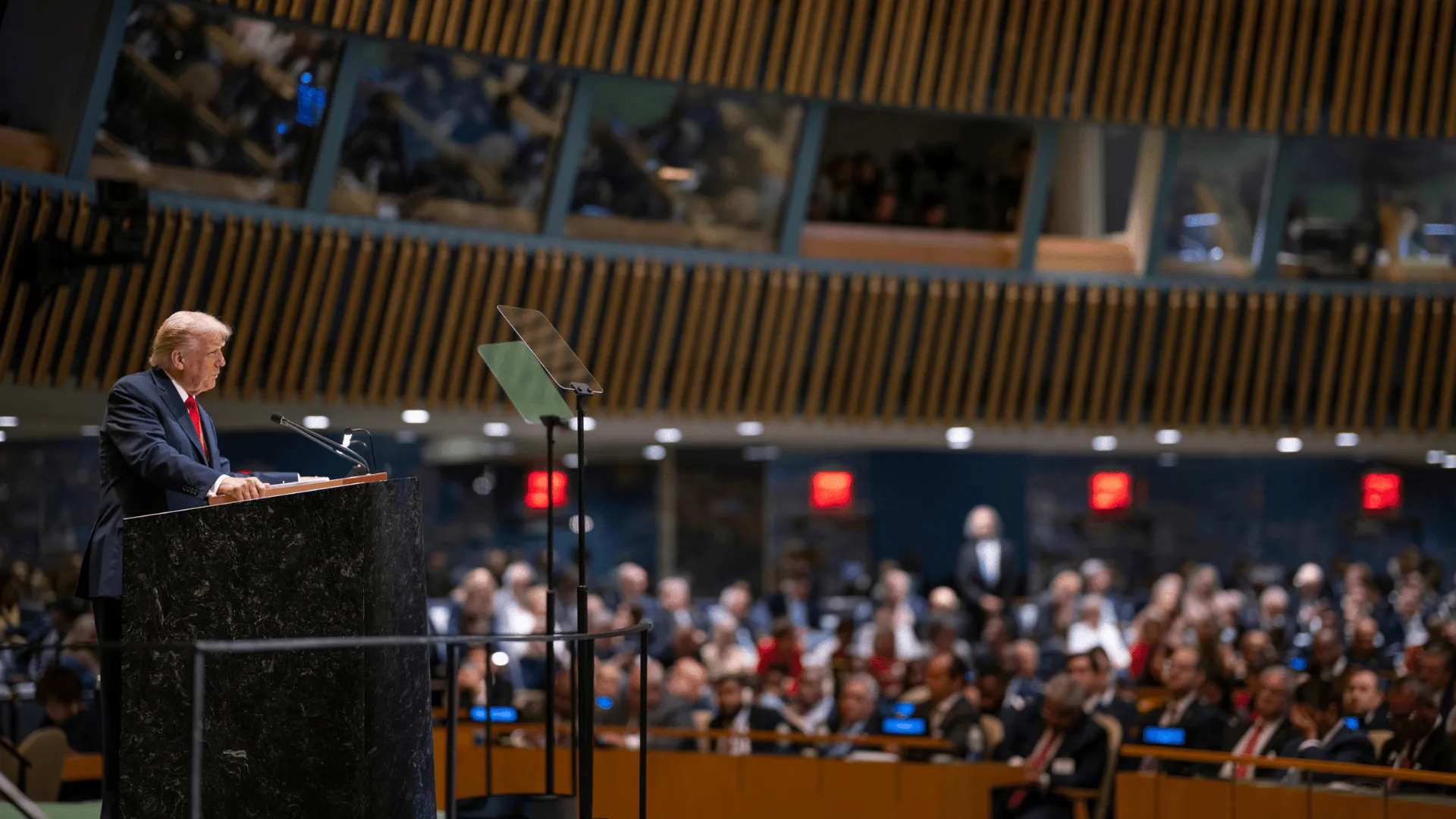
President of the United States Donald Trump addresses the United Nations General Assembly in September 2025. Photo: The White House/Flickr
Securing our future in a changing climate
The region is facing a rapidly evolving climate landscape, and many of the challenges ahead are already becoming clear. One is how Pacific countries can prepare for climate‑driven movement while holding firm to the principle that staying in place remains the first priority.
The Pacific Regional Framework on Climate Mobility speaks directly to this, recognising the growing scientific evidence that climate impacts will increasingly affect where and how people live. The framework is culturally tailored to the needs and rights of Pacific islanders.
Implementation is now under way, and that brings its own pressures. Countries are working through priority actions, from establishing a climate mobility hub to strengthening national systems that can respond to displacement, relocation and other movement. Peer‑to‑peer exchanges – like those recently between Palau and Fiji, and soon Vanuatu and Fiji – show the region leaning on its own ways of learning, but they also highlight how much coordination and resourcing is required.
Another enduring challenge is financing. Communities at the epicentre of the climate crisis need access to funds now more than ever, and the region’s focus is on building these systems and infrastructure through home-grown institutions such as the Pacific Resilience Facility, to ensure these are ready.
And even though the Australia-Pacific joint bid to host COP31 wasn’t successful, there’s still a win for the Pacific. Australia leading the negotiations is an opportunity to ensure Pacific priorities remain on the table in Türkiye later this year.
Uniting to fight transnational organised crime
Transnational organised crime has become one of the most urgent security challenges facing the Pacific.
The surge in drug trafficking across the region shows the problem is no longer confined to one or two countries. There have been major drug seizures in Fiji, Samoa, Tonga and French Polynesia. ‘Narco-subs’ have been spotted in Solomon Islands and the Marshall Islands.
With vast ocean borders, limited enforcement capacity, and growing pressures from global criminal networks, no state can manage this alone.
Pacific leaders have already called for collective regional action, building on the Boe Declaration and its action plan.
While many countries address transnational crime as part of their national security strategies, the challenge is turning words into action – developing step‑by‑step implementation, strengthening monitoring and surveillance, and ensuring policies don’t remain ‘on the shelf’. This will require serious investment in enforcement systems, maritime capability, and border security, especially for smaller states with limited capacity.
But government and law enforcement alone will not solve the problem. Churches, women’s groups, youth networks and customary institutions are increasingly stepping in to address community‑level impacts, offering prevention, awareness and social support where state systems struggle to reach. A whole‑of‑community effort, supported by regional cooperation and international partners, is essential if the Pacific is to stem the growing tide of drugs and transnational crime.

Australian Minister for Foreign Affairs Penny Wong and Tuvalu’s Foreign Minister Paulson Panapa sign the Falepili Union explanatory memorandum in May 2024. Photo: Australian Department of Foreign Affairs and Trade
Negotiating partnerships on Pacific terms
Over the past few years, the Pacific has seen a rapid rise in bilateral security agreements, which have the potential to shape the region’s security landscape.
These arrangements reflect the broader geopolitical contest playing out between major powers, with Pacific states navigating how to protect their national and regional interests while maintaining long‑standing principles such as ‘friends to all, enemies to none’. Countries seek to secure these arrangements to best achieve their national development objectives priorities, while not compromising other potential partnerships.
In this crowded and contested landscape, Pacific Island governments must remain vigilant to ensure that any security agreements or deals, whether bilateral or multilateral, continue to align with their national and regional interests.
Alongside traditional security agreements, newer deals and opportunities such as the Falepili Union and the Pacific Engagement Visa sit at the intersection of mobility and climate security. While ostensibly, benefits will flow to Pacific people through such arrangements, Pacific Island governments and people must engage in these processes with both their immediate and longer-term interests, and agency, in mind.
With a likely proliferation of such agreements, Pacific states should continue to ensure that regional stability, national priorities, and community wellbeing remain at the heart of any and all security partnerships.
Working together to meet shared challenges
As these issues show, 2026 will demand a renewed commitment to working together across the Blue Pacific. Whether the challenge is geopolitical uncertainty, the realities of climate mobility, the spread of transnational crime, or navigating a crowded and contested field of security partners, no country can respond effectively in isolation.
Regional frameworks, national strategies and community‑level initiatives all have a role, but their impact depends on how well they connect and support each other.
The resilience, agency and collective strength of the Pacific will not only shape how the region confronts these security pressures, but also how it charts a path forward that reflects its shared vision, values, and enduring solidarity.
Views expressed via the Pacific Wayfinder blog are not necessarily those of the Pacific Security College. Read our publishing policy.