Soft power, hard risks: how politicising army biculturalism weakens NZ’s Pacific credibility

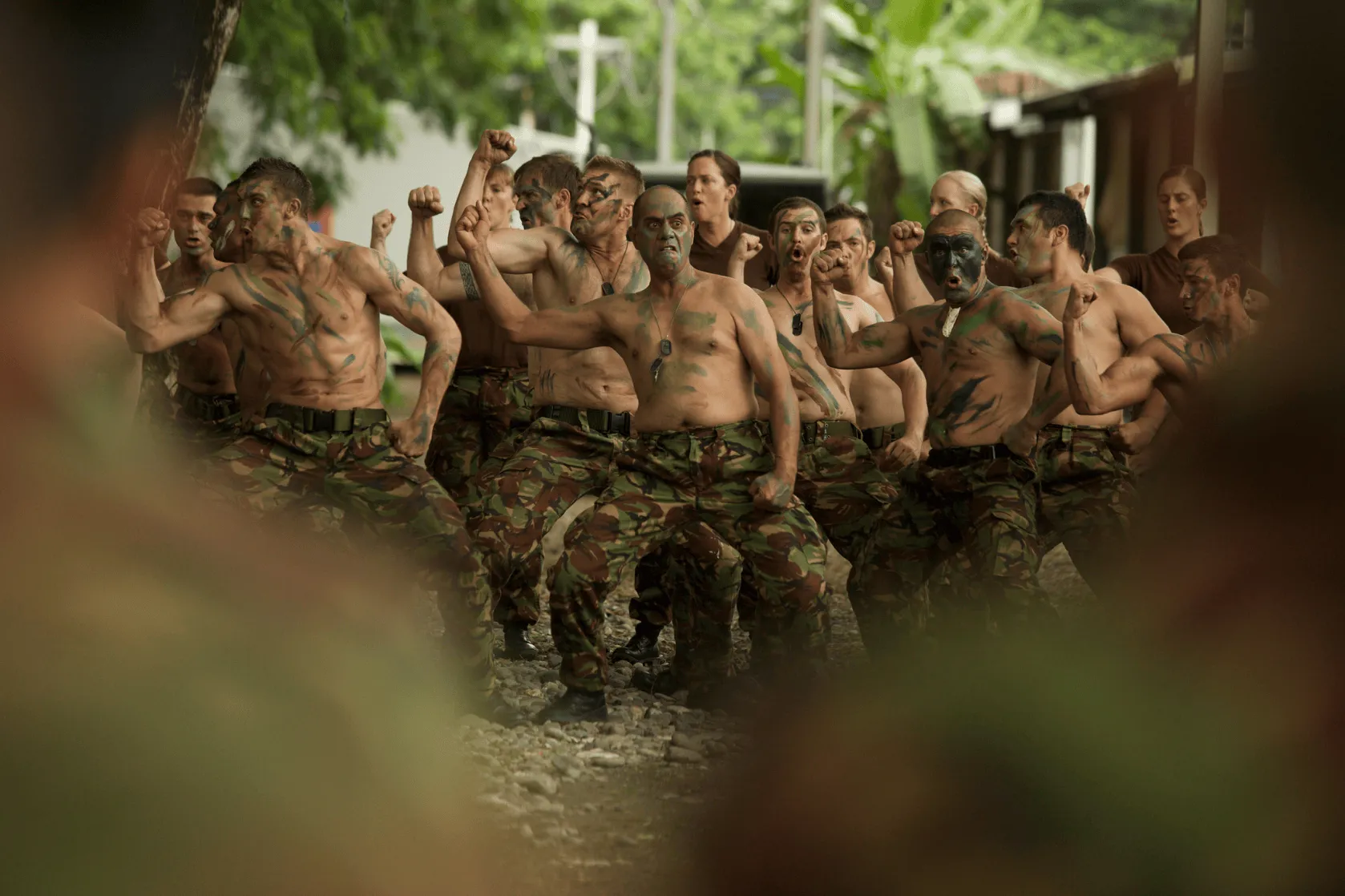
Members of the 8th Rotation of the New Zealand Defence Force perform a haka in 2009 at the main base for RAMSI military and police forces in Solomon Islands. Photo: Australian War Memorial (P08837.992)
In February, the New Zealand Army announced a stop-work on a new bicultural policy and framework after the direct intervention of defence minister Judith Collins. The policy, leaked but yet to be officially released, formalises planning through both indigenous Māori and settler Pākehā worldviews and sets standards for cultural competence among personnel.
This came after junior coalition leaders Winston Peters and David Seymour rallied against the developments as part of a sustained contest over the institutionalisation of Māori culture and language. Though Seymour interprets it as the army “taking sides” on a live political issue, the intervention actually constitutes the opposite: a move that risks politicising the independent operation of a key security agency.
The consequences extend beyond Aotearoa. This politicisation of the New Zealand Army risks eroding the country’s credibility within the Pacific security framework.
Army biculturalism is an effective, long-standing strategy
The integration of Māori and Pākehā cultures into the New Zealand Army has deep institutional roots. With distinguished service in both world wars, Māori soldiers have long been integral to the army’s reputation and operation.
This culminated in the 1990s reforms that remodelled the army as a bicultural institution, including building the first defence marae (Māori social complex) and being declared an iwi (tribe).
The proposed policy formalises practices already embedded in military life, and its operational value has been demonstrated repeatedly across the Pacific.
The Boe Declaration Implementation Action Plan identifies cross-cultural competency as an integral part of ensuring human security for the region. Aotearoa’s operational record in the Pacific demonstrates why that competency matters.
During the 1997-98 Bougainville intervention, army personnel facilitated the Burnham peace talks and led the subsequent Truce Monitoring Group. The central place of Māori culture – especially pōwhiri (ceremonies of encounter) – helped bridge a decade-long divide between factions and civilians. The active participation of non-Māori personnel in practices such as haka reinforced Aotearoa’s credibility as a post-conflict facilitator rather than an external enforcer.
In-country, Māori officers’ advocacy for an unarmed deployment, focused instead on music, haka, and relational engagement, contributed to a settlement that endured for decades. The embrace of bicultural practice created space for reconciliation and reduced the risk that soldiers’ presence would compound local trauma.
The same doctrine underwrote the deployment to Tonga during the 2006 Nuku’alofa riots. Forces navigated incendiary political tensions, including distrust of armed authority and delicate dynamics within Aotearoa’s own Tongan diaspora. Restoring order required more than force protection; it required cultural fluency and an understanding of Pacific communal hierarchies developed through bicultural training.
Following Cyclone Winston, Aotearoa deployed 500 personnel to Fiji alongside French, Australian and Fijian counterparts to rebuild and restore services in devastated communities. In a country shaped by repeated coups, engagement required sensitivity to local authority structures. While coordination with Fijian forces was essential, personnel immersed in Māori relational frameworks could engage directly with village leaders in ways respectful of cultural protocols, reducing reliance on military intermediates in a context where perceptions of armed authority are complex. In disaster recovery environments, this broader interface with communities and their traditional leaders shapes operational responsiveness and perceived credibility during recovery.
From Bougainville to Tongatapu and Viti Levu, biculturalism has shaped operational planning, conduct, and legitimacy. In Pacific contexts, cultural fluency is not peripheral to security: it is integral to how security is delivered.
Politicisation blurs civil-military boundary
The politicisation of army biculturalism blurs the civil-military boundary. Unlike debates over whether to deploy forces abroad – a legitimate function of civilian oversight – this intervention concerns how a force organises itself internally and develops doctrine. When partisan framing shapes internal professional standards, civilian oversight risks becoming political intrusion.
The complaint that enlisted personnel are “public servants” and therefore subject to political correction erases the unique service model of defence forces. Military institutions operate under civilian authority but rely on professional autonomy to develop doctrine and practice.
In an increasingly charged political environment around Māori culture, what appears to be a standard-setting exercise has been reframed as partisan ideological positioning. In doing so, the government risks setting a precedent that future evolution of defence doctrine and capabilities is subject to electoral fortunes.
Risks to Aotearoa’s regional standing
Aotearoa’s regional standing rests on more than military capacity – it depends on the trust earnt through consistent alignment with the Pacific’s own vision of security, one that elevates human, environmental, and cultural dimensions alongside territorial integrity. The New Zealand Army’s operational biculturalism is precisely that alignment in practice. Yet if its cultural competency standards become contested in domestic politics, the region has reason to question the depth and durability of Aotearoa’s alignment with that vision.
The immediate impact of the stop-work order is likely to be limited. Biculturalism is deeply embedded in the defence force. But the longer-term precedent matters. If internal doctrine and capability planning become politicised, Aotearoa’s credibility as one of the region’s few culturally Pacific militaries will weaken.
What has been framed as correcting an ideological ‘hijacking’ is, in practice, the opposite – a partisan intrusion into military doctrine that risks the same politicisation it claims to remedy.
For a small country whose influence depends less on scale and more on trust in a region where legitimacy often outweighs logistics, that is not a trivial risk.
Dr Jayden Evett (Pākehā) is an independent scholar. He completed a PhD from the Department of Pacific Affairs at the Australian National University in 2025 examining the impact of the Māori Renaissance on Aotearoa New Zealand’s Pacific diplomacy. His research work spans diplomacies, identities, and settler state decolonisation.
Views expressed via the Pacific Wayfinder blog are not necessarily those of the Pacific Security College. Read our publishing policy.