Climate security course supports shared and regional learning across the Pacific
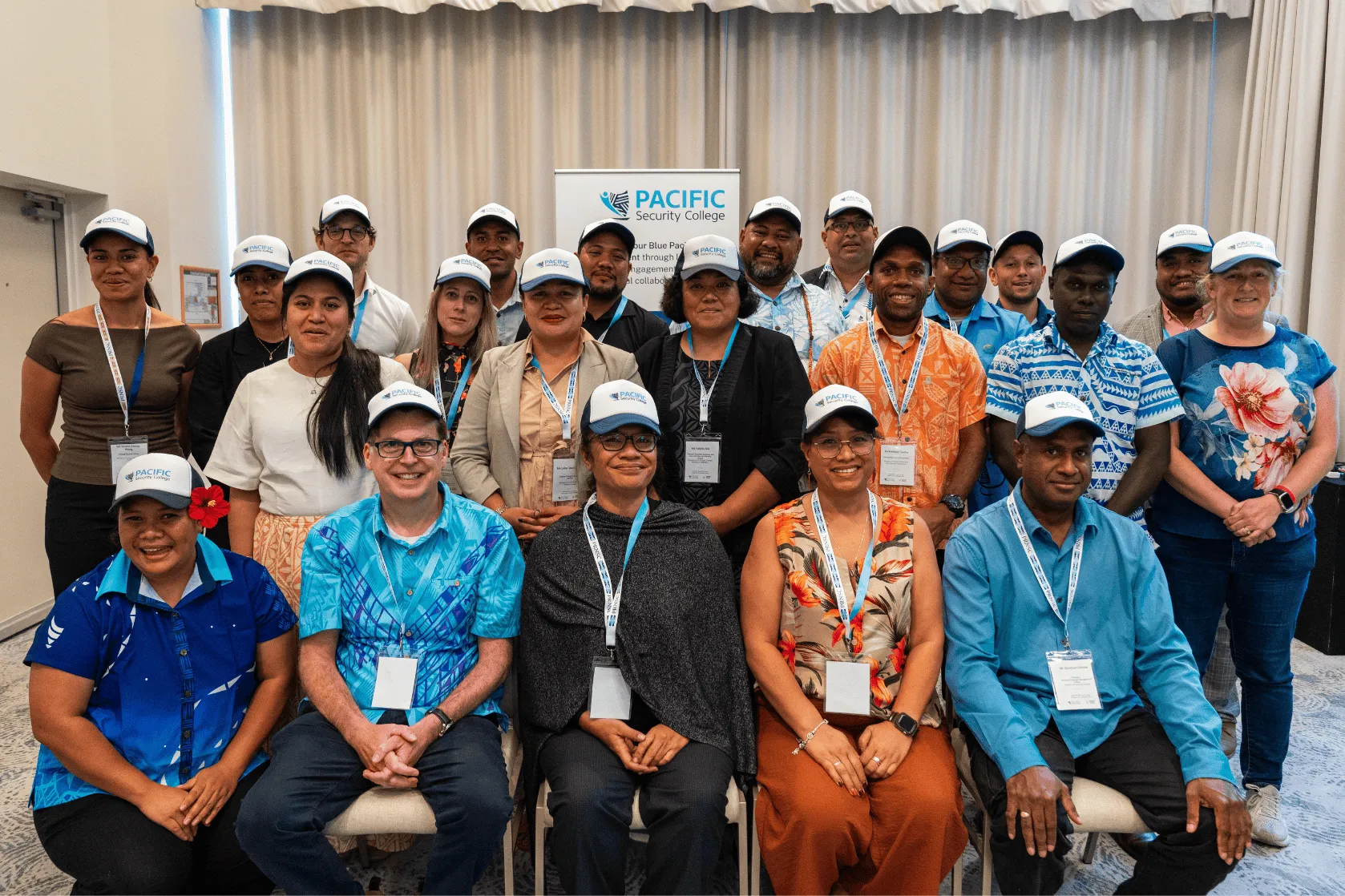
The Climate Security in the Pacific course brought together more than 20 participants from 16 Pacific Islands Forum member countries. Photo: Pacific Security College
Security officials from across the Pacific have gathered in Brisbane to deepen their shared understanding of climate-driven security risks through an expert-led course hosted by the Pacific Security College.
Delivered in collaboration with the Pacific Islands Forum Secretariat (PIFS) and the Secretariat of the Pacific Regional Environment Programme (SPREP), the two-day Climate Security in the Pacific training followed the first ever Pacific Regional Climate Security Dialogue three days earlier. The course was a talanoa and facilitated discussions from the Dialogue, and combined the latest research designed to support evidence-based decision-making.
Led by Salā Dr George Carter from The Australian National University (ANU), the program examined the climate change and security nexus, with a focus on both security risks and peacebuilding initiatives, enhancing participants’ knowledge and exploring how practical tools and solutions can be implemented in their respective countries.
Dr Carter said the course was informed by the Boe Declaration on Regional Security, which acknowledges that climate change impacts are a threat to the livelihoods, well-being and security of Pacific people, and encourages countries to implement strategies to respond to those challenges.
“There is an array of climate security courses out there, but this is the first that contextualises the Pacific, not only in terms of regional risks leading to conflict, but utilising Pacific values in understanding peace and harmony to empower policy, community and leadership responses within a country,” he said.
“Participants explored how climate change impacts not only security systems, but also political systems. The hope is that participants develop their understanding of this climate-security nexus and how to progress this work in their national governments.
“This regional climate security training allows us to connect the local and national efforts on climate and security to international spaces where the Pacific is leading in defining climate security like the UN Security Council and UN Framework Convention on Climate Change.”
The Climate Security in the Pacific course brought together more than 20 participants from 16 Pacific Islands Forum member countries, including officials from a range of government departments and ministries, as well as from regional organisations.
The program covered climate science; the impacts of climate change on environmental resources, infrastructure and public health; approaches to data collection; climate risk assessments; safeguarding state integrity; and developing effective responses to climate-related security pressures.
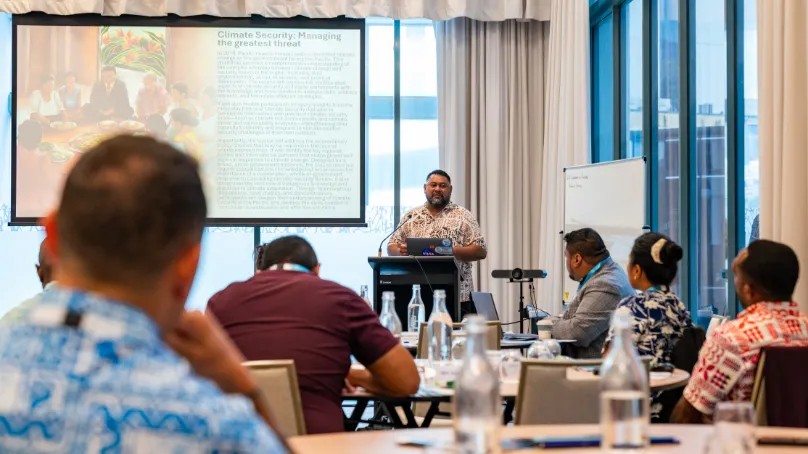
Salā Dr George Carter, from the Australian National University, addresses the Climate Security in the Pacific course. Photo: Pacific Security College
Presenters included Pacific Security College Research Fellows Anna Naupa and Akka Rimon; Emeritus Professor Mark Howden AC, from the Australian National Centre for the Public Awareness of Science at ANU and Vice-Chair of the IPCC Working Group II; Peter Waring from the Bureau of Meteorology; and Ross Henry from the Australian Climate Service.
Pacific Security College Research and Engagement Fellow Akka Rimon said the course provided an opportunity to unpack definitions of security in a climate context and understand the perspectives of countries as they grapple with the realities of security threats back home.
“It was encouraging to see participants share their experiences as well as the ways they have built resilience and developed strategies – many of which draw on approaches long embedded in their traditional knowledge systems,” she said.
“There is no single, cookie-cutter model that fits all climate security contexts in the Pacific. In fact, the region’s diversity of practices and experiences means we have far more to offer and more to draw from to strengthen our collective resilience. We learn from what others have done in their own contexts and those insights give us additional safeguards to inform our own climate strategies.”
The course was held on Thursday 19 March and Friday 20 March, following the Regional Dialogue on Climate Security in the Pacific hosted by the Pacific Islands Forum Secretariat and SPREP.
Jamie Tarawa, UNDP Climate Security Adviser to the Pacific Islands Forum Secretariat, seconded via the UN Climate Security Mechanism, said: “Climate impacts do not land in a vacuum. They interact with and amplify existing social, political, cultural and governance dynamics, including inequalities, in ways that are never neutral and always shaped by context. Climate science is only half the picture.
“Climate, peace and security asks what these pressures mean for peace, stability, social cohesion and security and how responses should be understood, designed and delivered in ways that strengthen legitimacy, resilience and cohesion.
“A key message last week was that any Pacific approach to climate, peace and security must be grounded in traditional knowledge, customary systems and local peacebuilding foundations of resilience across the Pacific that if overlooked, risk maladaptive outcomes.”