New policy brief urges regional summit to tackle Pacific meth crisis
Photo: adobe.stock.com
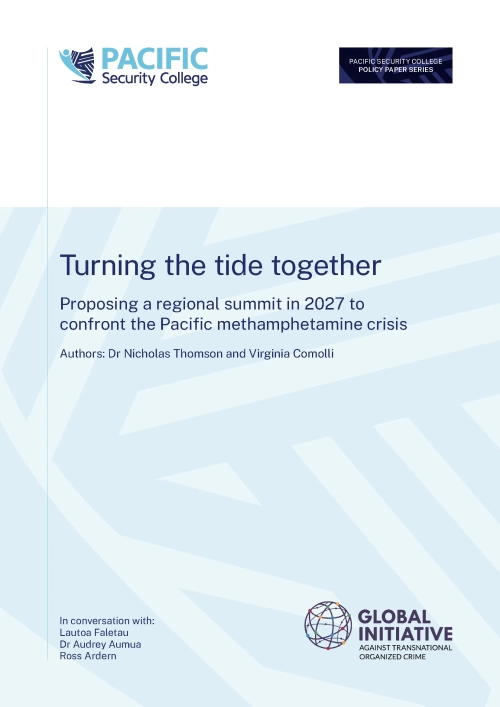
A new paper from the Pacific Security College proposes a cross-sector regional summit in 2027 to shape coordinated responses to the escalating methamphetamine crisis across the Pacific.
Released today, Turning the tide together recognises the need for cooperation between health, law enforcement, community leaders and civil society organisations to tackle the wide-ranging impacts of the surge in methamphetamine trafficking and use.
Published in collaboration with the Global Initiative Against Transnational Organized Crime (GI‑TOC), the paper is authored by Dr Nicholas Thomson, from the Pacific Security College, and Virginia Comolli, from GI-TOC.
“The Pacific is facing a rapidly escalating methamphetamine crisis that is no longer confined to trafficking routes but is increasingly affecting the health and security of communities across the region,” Dr Thomson said.
“The impacts are being felt at every level, from overstretched health and justice systems, to rising violence and social disruption within communities, and growing public health concerns.
“While we already see the sharing of needles in Fiji has driven the world’s fastest growing epidemic of HIV, there is an urgent need for rapid national and sub-regional assessments to better understand patterns of methamphetamine use, trafficking routes, impacts on communities and links to wider health risks such as HIV transmission.”
The proposed regional summit would bring together ministers, the health sector, law enforcement, civil society, community, and religious and traditional leaders. The paper argues that urgent, coordinated action is needed before the crisis deepens further, and notes the Pacific has shown its ability to coordinate regional responses to previous health and security crises such as COVID-19.
“What we are seeing is the transformation of the Pacific from primarily a transit corridor into an increasingly significant consumer market and, in some contexts, a site for local production,” Ms Comolli, Head of Pacific Programme at GI-TOC, said.
“The proposed 2027 Pacific Islands Forum-led summit provides an important opportunity to elevate the issue to the highest political level and develop a shared regional approach to synthetic drugs.
“This is not a challenge that can be addressed by law enforcement alone. It requires a genuinely integrated response bringing together governments, health authorities, policing agencies, civil society organisations, churches, traditional leaders and communities themselves.”
Ms Comolli said the period leading up to the summit would be critical for building the evidence base, partnerships and policy alignment needed for meaningful regional action.
“At the same time, there is important work already underway across Pacific communities that should be supported and documented, including community education initiatives, peer-based harm reduction approaches, culturally grounded rehabilitation models, and partnerships between health services, police and traditional leadership structures.”
“The summit should not be seen as the start of the conversation, but as the culmination of a broader regional process that strengthens cooperation and lays the foundations for a Pacific-led Regional Synthetic Drugs Strategy.”
Turning the tide together: Proposing a regional summit to confront the Pacific methamphetamine crisis includes insights from three regional experts with backgrounds across health, security and law enforcement: Lautoa Faletau, Dr Audrey Aumua and Ross Ardern.
Lautoa Faletau, an international development consultant with more than three decades of experience supporting law enforcement cooperation and governance reform, said: “The far-reaching impacts of this methamphetamine crisis necessitate regional leadership that is informed by different sectors.”
Ms Faletau welcomed the recommendation to develop assessments to support the inclusion of a diversity of perspectives and data.
“Such assessments are also an opportunity for all stakeholders – government, non-government, academic institutions, and the private sector – to inform national discussions and deliberations at the 2027 summit.”
Dr Audrey Aumua, Chief Executive Officer of The Fred Hollows Foundation NZ, acknowledged the strain of the drug crisis on communities and health systems.
“We have rising methamphetamine use, increasing HIV risk, and more people presenting with complex mental health needs. Not only are these clear signals of systems under strain, they also reveal gaps in prevention, early intervention, and community-based care,” she said.
“Across the region, communities are already responding. A key priority should be ensuring that these community-led responses are not seen as peripheral, but as central to the health system approach.”
Ross Ardern, who served with the New Zealand Police for 40 years including in the Pacific, said the proposed summit presents the opportunity for a regionally led, multisector response.
“To put it plainly, we have an illicit drugs epidemic on our hands and this is not a problem that can be resolved by law enforcement alone,” he said.
“We must look to those in the community that can offer support to law enforcement and work with them, including our traditional leaders and civil society. We can all do more, but the most important thing we can do is to trust each other and demonstrate a stronger willingness to share information.”
About the Pacific Security College policy paper series
The Pacific Security College’s policy paper series aims to contribute a diversity of views and ideas to regional conversations about the journey to 2050. The views expressed in the Pacific Security College policy papers are those of the authors alone and do not necessarily reflect the official positions of the College or the Global Initiative Against Transnational Organized Crime (GI-TOC).