The Pacific history lessons that might safeguard an Ocean of Peace

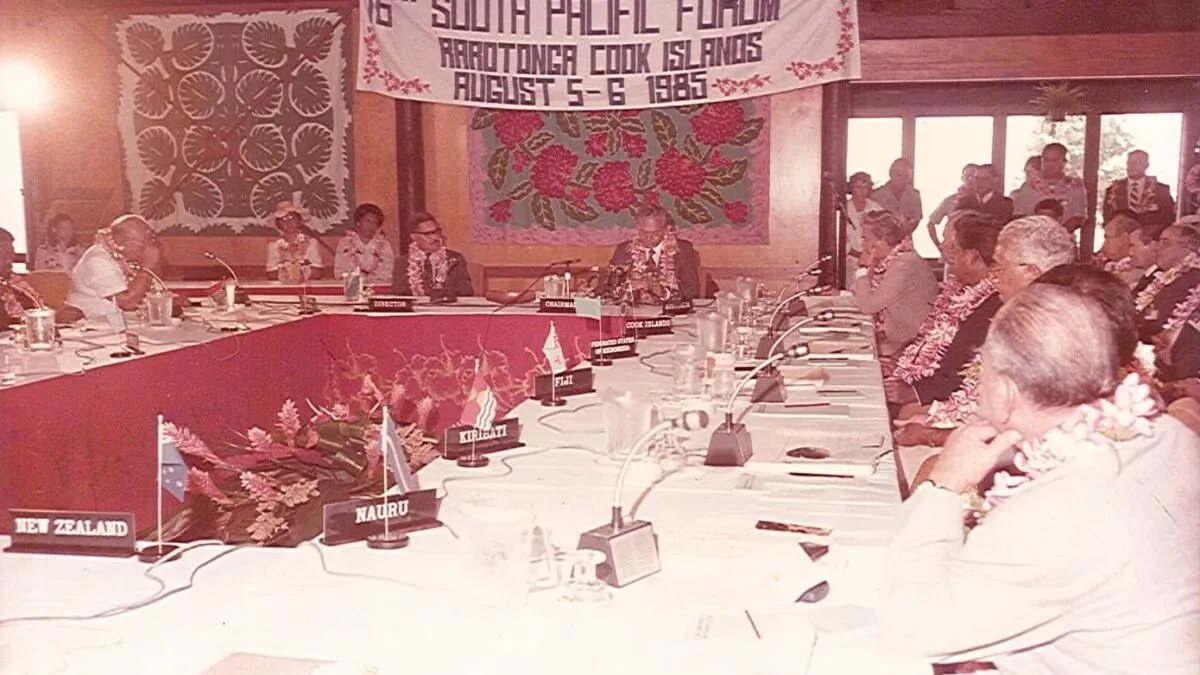
Leaders gather in Rarotonga for the 16th South Pacific Forum in 1985. Photo: Pacific Islands Forum Secretariat
What lessons does the history of our Blue Pacific hold to safeguard and future-proof an Ocean of Peace towards 2050? Dr Marco de Jong reflects on Pacific regionalism in a provocation at the 2026 Pacific Peace and Security Dialogue.
Any good Western academically trained historian would never deem to draw lessons from the past, however walking backwards into the future, living with ancestors, venerating the words of elders, we in the region are not so encumbered.
And indeed, the 2050 Strategy and the Blue Pacific narrative were informed and inspired by the historic achievements of our Pacific regionalism: the Law of the Sea negotiations that secured extended maritime jurisdiction commensurate with any continent; the Parties to the Nauru Agreement, which ensured equitable benefit from the world’s largest sustainable tuna fishery; and the achievement of Sustainable Development Goal 14, to conserve our ‘life below water’.
Lessons from Pacific regionalism
The first point I want to make is historiographical and it comes with an appeal to deepen our institutional memory.
So to that reference list, we might add the less celebrated Noumea Convention, the preamble of which is unique amongst regional seas conventions for recognising “the traditions and cultures of Pacific people”, our commitment to future generations, and “the special hydrological, geological and ecological characteristics of the region [requiring] special care and responsible management”. When negotiated, this compelled the United States to cede their ‘rights’ to dump low level nuclear waste in the high seas pockets of the Convention area despite not being party to UNCLOS. This tremendous achievement goes largely unheralded.
Further, by working through Secretariat of the Pacific Regional Environment Programme and the United Nations Environment Programme, the region gained recognition – at the Rio Earth Summit of 1992 – of the “special case” of Small Island Developing States within the UN system. This enabled the structure for climate action through the Alliance of Small Island States (AOSIS) and ultimately the crowning achievement of the 1.5-degree threshold in the Paris Agreement.
Together, these constitute our Blue Pacific regime of ocean governance, codify our expanded security, and undergird our Ocean of Peace.
But the lesson here is not only for advancing integration or the strong moral voice. It’s also about building strength from our diversity, it’s about knowing our leverage, it’s about adopting a strategy of mutual reinforcement and coordination across multiple inter- and subregional avenues, and show solidarity not sameness.
Security through de-escalation
We have also heard how this year marks the 40th anniversary of the entry into force of the Treaty of Rarotonga; how it stands as the foremost expression of a regional commitment to peace; and how we might be inspired to revitalise and further operationalise it to meet contemporary challenges.
It is worth remembering, however, that what became the South Pacific Nuclear Free Zone Treaty was originally tabled a decade earlier, at the Nuku’alofa Forum in 1975. This, coincidentally, marked the first time regional security appeared on the formal leaders’ agenda.
A paper by Tonga described the possibility of external subversion, prompting a broader debate about cultural and economic security, and the summary record includes the broad conclusion that “the present absence of an overt military threat, [meant] the best assurance of security and stability [lay] in continued economic and social development”. Our concept of expanded security was there from the beginning.
Of course, concerns about a growing Soviet maritime presence culminated in the infamous Soviet Scare of 1976, which formalised the policy of regional strategic denial within ANZUS. This dynamic continues to animate regional security, with the link between economic development, political stability, and what is termed ‘the sentiment of belonging to a Western-aligned security community’ utilised to block Eastern opportunities for regional influence by our metropolitan partners.
My second historical point, and further appeal is for Australia and New Zealand to take a more creative approach to regional security and, if they must, adopt a less rigid, community approach to strategic denial.
Attempting to lock down the region bilaterally and militarily is counterproductive and risks creating the insecurity it seeks to address. I say this with reference to the debates within ANZUS during the 1970s, which declassified and accessible, and reveal the strategic intent of the South Pacific Nuclear Free Zone.
New Zealand explained its support for SPNFZ by stating that “the Indian Ocean had become an area of strategic confrontation between the great powers and the establishment of a nuclear free zone would be a way of declaring the opposition of the Pacific countries to the wholesale deployment of nuclear weapons”. The word deployment is key and it’s notable this occurred as the United States was withdrawing from Vietnam and concerns arose in ANZUS about its regional resolve and attendant security guarantee.
The implication from NZ was that when major powers are unreliable, deescalation offers greater security for middle powers than attempts to draw smaller states into tight alignment with a favoured bloc, which would only invite further spiralling competition. Thus, regional disarmament agreements offer small states strategic value by insulating them from contestation and preserving collective agency. In this new era of rivalry, the region might look to this historic example.
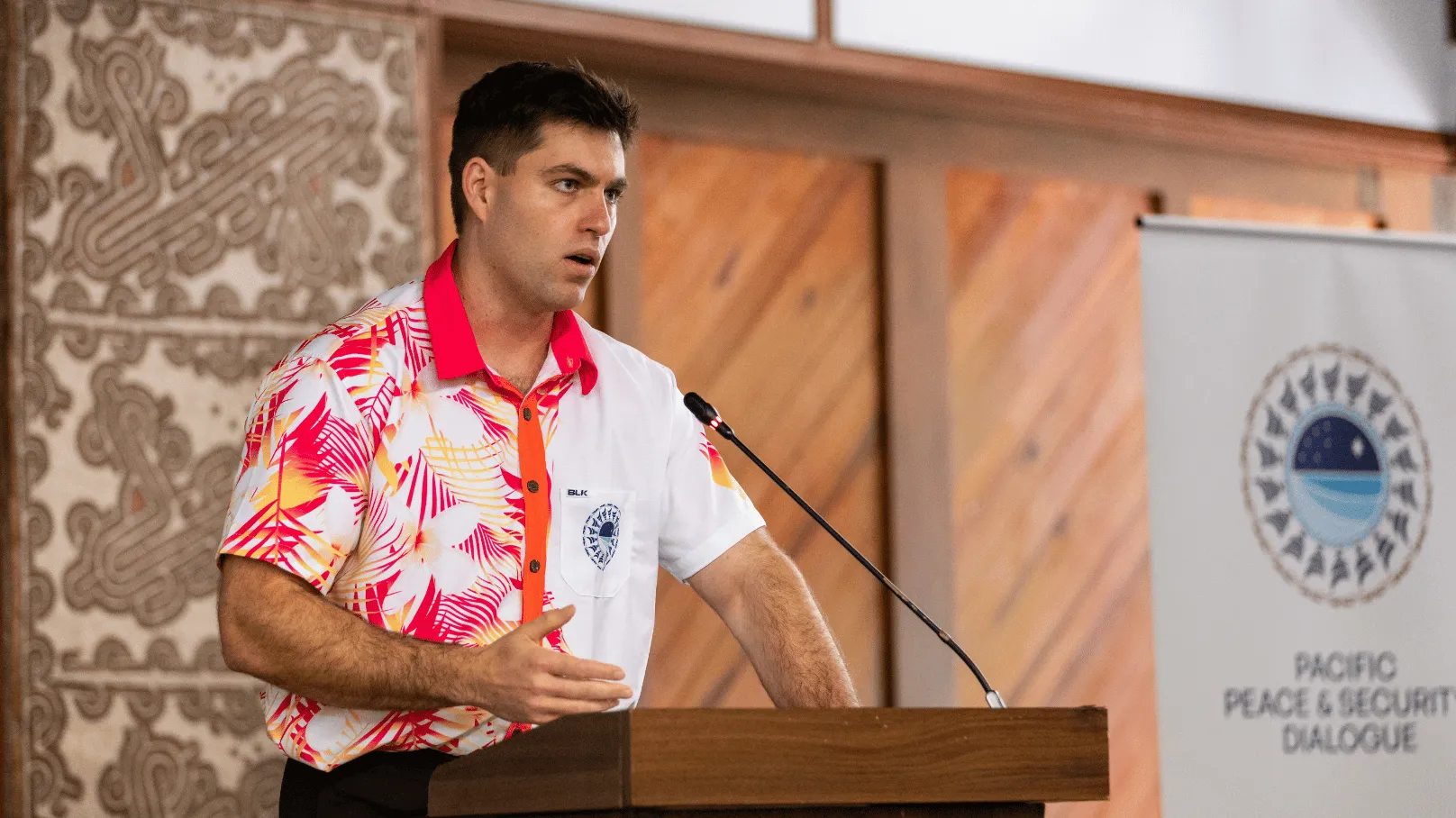
Dr Marco de Jong speaks at the 2026 Pacific Peace and Security Dialogue. Photo: Pacific Security College
New megatrends of concern
Conflicts in Ukraine and the Middle East demonstrate how technology is once again reshaping the conduct of war, most often in ways that are deeply inhumane, and in the Pacific we should be conscious of how this shifts our own strategic relevance for major powers.
My last point builds on the weaponisation of emerging domains, like space, cyber, and the undersea, and assets like undersea cables, ground-based space infrastructure and seabed critical minerals.
I want to discuss networked warfare and the proliferation risks, especially of uncrewed maritime systems, or sea drones. Because these systems are deliberately destabilising, highly networked, often autonomous, and potentially lethal, they challenge coastal states’ rights across all maritime spaces and threaten a regional commitment to peace and disarmament.
The status of uncrewed maritime systems and lethal autonomous weapons systems at international law is unsettled. Under UNCLOS, it is not clear whether sea drones qualify as ships or warships or what corresponding rights and obligations they have in territorial seas or the broader EEZ with regards to innocent passage, strategic intelligence gathering, or scientific research.
Similarly, under international humanitarian law, there is ongoing debate over whether weapons capable of selecting and applying force to targets without human intervention can reliably distinguish military from civilian targets or adhere to principles of proportionality.
Pacific nations, to the extent that they want to adopt drone technologies, are unlikely to support lethal systems.
To date, Australia and New Zealand are the only Forum members currently operating sea drones, most notably in the form of the Anduril Ghost Shark, which is an uncrewed submarine with a strike capability, and the Ocius BlueBottle, which resembles a solar-powered sailboat for persistence surveillance.
Recently, New Zealand and Fiji conducted a joint military operation, Calypso, on transnational crime that featured the latter. While the application of drones here is largely benign, given the unsettled legal issues and strategic interest in preserving coastal states’ control, Pacific nations should nonetheless be wary of setting precedents or fragmenting consent.
Thinking to history, and as with Rarotonga, the issue is deployment. Regional access becomes a key source of collective leverage, and Pacific nations have a pressing interest in setting pre-emptive norms, lest our waters become the site of escalating confrontation.
The Blue Pacific Ocean of Peace Declaration contains operative language around “promoting the responsible use of technology and innovation”, which might provide a basis for the further development of safeguards that allow Pacific nations access to useful technologies without sacrificing the ability to regulate them.
My hope is that such work might be a concrete historically informed contribution to future-proof the Ocean of Peace towards 2050.
Dr Marco de Jong is a Pacific historian and a Lecturer at Auckland University of Technology Law School. This article is a lightly edited version of an address delivered at the 2026 Pacific Peace and Security Dialogue.
Views expressed via the Pacific Wayfinder blog are not necessarily those of the Pacific Security College. Read our publishing policy.