Previous page
News
Observations from the 2026 Pacific Peace and Security Dialogue
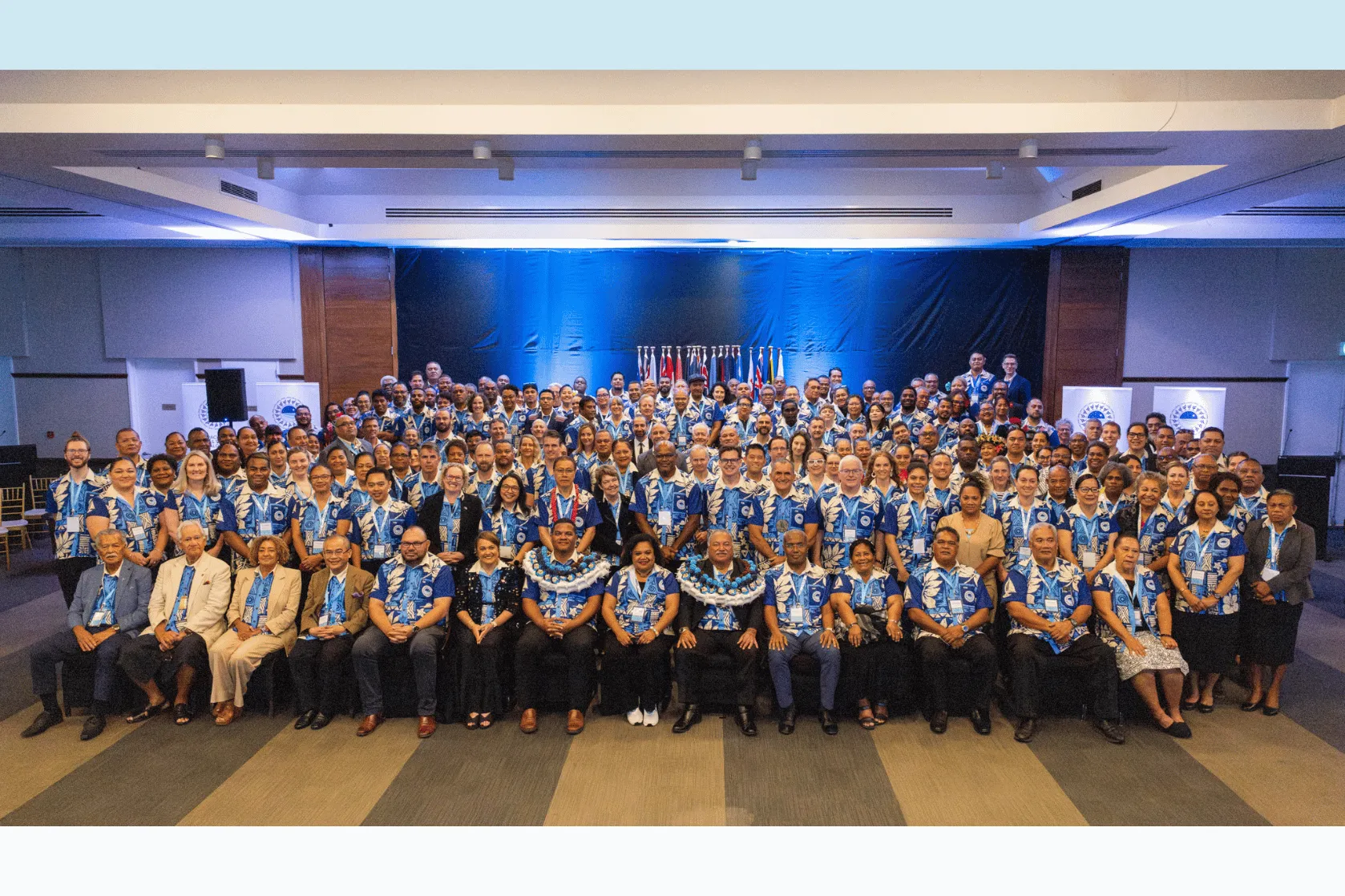
Delegates at the 2026 Pacific Peace and Security Dialogue: Photo: Pacific Security College
Conference statement
2026 Pacific Peace and Security Dialogue
The Grand Pacific Hotel / Pacific Islands Forum Secretariat
Suva, Fiji
15 – 17 June 2026
Overview
- In a spirit of cooperation and unity, the Pacific peace and security community gathered for the 2026 Pacific Peace and Security Dialogue, in Suva, Fiji from 15 to 17 June 2026.
- The Dialogue brought together political and official-level representatives from across the Pacific Islands Forum membership, as well as senior leaders from partner regional organisations, including the Forum Fisheries Agency (FFA); Joint Heads of Pacific Security Secretariat (JHOPS); Melanesian Spearhead Group (MSG); Oceania Customs Organisation (OCO); Office of the Pacific Ocean Commissioner (OPOC); the Pacific Community (SPC); Pacific Aviation Safety Office (PASO); Pacific Fusion Centre (PFC); Pacific Immigration Development Community (PIDC); Pacific Islands Chiefs of Police (PICP); Pacific Islands Forum Secretariat (PIFS); Pacific Islands Law Officers’ Network (PILON); Pacific Security College (PSC); the Secretariat of the Pacific Regional Environment Programme (SPREP); and the University of the South Pacific (USP) – highlighting the strength, breadth and solidarity of the Pacific’s peace and security architecture.
- The Dialogue also brought together a significant number of senior representatives from universities and research institutions from across the Pacific including: the University of the South Pacific; the Auckland University of Technology; the Australian National University; the College of Micronesia (Federated States of Micronesia); the College of the Marshall Islands; Fiji National University; Lowy Institute; the National University of Samoa; the National University of Vanuatu; Palau Community College; Pasifika Communities University; Solomon Islands National University; Tonga National University; the University of Auckland; the University of Canterbury; the University of Papua New Guinea; Papua New Guinea National Research Institute; Tangintebu Theological College; and the Compass Point Institute.
- The Dialogue also welcomed numerous representatives from civil society, the media, youth, faith-based and community-based groups from across the Pacific, further reflecting the breadth of stakeholders who contribute to the Pacific’s expanded concept of security as set out in the Boe Declaration on Regional Security.
- The Dialogue was honoured to welcome His Excellency Dr Chem Widhya, Secretary-General of the ASEAN Inter-Parliamentary Assembly (AIPA), and Ms Elizabeth Solomon, Assistant Secretary-General for Foreign and Community Relations at the Caribbean Community (CARICOM) Secretariat. Participants valued the opportunity to learn from the experiences of Southeast Asia and the Caribbean in advancing regional cooperation, collective diplomacy, and institution-building in an increasingly complex global environment.
- At the same time the Dialogue was privileged to welcome three former Secretaries General of the Pacific Islands Forum: Mr Henry Puna, Dame Meg Taylor and Tuiloma Neroni Slade. Their presence reflected the continuity in Pacific regionalism and provided a valuable reminder of the leadership, vision and commitment that has shaped the Forum and the wider regional architecture over many decades.
- The Dialogue recognised that all participants – including youth, women, faith-based organisations, traditional leaders, civil society, universities, and communities – are not peripheral actors, but essential parts of the Pacific peace and security architecture.
Strategic context
- The Honourable Simon Kofe, Minister for Transport, Energy, Communication and Innovation in the Government of Tuvalu, provided the opening keynote address. He urged that Pacific regionalism be grounded in the Pacific’s vision and core values as reflected in the 2050 Strategy for the Blue Pacific Continent. He highlighted how challenges such as climate change, transnational crime, technological disruption, and geopolitical competition are not only security issues but also tests of leadership, governance, unity, and collective responsibility.
- His address underscored that fragmentation remains a strategic vulnerability and he called for stronger regional cooperation, harmonisation and information sharing. Minister Kofe also noted that trust was a vital element in deepening regional cooperation. Drawing lessons from successful Pacific initiatives, he emphasised that sovereignty is strengthened through collective action and that lasting security depends on resilient communities, trusted institutions, effective governance, environmental stewardship, and a shared commitment to Pacific values and future generations.
- Complementing these remarks, Pacific Islands Forum Secretary General Baron Waqa highlighted the need for the region’s collective peace and security efforts to remain aligned, united and effective. He reminded the Dialogue that the review of the regional security architecture, and the development of the region’s peace and security action plan, would be central to these efforts. The Secretary General stressed that implementation and delivery of regional declarations and policies was now critical to bringing about long-lasting peace and security across the region.
- In his address, Professor Transform Aqorau, Vice Chancellor of the Solomon Islands National University, challenged participants to consider the future of the Pacific through the eyes of the generations to come, who would inherit the region in 2050, underscoring the long-term implications of today’s decisions. He emphasised that while the Pacific has developed strong regional frameworks, including the 2050 Strategy for the Blue Pacific Continent, the priority now is implementation, collective action, and sustained regional leadership. Drawing on examples of Pacific agency such as the Parties to the Nauru Agreement, Professor Aqorau highlighted the importance of self-reliance, solidarity and Pacific-led solutions across climate action, ocean governance, and security. His remarks emphasised that peace and security must be people-centred, ocean-centred, and future-facing. His remarks also underscored the importance of the continued development of the Ocean of Peace as a practical doctrine bringing together law, diplomacy, ocean governance, climate security and demilitarisation, leading to strengthened Pacific agency.
Security threats and responses
- During the Political leaders on challenges and opportunity panel, participants were reminded of the deteriorating global environment, the intensifying polycrisis and the weakening rules-based order. The Dialogue heard that security must remain people-centred and regional responses must continue to focus on concerns that relate to the lived realities of Pacific Island countries. The Dialogue also heard that the Pacific could be proud of the long-standing impact that its voice had in shaping rules and norms, including on oceans and nuclear issues, and on climate change advocacy. In making the most of the Pacific’s opportunities, speakers emphasised that trust was a vital ingredient for governments in managing security challenges, and that there was a need for a strong focus on the implementation and delivery of regional mandates and policies.
- In the Political leaders on economic security panel, the Dialogue heard that economic security is not separate to broader peace and security – but a core element of it, with economic resilience a foundation for stability and sovereignty across the region. Economic security issues such as fuel shocks, debt stress, employment constraints, infrastructure gaps, and cost-of-living pressures can quickly become social and political security issues, which require that economic resilience sit at the centre of the region’s security agenda. Participants also heard about the potential economic benefits to Pacific Island countries of closer coordination and pooling of resources.
- In the Society, peace and security panel, participants recognised that the rapid growth of digital technologies has brought significant social and economic benefits to Pacific communities, while also creating new and evolving cyber safety challenges. The discussion highlighted the need for coordinated action to address risks including cyberbullying, online misogyny, gender-based violence, privacy breaches, harmful online content, and the targeting of vulnerable groups such as women, girls, youth and older persons. The Dialogue heard that a whole-of-society approach involving government, industry, civil society, media, legal practitioners and communities, supported by stronger regulation, digital literacy and public awareness was required. More broadly, the Dialogue noted the ongoing need to recognise the link between digital safety and public trust, democratic resilience, and social cohesion.
- In the Regional cooperation in the Pacific and beyond panel participants reflected on the importance of regionalism as a foundation for peace, security and prosperity, drawing on experiences from the Pacific, the Caribbean and Southeast Asia. It was also recognised that regionalism strengthens sovereignty when it helps its member states act collectively on shared priorities. Further, the Dialogue heard that effective regional cooperation is grounded in shared values, unity and solidarity, based on trust and a commitment to collective action. The experiences of ASEAN and CARICOM offered encouragement for the Pacific Islands Forum: ASEAN’s decades-long effort to preserve peace through dialogue, rules and consensus had demonstrated the value of regional structures that endure under the pressure of geopolitical tension. CARICOM’s experience showed how small states can amplify their influence through collective diplomacy, shared institutions and coordinated advocacy including on issues such as climate change and international financial reform.
- In the Regional and community cooperation to fight transnational organised crime session, the Dialogue heard that transnational organised crime poses an escalating threat across the Pacific, with increasing narcotics trafficking and use, alongside money laundering, online scams and identity theft. While acknowledging the successes of law enforcement agencies in disrupting criminal networks, participants recognised that organised crime groups continue to adapt rapidly, exploiting capacity constraints and the region’s vast maritime geography. Panellists emphasised that law enforcement alone cannot address the growing challenge of transnational organised crime, and underscored the need for a coordinated, whole-of-society approach that brings together governments, law enforcement agencies, health and education sectors, civil society, communities, faith-based organisations, and the private sector. This approach should integrate intelligence-sharing, law enforcement cooperation, prevention, public awareness, early intervention, treatment, and harm reduction measures. Participants also expressed concern about the growing social and public health impacts associated with illicit drug use, including addiction, the spread of HIV, mental health challenges, and broader harms to families and communities.
- In the Regional cooperation for the energy transition session, the Dialogue heard about the importance of accelerating the Pacific energy transition, particularly given worsening climate change impacts and the current heavy reliance on fossil fuels, the global energy supply shock, and enduring supply chain challenges. The Dialogue also recognised the renewable energy transition as a sovereignty-building measure for the Pacific. Regarding the current fuel crisis, participants heard the crisis had received high-level attention at national and regional levels, including through Forum Leaders’ invoking of the Biketawa Declaration, while there was also a call for greater clarity on a sequenced regional response: identifying immediate actions to address current fuel-related pressures; medium-term measures to strengthen coordination and resilience; and longer-term pathways beyond the Biketawa Declaration response to advance energy security. It was also noted lower socioeconomic groups were most affected. More generally, participants heard the region had in place much of the necessary enabling environment for the energy transition, particularly in terms of policy, legislative and regulatory frameworks, but that implementation of the transition remained the key challenge.
- In the Regional cooperation for Pacific mobility, dignity and adaptation panel the Dialogue reflected on the central place of mobility in Pacific societies, recognising its historical roots across the Pacific, as well as its growing significance in the context of labour migration, demographic change, and climate change impacts. Panellists highlighted the diverse factors driving mobility, including access to education and employment opportunities, as well as environmental and political considerations. Participants further considered the complex challenges associated with increasing mobility, including brain drain, social division, urbanisation, gendered social relations, forced return and changing border and visa arrangements, while also acknowledging the opportunities presented through diaspora engagement, economic opportunity and digital connectivity. The Dialogue recognised that future mobility and adaptation practices should be approached in ways that draw upon Pacific values, customary systems and community leadership. The Falepili Union was also an important topic in the discussion.
- In the Land as security: national and regional cooperation panel participants discussed the central role of land as a foundation of peace, security, identity and resilience across the Pacific. It was noted that customary land tenure systems continue to underpin social cohesion, cultural continuity, food security and community wellbeing throughout the region. At the same time, pressures arising from climate change, disaster displacement, urbanisation, demographic change and historical legacies are increasing demands on land, creating new sources of vulnerability and conflict, if not carefully managed. Panellists emphasised the importance of traditional governance systems, customary leadership, reconciliation processes and community relationships in maintaining social harmony and supporting adaptation. They also highlighted the need to strengthen the integration of customary knowledge, education, research and policy development, while recognising the value and rich traditions of Pacific approaches to mobility, relocation and community support.
Youth and the future
- The session Looking ahead: today’s youth on a secure future for the Blue Pacific comprised of a group of young Pacific thinkers who discussed what was required to realise the 2050 Strategy for the Blue Pacific Continent. The panel emphasised the next generation would inherit a complex range of intersecting threats such as climate change, the spread and impact of drugs, and social media and artificial intelligence. Based on this, they highlighted that youth should have a permanent seat at the table in discussions related to regional peace and security processes, futures and foresight work, implementation and monitoring, and broader regional decision making. While the panel was realistic about the challenges the region faced into the future, there was also optimism that the Pacific’s values of respect, humility, loyalty and stewardship of the environment would continue to guide it through the difficult years to come.
- The Futures Exercise delivered through the partnership between the Pacific Community (SPC) and the Pacific Security College (PSC), was an opportunity for participants to consider future scenarios and develop a range of potential policy and operational level options to ensure the region would remain on track to deliver on the 2050 Strategy for the Blue Pacific Continent. The Dialogue recognised the importance of futures and foresight methods, and encourages their use in national security strategies, regional planning, leadership training, youth engagement, and institutional capacity-building. The Dialogue also acknowledged the speakers who opened the day and inspired us with their vision for 2050, and the national security leaders who closed the day with their reflections, including on next steps.
Regional peace and security architecture
Peace and security action plan
- Participants heard the Regional Peace and Security Action Plan 2026-2030 would be completed in 2026, and it would be a critical part of translating regional security commitments into coordinated and practical action. The Pacific Islands Forum Secretary General also highlighted the Action Plan would be a key mechanism for strengthening collaboration among regional agencies, improving the alignment of national and regional priorities, and ensuring resources were directed towards the region’s most pressing security challenges. Across the Dialogue, participants heard about the importance of political leadership, financing, institutional capacity, legal and policy alignment, training, data, monitoring, and accountability, as being critical elements in the successful delivery of the Action Plan. Further, the Dialogue also recognised that implementation was a decisive test.
National security strategies
- A number of Forum member representatives highlighted the benefit of having national security strategies, and it was reported the national security strategies in place had increased – from three in 2018 to 11 in 2025 – with others being worked on, and some of the initial strategies being reviewed and renewed. To that end, participants congratulated Tonga for the launch of its national security policy and looked forward to the launch of further strategies by other Forum members this year. The Dialogue also recognised there may be value in promoting peer learning across Forum member countries when it comes to the development, review and refreshing of national security policies and related work. The Dialogue also recognised the National Security Coordinator’s roundtable as a potential central point for this activity.
Role of the Pacific Peace and Security Dialogue
- Participants reflected that the Pacific Peace and Security Dialogue was an important convening in the broader regional security architecture that critically brought together a broad cross-section of the region’s peace and security community. Participants urged its continuation into the future and believed there was an opportunity to link it to the wider regional security architecture, and for its outcomes to be explicitly connected to broader regional peace and security policy processes – including the Regional Peace and Security Action Plan 2026-2030.
Looking forward
- In supporting the ongoing finalisation of the Regional Peace and Security Action Plan 2026-2030, the Dialogue underscored the importance of ensuring that the Action Plan was practical, implementation-focused, and capable of translating regional commitments into tangible outcomes for Pacific peoples. Participants highlighted several cross-cutting priorities for consideration, including:
- strengthening political leadership and regional coordination
- reinforcing implementation capacity at national and regional levels
- promoting whole-of-society partnerships that engage government, community, civil society, faith-based organisations, youth, women, academia and the private sector
- improving information-sharing, research, and futures and foresight capabilities
- embedding monitoring, evaluation and accountability mechanisms
- ensuring the Action Plan remains sufficiently flexible to respond to emerging and interconnected security challenges.
- Above all, the Dialogue reaffirmed that the success of the Action Plan will depend not only on the quality of its design, but on sustained commitment to its collective implementation across the region.
Conclusion
- The Dialogue participants and organisers sincerely thank the Government and people of Fiji for their warm hospitality and support.
- We also sincerely thank Secretary General Waqa and the Forum Secretariat team for making the Forum Secretariat’s facilities available for the conference, and for their broader support to the 2026 Pacific Peace and Security Dialogue.