A united front: the collective effort behind the ICJ campaign
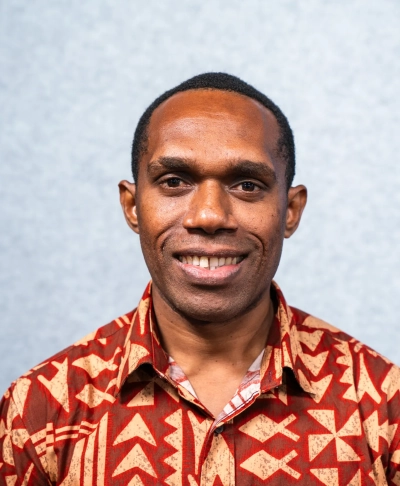
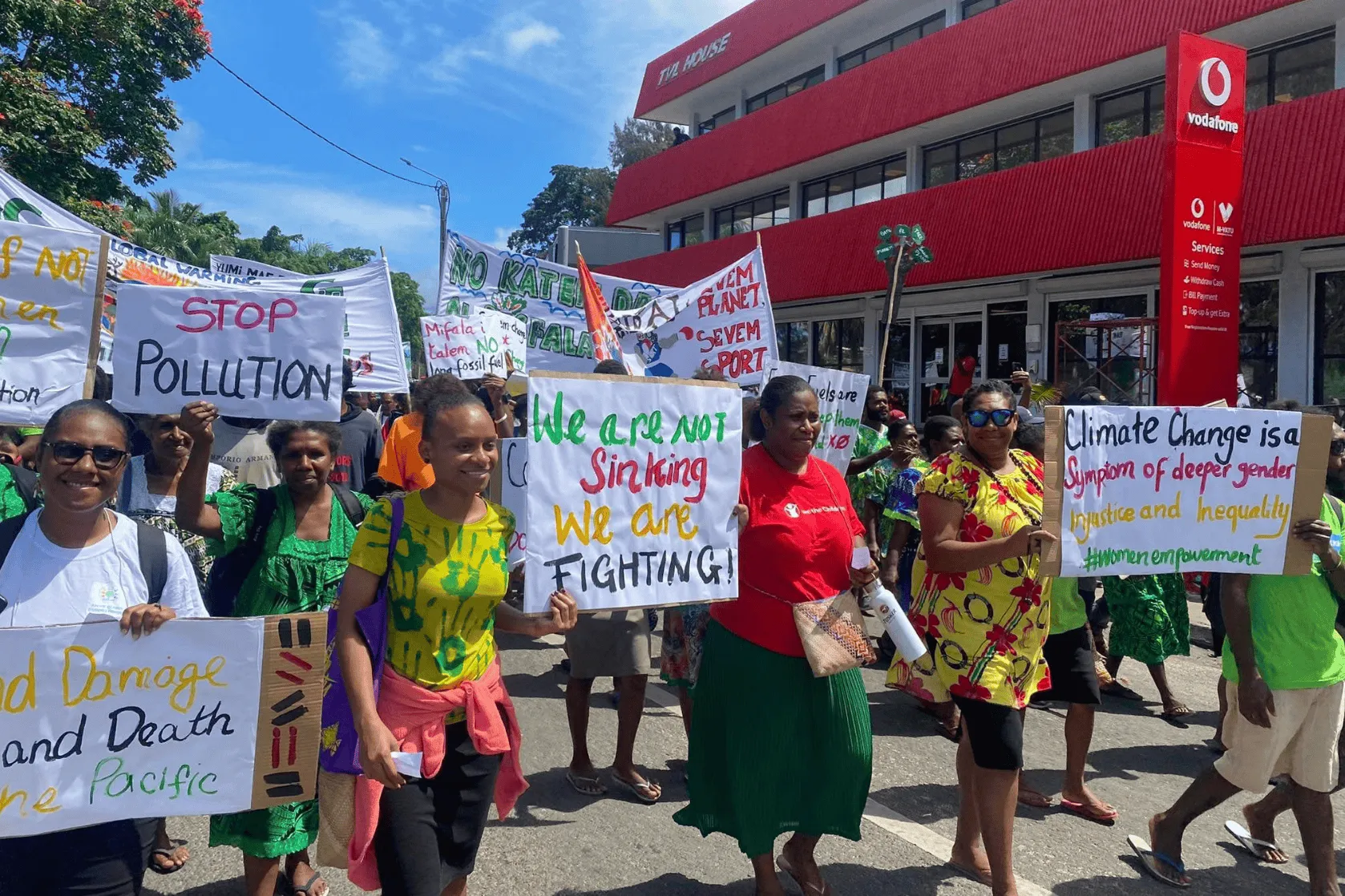
The International Court of Justice initiative became a unifying national effort across Vanuatu. Photo: Pacific Islands Students Fighting Climate Change/@pisfcc
As a Pacific Islander and ni-Vanuatu, I know how climate change affects our communities. The worst climate threat I have personally experienced was when category 5 Cyclone Pam struck Port Vila in 2015. Facing the cyclone and living through its aftermath were terrifying and desperate experiences.
Cyclone Pam caused about US$449 million in damages in Vanuatu, while the damage bill from Cyclone Harold in April 2020 was between US$408-525 million in Vanuatu, and more than US$291 million across Tonga, Fiji and Solomon Islands.
But a sole focus on the numbers can obscure the real-life consequences of climate change, which has created both hardship and resilience across Pacific communities.
Climate change affects behaviour and causes emotional stress, which generates frustration over the slow pace of global climate action. Many young people have grown up facing constant climate threats and their related traumas. Adaptation and resilience measures are extremely costly for communities whose livelihoods rely primarily on small scale agriculture and subsistence farming, noting that in the case of Vanuatu, more than 70 per cent of the population lives in rural parts of the archipelago.
Meanwhile, many Pacific economies remain trapped in a cycle of rebuilding after repeated disasters. In the early weeks of March this year, Vanuatu responded to three disasters: the eruption of the Manaro Voui volcano on the island of Ambae, flooding in Port Vila and damages caused by Tropical Cyclone Urmil.
Looking for a change of direction
As climate impacts intensify, Pacific states have increasingly questioned the effectiveness of existing United Nations frameworks. While the United Nations Framework Convention on Climate Change (UNFCCC) has progressed in negotiating climate action under the Paris Agreement, it has limitations in enforcing commitments and ensuring real reductions in greenhouse gas emissions, which is the dominant cause of global warming.
In 2019, Pacific law students at the University of the South Pacific’s Emalus Campus in Port Vila began reflecting on these challenges. They proposed seeking an Advisory Opinion from the International Court of Justice (ICJ) to clarify states’ obligations under international law to protect the climate system for present and future generations.
The students and Pacific youth more broadly recognise a gap between the urgency of the crisis and the slow pace of the international response, in contrast to increased global military spending and fossil fuel investments and subsidies.
Collective action: politics, diplomacy and civil society
These frustrations led Pacific students to explore new avenues for climate accountability. When they presented their proposal to Honorable Ralph Regenvanu, then Minister of Foreign Affairs of Vanuatu, the government took the initiative seriously and supported efforts to seek clarity from the ICJ.
The ICJ initiative quickly became a unifying national effort across Vanuatu. It brought together the government and opposition, the Head of State, civil society, churches and citizens throughout the process.
Students formed a new organisation, Pacific Island Students Fighting Climate Change, to partner with the Pacific Islands Climate Action Network, and used their network to amplify the call for support globally.
Vanuatu worked closely with regional and international partners to build political and diplomatic support and momentum.
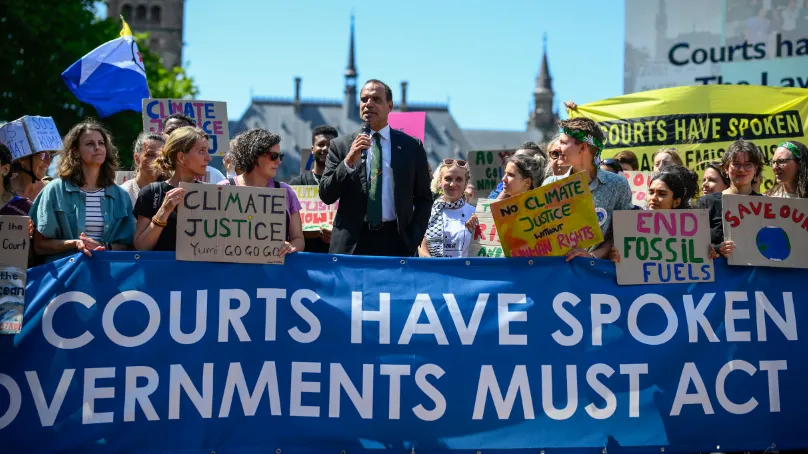
Vanuatu’s Climate Change Minister Ralph Regenvanu ahead of the reading of the International Court of Justice’s advisory opinion in 2025. Photo: John Thys/AFP
The road to the ICJ
On 29 March 2023, the draft resolution co-sponsored by 132 countries was presented to the United Nations General Assembly and unanimously adopted.
This decision was celebrated as a significant achievement for Vanuatu and its partners. It also marked the start of the next stage of the ICJ campaign, as Vanuatu began to build its case.
It worked tirelessly with regional partners to organise writeshops that guided the preparation of written submissions during the Court’s oral proceedings. This was a critical and decisive step, as it helped ensure that more submissions were made in support of the case than against it, and that these submissions were factual and reflecting the climate impacts experienced.
A record-breaking 91 written statements were submitted to the court by states and international organisations, followed by 62 written comments responding to those statements. During the hearings, 96 states and 11 international organisations presented oral statements.
The court delivered its landmark advisory opinion on 23 July 2025, adopted unanimously by its 15 judges.
The advisory opinion affirmed that climate change constitutes an urgent and existential threat caused by human activities and clarified that states have binding legal obligations under international law to prevent, mitigate, and remedy harm to the climate system.
The Court emphasised that states must act with due diligence, cooperate in good faith, regulate harmful activities (including those of private actors), and align their actions with the best available science. It further established that failure to meet these obligations may constitute an internationally wrongful act.
Uniting for the fight ahead
For vulnerable communities, the opinion represents an important step towards climate justice. Although it is not legally binding, it carries significant moral and normative authority that may influence international law and global climate governance.
The journey to the decision also holds lessons for future climate action.
The success of the ICJ initiative is a testament to the joint efforts of political leadership, diplomatic and civil society engagement, and the contributions of dedicated individuals throughout the process.
The initiative embodies the voice of communities seeking clarity and accountability in addressing climate change and could be understood as an expression of impatience and frustration over the slow pace of climate action.
The collective effort behind the campaign sets an important precedent and provides a pathway that could be followed to advance future climate priorities, noting the current global movement around the energy transition, the fossil fuel treaty initiative and the criminalisation of ecocide.
The unanimous support of the UN General Assembly and the majority decision of the judges of the ICJ demonstrate growing global recognition that states have legal responsibilities to comply promptly with their international obligations in addressing climate change.
While writing this piece, Vanuatu and its partners are working on a follow-up resolution seeking the Assembly’s endorsement for implementing the opinion. While it has already received pushback from the United States, it is a critical step forward for the urgent task at hand: elevating climate actions and securing climate justice.
Kemson Tavdey was a participant in the Pacific Security College’s Pacific Visitorship Program. He is a Climate Diplomacy Coordinator and former Regional Cooperation Coordinator at the Department of Foreign Affairs and International Cooperation in Vanuatu. His views are his own.
Views expressed via the Pacific Wayfinder blog are not necessarily those of the Pacific Security College. Read our publishing policy.
- Themes:
- Climate change