Shared seas, shared challenges: securing our region though the Boe Declaration

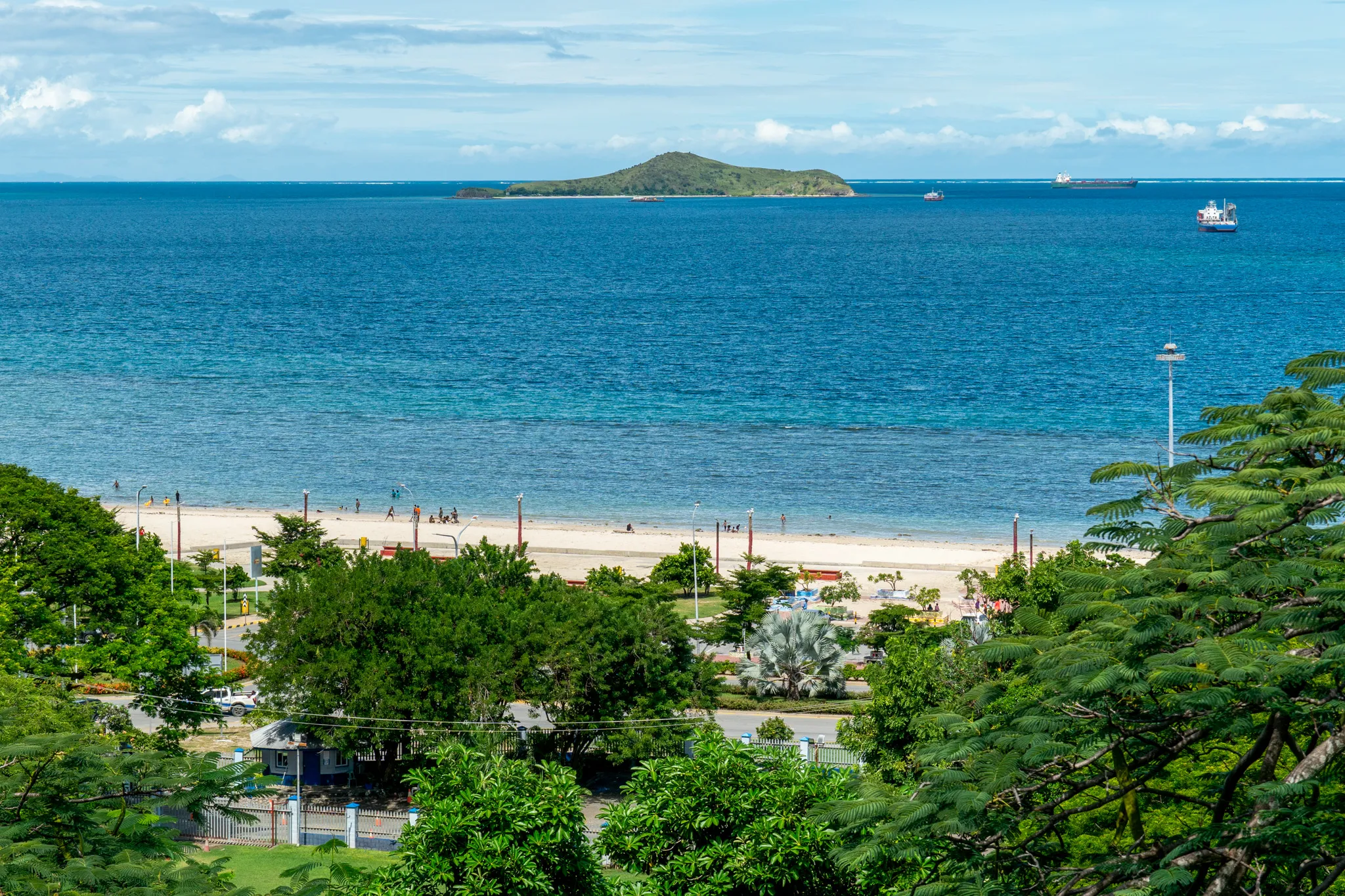
Australia’s First Nations people have strong links to the Pacific through shared seas. Photo: Pacific Security College
Shared seas connect Australia’s First Nations people with their Pacific neighbours. How can we protect these bodies of water amid growing security challenges, writes Dr Henry Ivarature.
Australia is a big island continent. Its First Nations people have deep and strong historical and cultural connections and ties to the Pacific through the Timor Sea, the Arafura Sea, the Torres Strait, the Coral Sea, the South China Sea, the Indian Ocean, the Southern Ocean and of course, the Pacific Ocean.
To protect our people and our seas and oceans, there is a richness of history we must turn to in order to guide our path going forward.
Preserving traditional ways of life in a changing world
Around four kilometres of sea separate the Torres Strait islands of Boigu and Saibai from the Papua New Guinea coastline of Western Province. In fact, Saibai and Boigu are geological extensions of Western Province.
Torres Strait Islanders share strong historical, cultural and family connections with the Kiwai people of Western Province. This is recognised by the Torres Strait Treaty, first signed in 1978 and ratified in 1985.The treaty ensures that inhabitants’ traditional way of life is protected and promoted, enabling the free movement of people, trade within the border, fishing and the harvesting of marine resources, such as minerals, oils and gas. For island communities, these resources provide food, economic security, and livelihoods.
But this maritime space has faced a number of security threats.
Transnational organised crime, illegal, unregulated and unreported (IUU) fishing, people trafficking and illicit drug smuggling operations are all ongoing problems. Presently, our people are struggling with the challenges of climate change, and its negative impact on island communities.
It was also not so long ago that people from these seas and ocean had to deal with the COVID-19 pandemic – borders were closed and movement was regulated to prevent spreading the virus.
Today, the lives of these people are disproportionally impacted by the US-Israel war with Iran. Imported fuel is crucial to enabling travel inside and outside the islands. As long as ships are prevented from carrying oil through the Strait of Hormuz, people’s very livelihoods will be affected. This disruption illustrates the economic necessity and strategic vitality of safe passage of vessels in our seas and ocean.
Defending our oceans
In light of the current geopolitical competition in our part of the region, we must reach into our rich history to guide us going forward.
Our experiences in 1942 during the Second World War inform us that our maritime space was an essential part of our defence. The war revealed invaluable lessons about defending the sea lines of communication, particularly those vital to the supply lines in the South Pacific.
In 2025, Australia’s historical relationship with Papua New Guinea was reaffirmed by the Pukpuk Treaty, a forward-looking defence and strategic arrangement. The Australia-Indonesia Defence Treaty, signed in February 2026, was another positive step towards defence preparedness.
But defence is not our only consideration. Our concerns also extend to people smuggling, terrorism, the exploitation of natural resources, environmental pollution and illegal activities in protected areas such as the Torres Strait.
There are existing interventions, including the Pacific Maritime Program and Pacific Policing Initiative, that support the law enforcement capacity of Pacific Islands states. But more needs to be done. Building alliances and developing our defence and law enforcement capabilities with interoperability in mind would enable us to prepare and tackle unwanted incursions.
Climate and collaboration
For Australia and its Pacific neighbours, climate change is our most present security challenge. The Torres Strait Islands, along with many low-lying Pacific Islands, are climate-vulnerable to sea-level rise, tidal surges, and salt-water inundation.
So, what can we do about security in our seas and ocean?
In 2018, Pacific Island Forum Leaders endorsed the Boe Declaration on Regional Security, which looks beyond traditional security and geopolitics. The Boe Declaration identifies an expanded concept of security including humanitarian assistance, transnational organised crime, cyber security, as well as environmental and resource security and climate change.
Eleven Forum Island Countries have developed security policies to secure the region. Two more are currently in development.
But Australia, the Federated States of Micronesia and Kiribati have yet to create national security policies.
The Australian National University’s National Security College recently released the findings from its extensive community consultations on security.
Considering two in three Australians are worried about national security, perhaps, it’s time for Australia to consider joining its Pacific vuvale by supporting Boe and developing a security framework.
Associate Professor Henry Ivarature is the Deputy Director of the Pacific Security College. His areas of research cover health, politics, regionalism, education, governance and democracy.
This blog is adapted from a presentation at the ANU National Security College’s Securing our Future 2026 conference.
Views expressed via the Pacific Wayfinder blog are not necessarily those of the Pacific Security College. Read our publishing policy.