Strengthening regional architecture to confront shared security threats

Pacific Wayfinder’s new ‘Join the Conversation’ series invites scholars and policy practitioners to respond to a shared question through the lens of their expertise.
In this edition, writers consider the question: How can sub-regional security strategies align with and advance regional efforts under the Boe and Ocean of Peace declarations?
We invite you to join the conversation by leaving a comment below or submit your thoughts to psc@anu.edu.au.
Dr Akka Rimon considers sub-regional security strategies from the perspective of Small Islands States.
Framing this question through a Small Island States (SIS) lens highlights how structural vulnerabilities embedded within this subgrouping can be interpreted as a point of sensitivity in Pacific regionalism.
This is not to imply a deficit of capacity among SIS members – Cook Islands, Federated States of Micronesia, Kiribati, Niue, Nauru, Palau, Republic of Marshall Islands and Tuvalu. Instead, it foregrounds categorisation and draws attention to a deeper constellation of structural development constraints that underpin it: geographic remoteness, limited infrastructure and institutional capacity, and heightened exposure to external shocks – particularly climate change and economic volatility. Collectively, these factors continue to shape SIS members’ ability to engage fully, consistently, and on equal footing in regional security processes.
However, these conditions do not diminish the value, agency or strategic importance of SIS members. Instead, they highlight where the regional architecture requires deliberate strengthening to ensure SIS perspectives are not overshadowed by the priorities of larger or better-resourced Pacific states.
This concern took centre stage at the 2026 Pacific Peace and Security Dialogue. In his opening keynote, Minister Simon Kofe warned against the strategic costs of fragmentation: “Fragmentation is now one of the most persistent strategic vulnerabilities facing our region. It erodes effectiveness, weakens resilience, and diminishes our collective influence.”
The characteristics of the SIS sub-regional grouping present a set of unique circumstances that must be addressed at the outset if regional security mechanisms are to function effectively and the Pacific is to advance a genuinely collective security agenda. Doing so enables the SIS grouping to deepen ownership of their security systems and readiness; though this ownership does not always equate to full leverage over their security landscape.
This is due to SIS members having huge governing responsibilities over vast maritime zones and widely dispersed geographies that impose governance, surveillance and operational demands far beyond their institutional, financial and logistical capacities.
Kiribati alone oversees an exclusive economic zone (EEZ) of roughly 3.5 million km2, placing it among the world’s largest ocean jurisdictions. The SIS states are not disadvantaged because they are small, but because they are immense. Ongoing scholarship and policy discourse have sought new narratives and labels that better reflect states of remarkable size, defined and bounded by ocean.
Their security challenges stem from the sheer scale of the domains they must manage, yet they are supported by only modest enforcement capacities. This imbalance turns tasks that appear straightforward – such as monitoring vast EEZs or delivering basic services across dispersed archipelagos and addressing challenges – into primary structural constraints, consistently stretching institutional and operational systems beyond their limits, while undermining capacities to address emerging security threats.
As the region confronts an increasingly complex security environment where multiple security pressures converge into what is now described as a ‘polycrisis’, the SIS subregional grouping is being exposed to heightened risks. This volatility creates greater openings for transnational organised crime and human trafficking networks to exploit the vast, sparsely monitored maritime spaces and limited enforcement capacities.
A resilient SIS security collective is essential for bridging this gap.

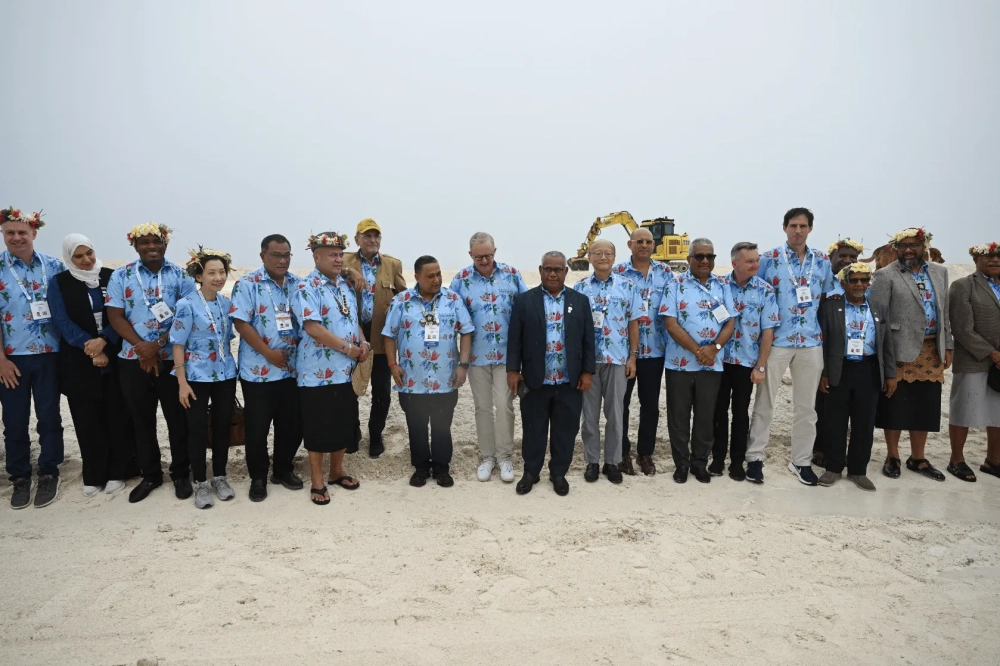
Small Island States have huge governing responsibilities over vast maritime zones and widely dispersed geographies. Photo: Pacific Security College
Central to this is the need for sustained investment in security infrastructure and governing mechanisms at the SIS national levels, designed to operate effectively within countries while remaining aligned with broader regional frameworks.
Despite substantial work in security cooperation through multilateral, regional, and national development strategies, a structural gap persists: the absence of a regional security architecture. In the absence of an overarching governance system, Small Island States will require deeper collaborative arrangements and institutional systems strengthening. This must include coordinated capacity development across the full security spectrum, from fisheries monitoring and surveillance, law and order, immigration and border enforcement, economic and climate shock preparedness, social and health security, and other expanded definitions of human security.
Such investments must be integrated both within national processes and in alignment with the regional mechanisms that support them, many of which currently operate in parallel, and at times in silos. Aligning these layers of governance ensures coherence, reduces duplication, and enables the SIS to benefit from a more connected and mutually reinforcing security architecture.
Crucially, such a step ensures that the grouping is consistently informed, connected and able to meet regularly to address security concerns as they arise. This aligns with the principles articulated in the Boe Declaration on Regional Security and the 2026 Pacific Security Outlook Report, both of which emphasise the importance of Pacific-led, proactive and coordinated security governance. Strengthening national systems in tandem with regional support enables SIS to move from reactive responses to a more prepared and planned approach to security threats.
Notably, this approach safeguards SIS agency and ownership and avoids pressures of externally driven security initiatives. A resilient SIS security collective must be grounded in its own priorities and agency, realistic capacity considerations, and an understanding of how a security strategy can organically support existing efforts rather than impose additional burdens.
When the SIS members feel genuine ownership over their security systems, regional strategies become actionable, meaningful and impactful. This also helps mitigate potential tensions or misunderstandings, particularly considering the pressures that culminated in the Micronesian Presidents’ walk-out and Kiribati’s withdrawal – episodes that exposed deep fractures in regional cohesion and shook confidence in the Pacific Islands Forum.
These ruptures did not simply challenge the Pacific Islands Forum’s integrity and legitimacy as the region’s elite political institution; they also underscored the vulnerability of the Pacific’s hard-won security work, built over decades of collective effort, trust building, and cooperation.
Ensuring SIS voices are meaningfully included through a security collective that proactively addresses their concerns is critical for promoting a workable and truly collective security architecture that embodies genuine Pacific Way regionalism in an increasingly complex and contested security environment.
Dr Akka Rimon is a Research and Engagement Fellow at the Pacific Security College.
Views expressed via the Pacific Wayfinder blog are not necessarily those of the Pacific Security College. Read our publishing policy.