As the Forum’s approach to partner engagement evolves, what can be learned from the ASEAN model?


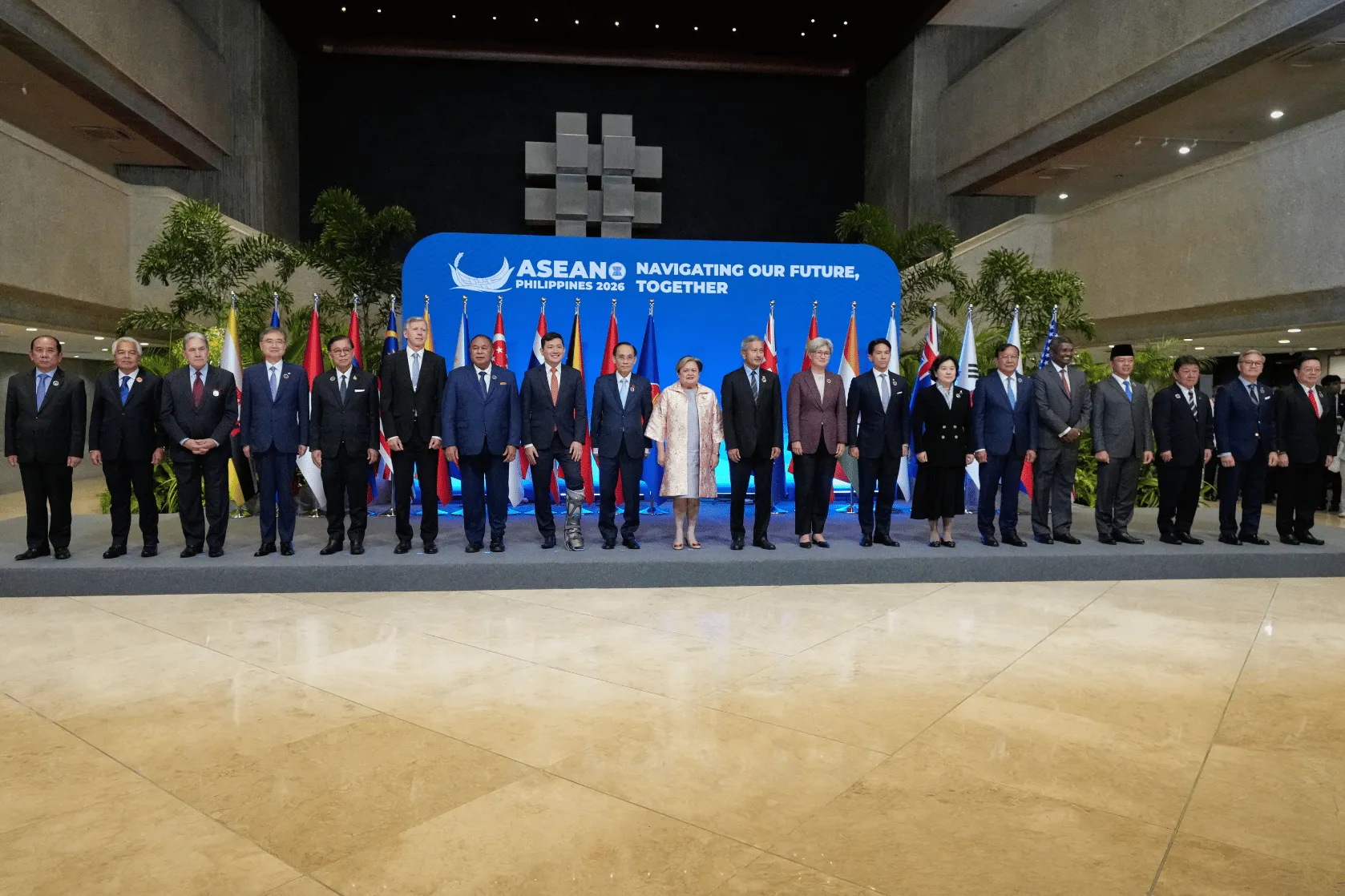
Ministers gather at the ASEAN Foreign Ministers Meeting in July 2026. Photo: Aaron Favila/Pool/AFP
ASEAN’s approach to partner engagement offers lessons for the Pacific Islands Forum as it implements its own reforms, write Dr Eric Frécon and Joel Nilon.
Over the past two years, Pacific Islands Forum Leaders have agreed to reforms that significantly change the way they engage with partners.
Under the 2025 Pacific Islands Forum Leaders Policy on Partnerships, reaffirmed and advanced through a further decision in 2026, these reforms now categorise—or tier—partners based on the nature and scope of their engagement in the Pacific.
The tiers establish different levels of access and privilege within the Forum architecture, determining which meetings partners may attend and the extent to which they can engage with Leaders.
While sorting partners according to their value and contribution to the Forum may provide members with greater control over regional engagement, implementing the approach in a geopolitically sensitive environment carries inherent risks.
For instance, the way partners are tiered at the regional level may not always stack up with how individual members view or value those same partners in their bilateral relationships.
Given this, there is value in considering how other regional groupings such as ASEAN have approached partner engagement over the years.
Flexibility, pragmatism, consensus: the ASEAN way
There are at least three observations to make about ASEAN’s approach to partnerships.
Firstly, ASEAN’s approach to partner engagement has evolved pragmatically over time, adapting to emerging opportunities and shifting priorities.
Its earliest partnerships were established in the 1970s, when Japan, Australia, New Zealand, the United States, the European Union and Canada became ASEAN’s first formal dialogue partners.
The post-Cold War period saw several new countries added before an informal moratorium was put in place to allow the group to manage existing institutional capacity and consolidate existing partnerships.
The inclusion of the United Kingdom in 2021 broke that moratorium, and Türkiye became ASEAN’s 12th dialogue partner in July 2026.
Continued global interest in ASEAN drove it to continually reconsider how it engaged partners. It added sectoral dialogue partner and development partner categories to its classifications, and introduced strategic partner and comprehensive strategic partner labels, to better define the roles and contributions of its dialogue partners.
It also strengthened its partnership processes over time to promote greater transparency and reporting, while ensuring contributions aligned to ASEAN’s priorities, and that support channelled through ASEAN mechanisms.
Secondly, ASEAN has learnt that diplomatic sensitivity and judgement are critical in the forging of its strategic partnerships.
While there have been advancements in ASEAN’s partnership approach, it continues to be a highly complex exercise, requiring sensitivity and sound judgement on the part of ASEAN members and the secretariat.
Southeast Asia is a complex environment where geostrategic and trade competition, as well as security matters, all converge.
Reconciling members’ national and regional interests is also an enduring challenge, and there is a constant risk that partners may engage through other multilateral or regional fora if ASEAN’s mechanisms are not deemed satisfactory.
Thirdly, partner engagement is ultimately a political exercise for ASEAN.
While a rigorous framework for engaging partners has emerged over time, the final say on partnerships remains in political hands.
Notwithstanding the formal assessments developed by officials, ASEAN leaders and ministers assert themselves in partnership decisions, balancing national and sovereign interests with regional constraints, and all in the midst of geopolitical dynamics and sensitivities.
Political consensus too, rests at the heart of decision making on partnership matters in the ASEAN system.
What can the Forum learn from ASEAN?
As the Pacific Islands Forum enters its new phase of partner engagement, what might it learn from the ASEAN approach?
To start, the Forum’s current partnership framework should not be seen as its final iteration.
The Forum partnerships policy contains review provisions, and Forum members should expect a period of refinement and adjustment as the approach is bedded down, and as it interacts with political and geopolitical reality.
This initial period should allow for regular review, adjustment and adaptation.
Secondly, Forum members must exercise care and judgement in the delivery of these new arrangements.
The Pacific’s development partner and donor landscape is highly crowded, competitive and complex. And like in ASEAN, the calibration of members’ national interests versus their regional ones is a never-ending challenge.
There is a need to avoid rigid application of framework criteria, so as not to disincentivise partners from engaging through the Forum.
On the other hand, too much flexibility, or a sense that the framework is not fairly executed, may undermine confidence and drive partners to engage elsewhere.
Finally, technical assessments should inform, not determine, political decisions on partner engagement.
The process to examine and assess partnerships should be objective and evidence-based, while remaining sensitive to the merits and character of each relationship.
But the process must ultimately culminate in a way that allows Forum Leaders to exercise political judgement as to where partners sit within the new tiering framework.
The success and longevity of the Forum’s new partnership arrangements will rest in part on the flexibility, judgement and wisdom on which its arrangements are delivered.
Given that much of the Forum’s new partnership framework appears to draw on ASEAN’s example, the Forum should consider the lessons that ASEAN has wrestled with over the years in delivering on its own tiered partnership approach.
Dr Eric Frécon is a visiting fellow at the Australian Strategic Policy Institute. Before that, he worked at the Rajaratnam School of International Studies in Singapore (2008-2011), coordinated the Asia Centre Southeast Asia Observatory (2012-2019) and gave lectures at the Bruneian Command and Staff College (2020-2024).
Joel Nilon is Pacific Fellow at the Pacific Security College at the Australian National University. He previously served at the Pacific Islands Forum Secretariat for nine years as a Policy Adviser and led the development of the 2050 Strategy for the Blue Pacific Continent.
Views expressed via the Pacific Wayfinder blog are not necessarily those of the Pacific Security College. Read our publishing policy.