Pacific submarine cables need resilience, not just rivalry

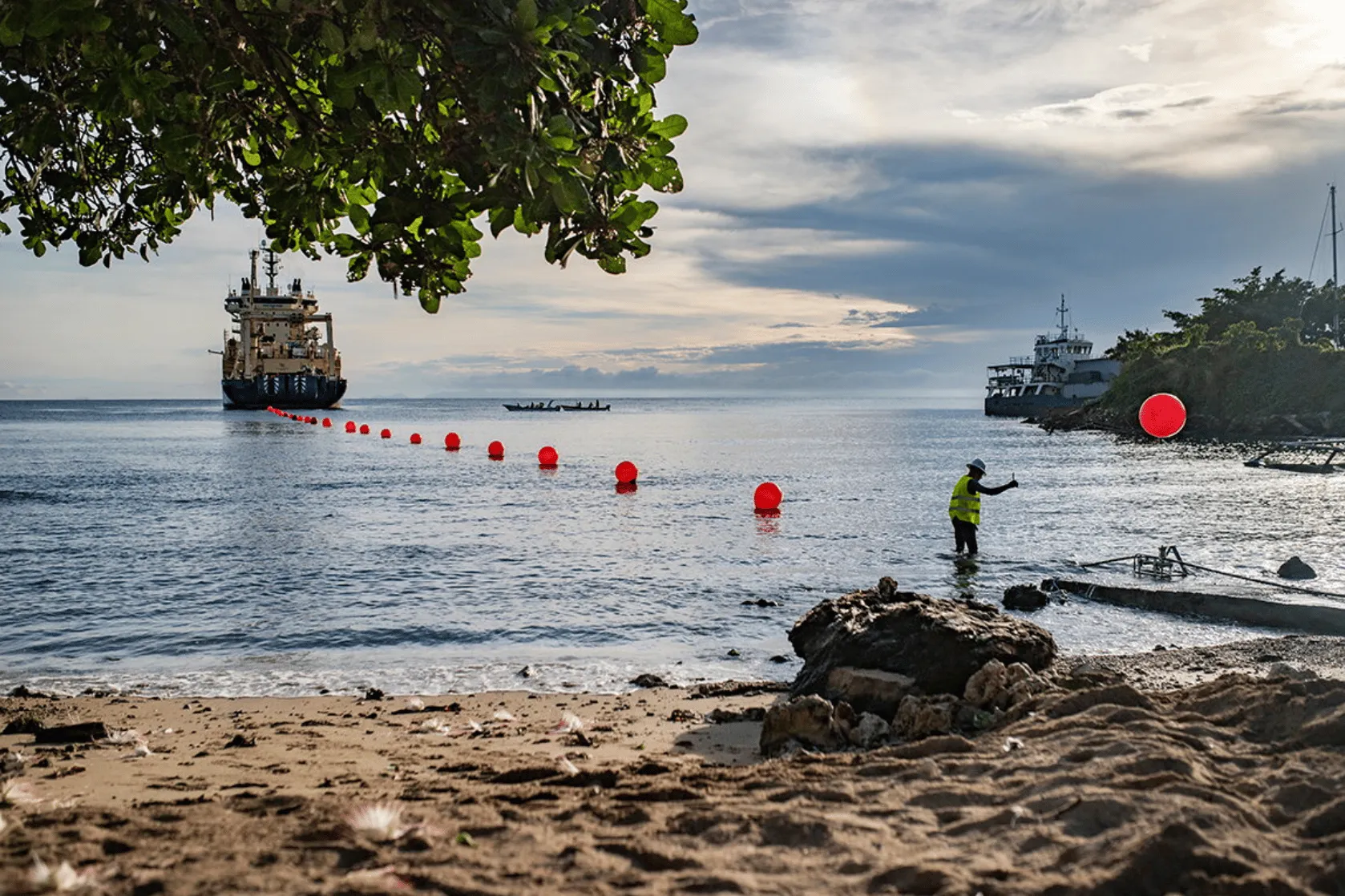
The Coral Sea Cable System, which connects Australia with Papua New Guinea and Solomon Islands. Photo: Australian Department of Foreign Affairs and Trade
As more of the Pacific benefits from, and relies on, the growing network of submarine cables, attention must turn to increasing resilience and repair capacity and capability in the region, writes Louise Chevalier.
The Pacific’s submarine cables are facing a hybrid threat, physical and digital, and neither can be solved by treating cable investment as a contest for strategic access. Instead, it must become a question of resilience.
Worldwide, 7 per cent of all damage to submarine cables is caused by natural factors such as seaquakes or tsunamis. The impact of environmental threats to such critical infrastructure was well-illustrated by the eruption of Tonga’s Hunga Tonga-Hunga Haʻapai underwater volcano in 2022, which destroyed the country’s only domestic and international fibre optic cables. International connectivity was abruptly halted for five weeks and repairs to its domestic cable connecting Tongatapu with the outer islands of Vava’u and Ha’apai took 18 months. The subsequent consequences were alarming.
By immediately losing power, all digital communication, internet access and phone lines to and across the islands stopped. The subscription for the Tongan Government’s satellite phone had expired and it took days to contact international partners for help. This significantly affected local aid efforts and delayed partners sending relief supplies. Banking reverted to physical spreadsheets and centralised food distribution sites were set up.
A more routine cause of damage is from fishing vessels and anchors, which accounts for about 80 per cent of cable faults globally. In 2023, a fishing vessel anchor damaged a domestic cable in Solomon Islands, cutting services between Honiara and Auki, Noro and Taro.
Physical threats, deliberate or not, are not the only risk to submarine cables connecting Pacific nations.
The cables rely on onshore equipment to transmit optical signals and are controlled by a software platform, the network management system. This software system becomes an easy target for bad actors who want to disrupt the transmission of data or cable maintenance vessels from a distance. Moreover, the increase in the use of grey-zone tactics in the region, risks an increase in cyberattacks. In 2022, a telecommunication company that operated a trans-Pacific cable connected to Hawai’i was targeted.
What happened in Tonga and what almost happened in Hawai’i are glimpses of what the future holds if submarine cable redundancy and repair capacity does not become a priority.
The framing of cable redundancy needs to shift from one of strategic investment to one of regional resilience.
In the Biketawa Declaration, countries committed to recognising the vulnerabilities of Forum members to threats to their security. The Boe Declaration emphasises the protection of “Pacific infrastructure and peoples in the digital age” as a security responsibility. By the Pacific’s own definition, the gaps in the Pacific’s cable resilience are security failures.
Yet cable development across the region is still discussed as a matter of strategic access rather than building resilience against deliberate or non-deliberate threats. For instance, Australia’s 2018 deal to fund a cable to Papua New Guinea and Solomon Islands only came after a Chinese company initiated the project, triggering security concerns.
While connectivity has improved across the region, the focus on who lays the cable does not ensure the infrastructure is adequately supported in the long term, particularly when repairs are needed. This gap reflects whose priorities have shaped Pacific cable investment.
If the region can build climate resilience into national planning, there is no reason cable resilience should sit outside the same logic.
Building additional cables to ensure redundancy should remain a priority, but it is costly and lengthy. Simultaneously, there should be focus on increasing the regional fleet of cable repair vessels, ready to respond to national emergencies.
In the South Pacific, there is currently only one repair ship in operation covering about 60 per cent of the Pacific Ocean, the 43-year-old CS Lodbrog based in Suva, which is responsible for 100,000km of cable — a clear structural weakness.
Boosting regional cable repair capability would reduce dependency on foreign vessels and speed up the repair process, which averages between 14 and 30 days for Pacific Island Countries.
Additionally, given that cables can cross multiple jurisdictions, protectionist policies risk hindering repair times. In April 2024, Indonesia’s mandate that repairs in its waters be carried out only by Indonesian-registered and crewed vessels caused major delays to repairs to a cable connecting Singapore and France. A pre-determined regional repair force could overcome this potential obstacle.
Additionally, investing in Pacific engineers to crew and maintain the fleet, and building regional cybersecurity capabilities, would provide Pacific-led responses to Pacific security challenges.
Tonga went dark for five weeks because it had one cable and no fast way to fix it. Hawai’i only just narrowly escaped a cyberattack.
The Pacific doesn’t need contests over who owns the next cable; it needs to have the capability to fix existing ones. That is what regional, Pacific-led resilience looks like.
Louise Chevalier is studying a Master of National Security Policy at the Australian National University (ANU).
This blog has been adapted from an assessment for the Pacific Regional and National Security Policy course delivered at ANU by the Pacific Security College.
Views expressed via the Pacific Wayfinder blog are not necessarily those of the Pacific Security College. Read our publishing policy.