Pacific security needs more women at the table, not in the waiting room

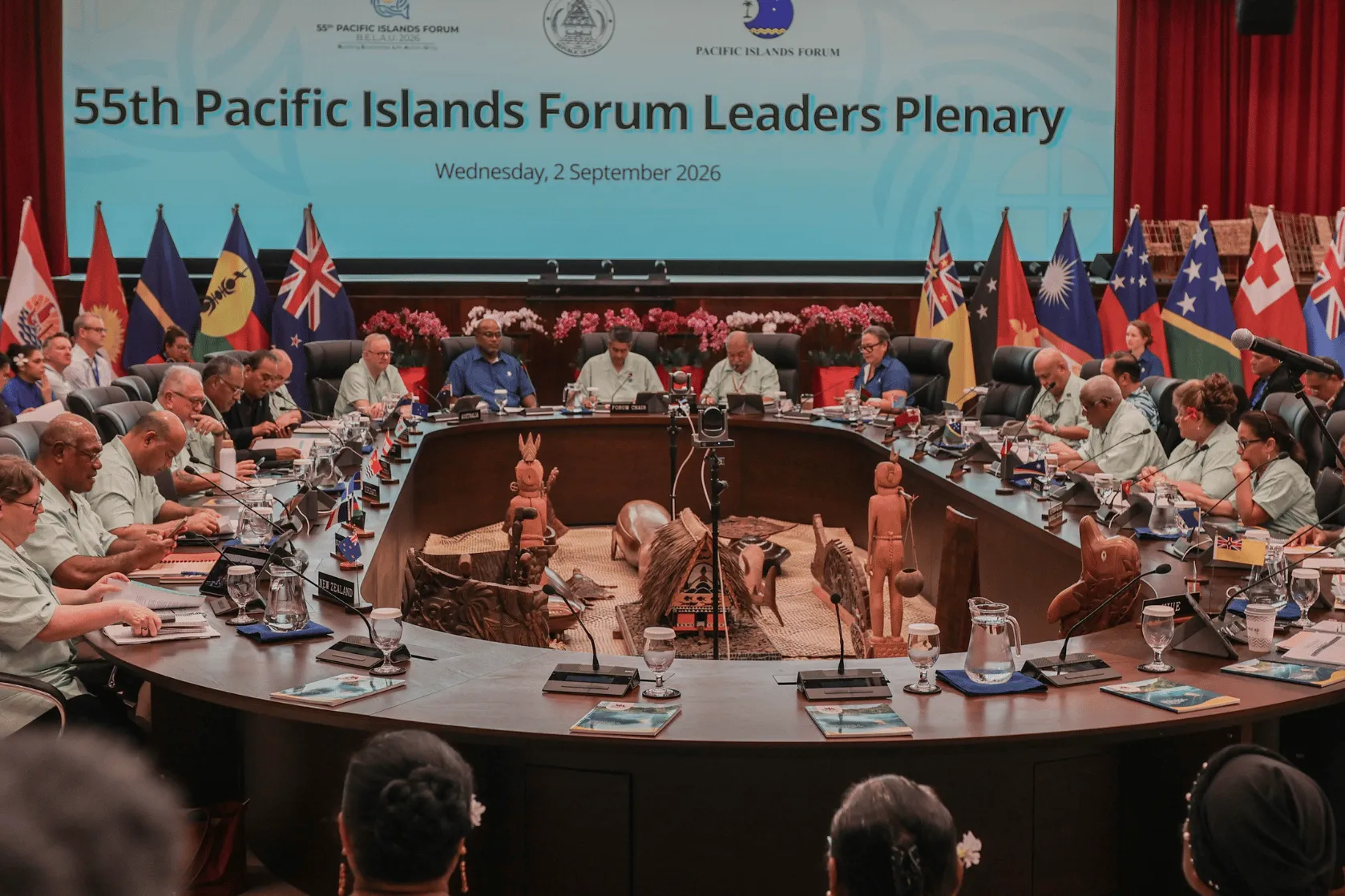
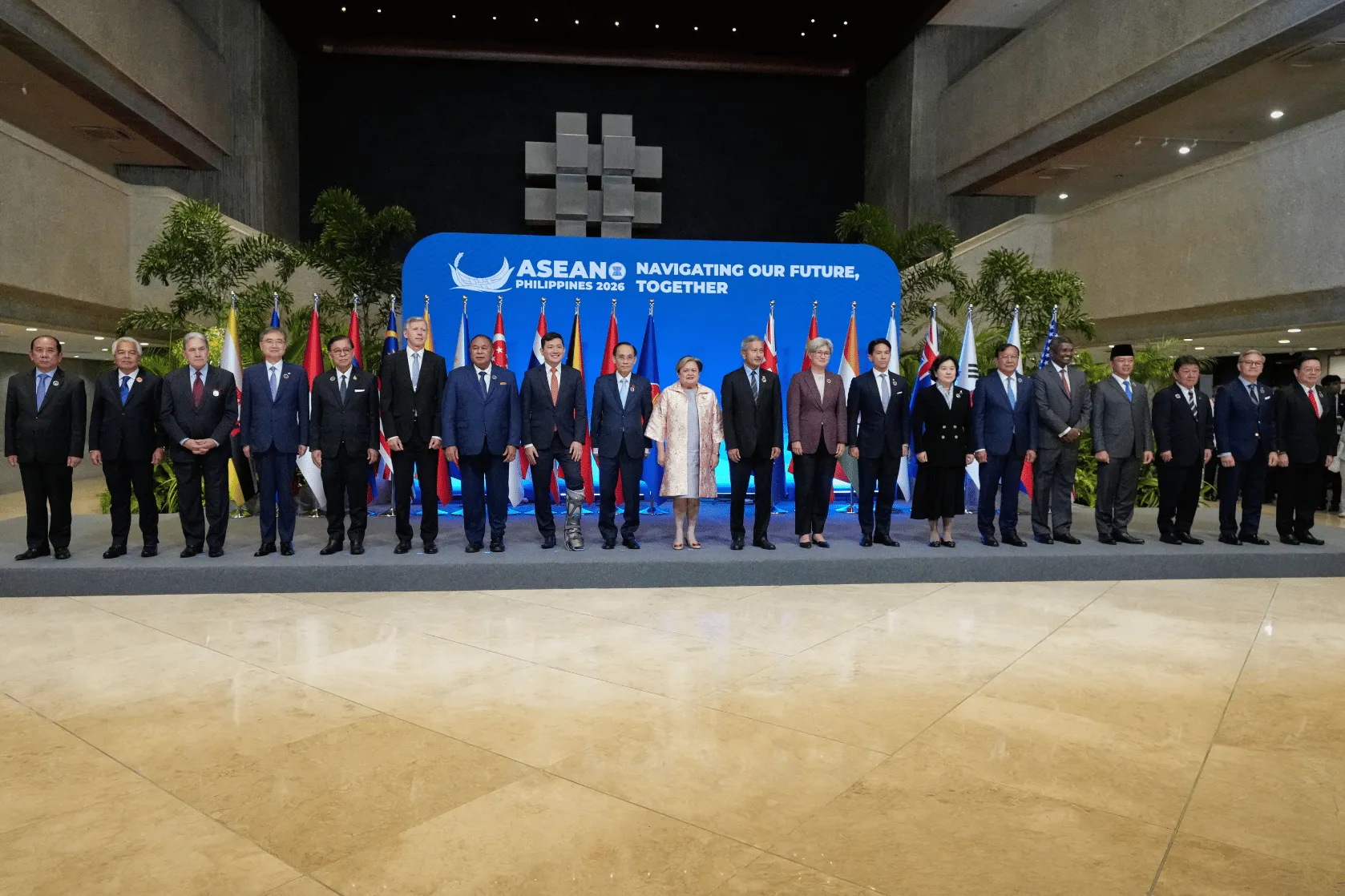
The Leaders Plenary at the 55th Pacific Islands Forum Leaders’ Meeting in Palau. Photo: TMC Palau/Pasifika TV
Women’s expertise already helps sustain peace and security across the Pacific. The next step is ensuring it is consistently reflected in the region’s highest decision-making forums, writes Grace Madden.
The Boe Declaration on Regional Security promises a Pacific security built on inclusion, a commitment the 2050 Strategy for the Blue Pacific Continent repeats through its own inclusion and equity pathway. In practice, the region has largely confined women’s participation to parallel, advisory spaces rather than the rooms where security priorities are decided.
Each year, Pacific Islands Forum leaders meet to determine the region’s priorities. Days earlier, Pacific women leaders meet separately to formulate what they want leaders to consider. Yet this meeting of key Pacific women leaders has no authority to determine outcomes: it can advise the room where decisions are made but cannot enter it.
Pacific parliaments have the lowest share of women of any region globally, at less than seven per cent. Capability is not the problem; translating it into power is. Closing that gap takes two things: power for the women already at the table, and a way in for states that have few women at senior levels to send.
The cost of this exclusion is felt across every part of the architecture Boe aims to expand. Peace agreements negotiated with women’s participation are more durable, contain more provisions for political reform, and have higher implementation rates. The likelihood of an agreement lasting 15 years also increases by 35 per cent.
The consequences are just as stark on the frontline: gender-based violence causes more direct physical harm to people in the Pacific than any other threat named in Boe’s expanded concept of security. Yet, six in 10 women in Solomon Islands who report violence to police receive no help at all. The issue is not simply about fairness, but about effectiveness.
The history of women peacebuilders in Bougainville shows the impact of inclusion in peace and security. During the 1988-1998 civil war, women crossed conflict lines to negotiate directly with an active insurgency, and organisations such as the Leitana Nehan Women’s Development Agency went on to monitor implementation of the peace agreement that ended it.
The peace process they helped deliver resulted in a constitution that reserved three of the region’s 39 legislative seats for women, with one directly elected representative from each region, recognising their role in ending the conflict. But within Bougainville’s own legislature, the precedent stalled. The most recent published assessment of the delegation currently negotiating Bougainville’s political settlement with Papua New Guinea found all five members were male and Bougainville’s own reserved-seat MPs joined only as observers.
But Bougainville is not an isolated case, and slow, generational change is not the only model available. Samoa’s 2013 constitutional amendment reserves a minimum 10 per cent of parliamentary seats for women; making it the first independent country in the Pacific to introduce a parliamentary gender quota.
Elsewhere, greater women’s legislative representation is found to measurably reduce conflict behaviour and defence spending.
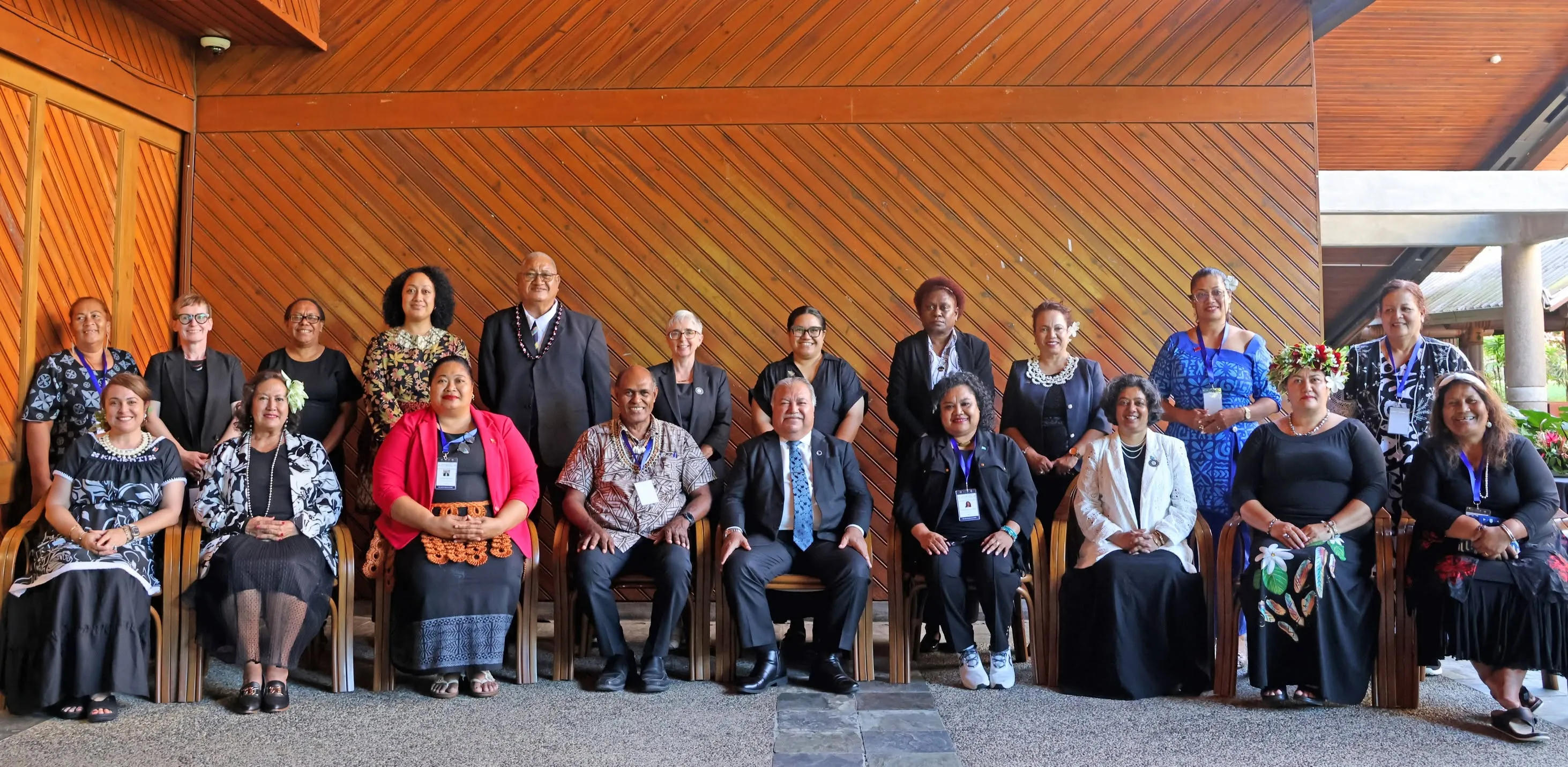
The Pacific Islands Forum Women Leaders Meeting in June 2026. Photo: Pacific Islands Forum Secretariat
Strengthening women’s positions in regional security architecture and decisions-making at senior and leader level involves two key reforms; the first of which is already partially realised.
Where women are already elected, either supported by a quota system as in Samoa and Bougainville, or without such a mechanism, the next step is negotiating full standing on delegations representing states at the Leaders’ Meeting and the Forum Officials’ Subcommittee on Regional Security (FSRS).
The second change addresses what the first cannot: extending the reserved-seat model Samoa and Bougainville have already legislated to facilitate the election of more women to Pacific parliaments so future delegations have more women to include at high-level regional and security meetings.
Neither change can be imposed from outside, but political will is essential. Papua New Guinea shows what happens without it: a 2011 law proposing 22 reserved seats for women — one seat per province—has still not come into force, stalled for want of sustained political pressure, not capacity or precedent. The most recent progress in increasing women’s participation in Papua New Guinea, which currently has three women serving in its 111-seat Parliament, was the adoption of a new elections rule requiring 10 per cent of political parties’ endorsed candidates to be women.
The region has tried accountability mechanisms without enforcement before. A review of the Pacific Leaders Gender Equality Declaration (PLGED) in 2021 found that three mechanisms established to improve governance and accountability for gender commitments — the CROP Gender Working Group (1998); the High-Level Reference Group on Sexual and Gender Based Violence (2009) and the Pacific Working Group on Women, Peace and Security (2011) — were inactive. More broadly, the review of the original declaration, which had included commitments to increase the participation and inclusion of women in decision-making, recommended steps to improve governance, accountability and implementation.
At this year’s Pacific Islands Forum Leaders’ Meeting, Leaders “urged members to adopt national policies and laws to increase women’s political participation and representation”, but more tangible actions are needed.
Unlike a declaration, a legislated seat survives regardless of oversight. A leader-level mechanism for reporting on gender equality, such as the report card recommended by the PLGED review, would ensure that progress, or its absence, is visible at the same table where security priorities are set. Reporting on Women, Peace and Security as a standing item at FSRS, as suggested by the Guidance Note on Women, Peace and Security in the Blue Pacific Continent, would raise visibility of WPS at a critical security meeting.
None of this requires new machinery. Boe and the 2050 Strategy gave the region institutions capable of holding this problem. What has been missing is the will to use them for women specifically.
Bringing women into these rooms in a meaningful, tangible way, with a vote rather than an invitation, reinforces the same architecture Boe was built to fortify: national capability feeding into regional resilience.
This is not a quick fix. Structures built across generations will not unwind in one. But the region does not need to invent capability. It needs to use what it has already built, for everyone it was meant to include.
Grace Madden is a Canberra-based Master of National Security Policy student at the Australian National University, whose work brings a gendered lens to national security. The views expressed in this article are her own.
This blog has been adapted from an assessment for the Pacific Regional and National Security Policy course delivered at ANU by the Pacific Security College.
Views expressed via the Pacific Wayfinder blog are not necessarily those of the Pacific Security College. Read our publishing policy.