Experts highlight need for pathways that uphold choice, dignity and opportunity
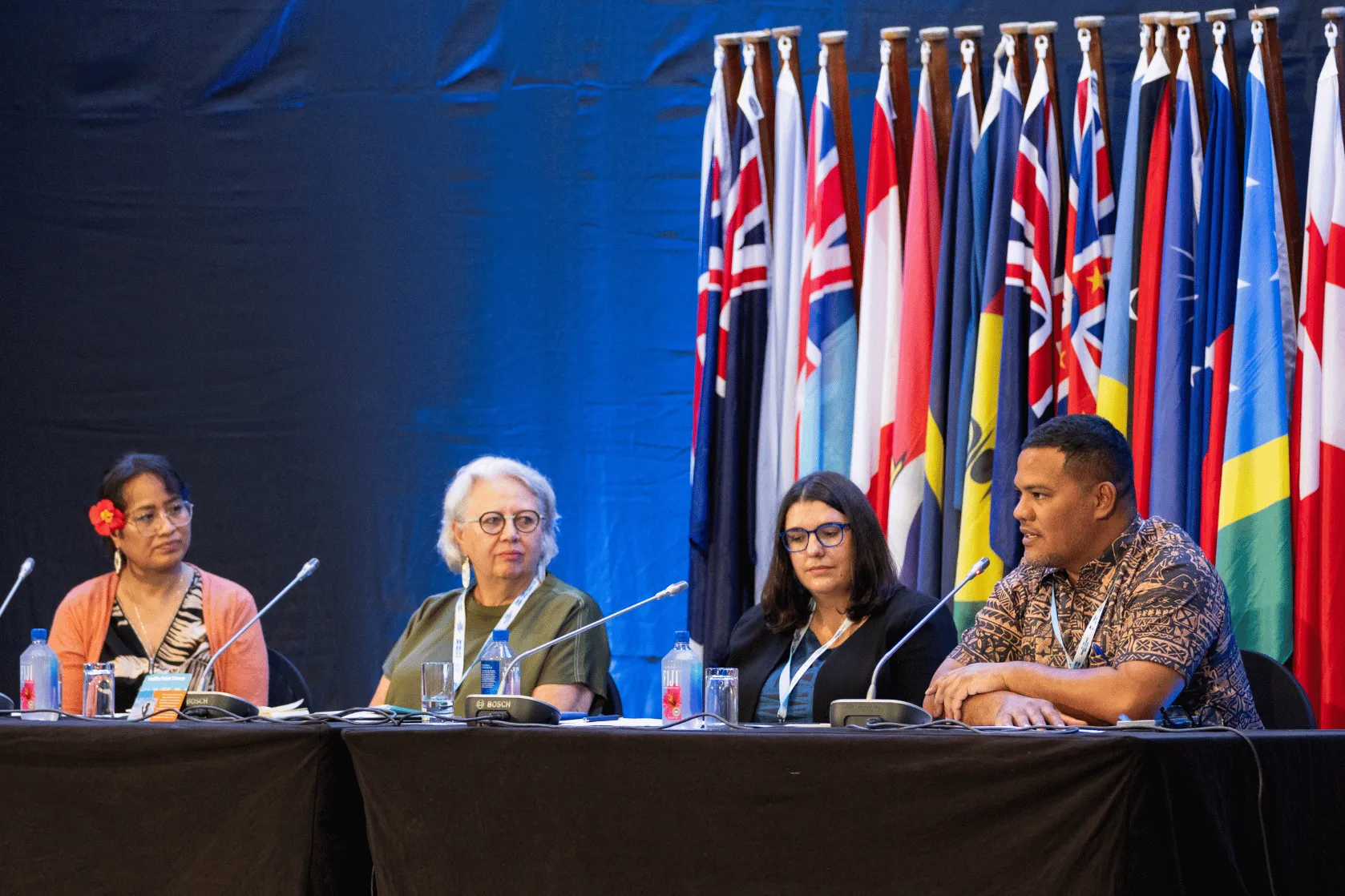
Professor Yvonne Underhill-Sem, from the University of Auckland; Dr Henrietta McNeill-Stowers, from the Australian National University; and Tuvalu’s Minister for Transport, Energy, Communication and Innovation, the Honourable Simon Kofe, with (far left) moderator Dr Akka Rimon. Photo: Pacific Security College
Pacific Island governments need to create opportunities that support people to remain in their country, while also enabling mobility pathways that provide options for their communities, panellists at the 2026 Pacific Peace and Security Dialogue have said.
Tuvalu’s Minister for Transport, Energy, Communication and Innovation, the Honourable Simon Kofe; Professor Yvonne Underhill-Sem, from the University of Auckland; and Dr Henrietta McNeill-Stowers, from the Australian National University, featured on the Regional cooperation for Pacific mobility, dignity and adaptation panel at the Dialogue.
The panel discussed the benefits and challenges of mobility in the Pacific, including workforce impacts, return migration, labour mobility schemes, and the need to provide people with meaningful choices about where they live and work.
They also outlined the motivations for some Pacific islanders leaving their home countries, including pursuing employment or education opportunities, and the importance of people having the option to leave and return as they wish.
Speaking from Tuvalu’s perspective, Minister Kofe said that in the past, one of the drivers of migration was the conditions on the island, including droughts or other times of insufficient resources.
“I think the same would apply today. The conditions is one thing that drives people to leave. In the context of Tuvalu, people are looking for better education for their kids, better job opportunities,” he said.
“As a government we need to have a hard think about that, because I think if all things were equal in terms of conditions at home and conditions of where they’re traveling to, I am pretty confident that everyone would choose to stay back in Tuvalu.”
Professor Underhill-Sem recognised the legacy drivers of mobility, including service-based mobility and the pursuit of economic opportunities, and the increase in the number of women moving.
“Some of the very early drivers of mobility were curiosity-based, and a lot of that was people interested in just even going to another village nearby or another island,” she said.
“Increasingly, the environmental changes and the political changes that are happening in our countries are also a driver of mobility in our countries, and the political changes kind of move into the social changes that are happening in places as well.”
The panel discussed the implications of mobility, including on the workforces in Pacific Island countries, and the reintegration of citizens who return home, either by choice or through forced relocation or deportation.
Dr McNeill-Stowers raised the issue of ‘return mobility’ and highlighted the impacts of immigration policy changes, particularly in the United States, on Pacific communities.
“True mobility with dignity means that people can come home whenever they choose, but for some they don’t necessarily choose that. [They] are forced home and may not have been home for a long time,” she said.
She said the return of deported citizens shouldn’t be treated solely as a law enforcement or national security issue.
“[We should be] thinking about whole-of-government approaches, churches, and village governance structures that can help people and communities accommodate and accept, so that they can live in a positive and peaceful way in their homes,” she said.
The panel also reflected on whether the region was building nations that encouraged citizens to remain, or building systems to send people abroad.
Professor Underhill-Sem discussed the effects of labour mobility schemes on the region.
“There are pros and cons to some of the recent labour mobility programs we’ve had,” she said.
“It’s not just the worker, it’s not just the country, it’s not just the home place that benefits, but there are a myriad number of other entities and agencies who are part of mobility.
“If we look around the region, we will see the places that have been built by remittances, that are occupied by people who have returned, and we can see those ways in which that’s been quite positive.”
However, Professor Underhill-Sem said the New Zealand Recognised Seasonal Employer (RSE) labour mobility scheme had demonstrated some of the other impacts, particularly as research showed some people had been returning to the program for 10 years or longer.
“It starts to make those divisions in our communities, those who’ve got things and those who don’t. So, that’s one thing we’ve got to keep in mind, that it’s not a simple case of those coming and going.
“The second thing is that it really does allow our governments to abrogate their responsibilities in terms of providing the economic basis for employment, and this is not an easy task.”
Dr McNeill-Stowers echoed the concerns about the implications of mobility on communities.
“What does it mean for Pacific Island governments to be able to deliver core services if qualified and experienced healthcare or national security professionals are away on seasonal work?
“What does it mean when a country has an economically vital tourism industry, but have to import labour because there aren’t enough people at home to be able to service that industry?”
Speaking of the Falepili Union Treaty, Minister Kofe said Tuvalu’s motivation for the agreement was to provide freedom for people to travel, but he acknowledged it had impacts on the labour force.
“We just want to give people that opportunity to travel, explore other places, get better education for their children. But it comes with consequences as well.
“It’s important to think about how we can motivate, incentivise our people to stay. Of course, better pay is one major incentive for people to stay. But I think also, from a leadership level, is to have a vision that people can buy into.
“There has to be that vision and that environment for them to come and input their skill, and so I think that’s a responsibility of leadership.”
Minister Kofe said trends such as the increase in remote work presented opportunities for Tuvalu.
“We have this vision of a digital nation. In this day and age, you don’t necessarily need to be physically in Tuvalu to serve the country. You can work remotely, and COVID showed us that is actually possible. We have a digital nomad sector that is thriving as well.”