New paper calls for renewed attention on land security in the Pacific
Photo: Pacific Security College
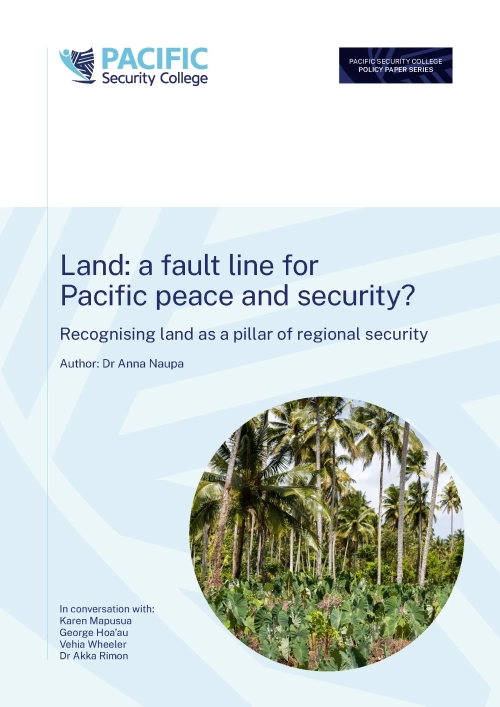
Land governance must be restored as a central pillar of regional peace and security efforts in the Pacific, according to a new paper released by the Pacific Security College.
Authored by Dr Anna Naupa, a Senior Research and Engagement Fellow at the Pacific Security College, Land: a fault line for Pacific peace and security? says the region must renew its attention on land security.
“As climate change reshapes coastlines, affects food systems and forces communities to relocate, land is becoming a critical security issue. It underpins identity, livelihoods, governance and community cohesion, yet it has become increasingly absent from regional security discussions,” Dr Naupa said.
“This has created a vacuum in regard to regional land policy.”
Dr Naupa proposes several initiatives to strengthen the consideration of land in regional peace and security efforts, including:
- refocusing on land and its centrality to Pacific peoples’ identity and belonging
- reintroducing land governance as a critical component of regional peace and security discussions
- using the development of the Regional Peace and Security Action Plan to formally recognise the role of plural land governance systems
- using the annual Pacific Security Outlook Report to spotlight pressing land policy issues.
“Sustainable access to and management of land are fundamental for the environmental, human and livelihood security of Pacific peoples,” Dr Naupa said.
“Developing regional collective actions within a Regional Peace and Security Action Plan presents an opportunity to focus on how land governance systems could contribute to regional goals for peace, prosperity and security.”
Land: a fault line for Pacific peace and security? includes responses from four regional experts: Karen Mapusua, George Hoa’au, Vehia Wheeler and Dr Akka Rimon.
Ms Mapusua, Director of the Land Resources Division at the Pacific Community, said the paper highlighted a critical gap in the discourse on security and resilience in the region.
“Donor institutions, development banks and regional policy frameworks routinely approach land as a resource. Pacific peoples, however, have long understood land as something far more elemental: not as an asset to be exploited, but the very ground of identity and belonging,” she said.
“Food insecurity and hunger are drivers of social unrest. When people cannot feed themselves, and cannot afford healthy imported alternatives, the crisis is real. As climate-related relocation, urbanisation, non-agricultural developments such as tourism, and population growth put pressure on arable land, these issues will grow.”
Mr Hoa’au, Permanent Secretary of the Ministry of Foreign Affairs and External Trade, Solomon Islands, said there was much to be learned from national policies regarding land.
“We need more regional knowledge exchange so we can learn from each other,” he said.
“They are not abstract practices; they are already happening. But our regional security efforts must catch up. We need to look to these national lessons, codify them and incorporate them into regional policies and planning.”
Ms Wheeler, a Ma’ohi Nui scholar and environmental and cultural consultant at Sustainable Oceania Solutions, reflected on the lessons from the past, including nuclear testing and its impact on land and oceans, and subsequently on food security and displacement.
“Without secure, healthy land and ocean space for people to practise traditional management, agriculture and fishing, we create vulnerable societies,” she said.
“Furthermore, the Pacific can look to the history of several communities that have experienced similar issues of displacement due to factors out of their control. Our past can, and should, inform our future.”
Dr Rimon, a Senior Research Fellow at the Pacific Security College, said Dr Naupa’s paper highlights that land remains the spiritual, relational and cultural foundation of society.
“This worldview underscores why land insecurity, whether driven by climate change, economic shocks or poorly informed policies, could potentially undermine Pacific peace and security,” she said.
“As climate impacts intensify and mobility pressures rise, the region faces mounting challenges of land scarcity, contested tenure and undermined sovereignty. Naupa’s call to foreground land-rooted security is therefore both timely and urgent.”
About the Pacific Security College policy paper series
The Pacific Security College’s policy paper series aims to contribute a diversity of views and ideas to regional conversations about the journey to 2050. The views expressed in the Pacific Security College policy papers are those of the authors alone and do not necessarily reflect the official positions of the College.