Leaders call for regional collaboration amid growing global instability and climate impacts
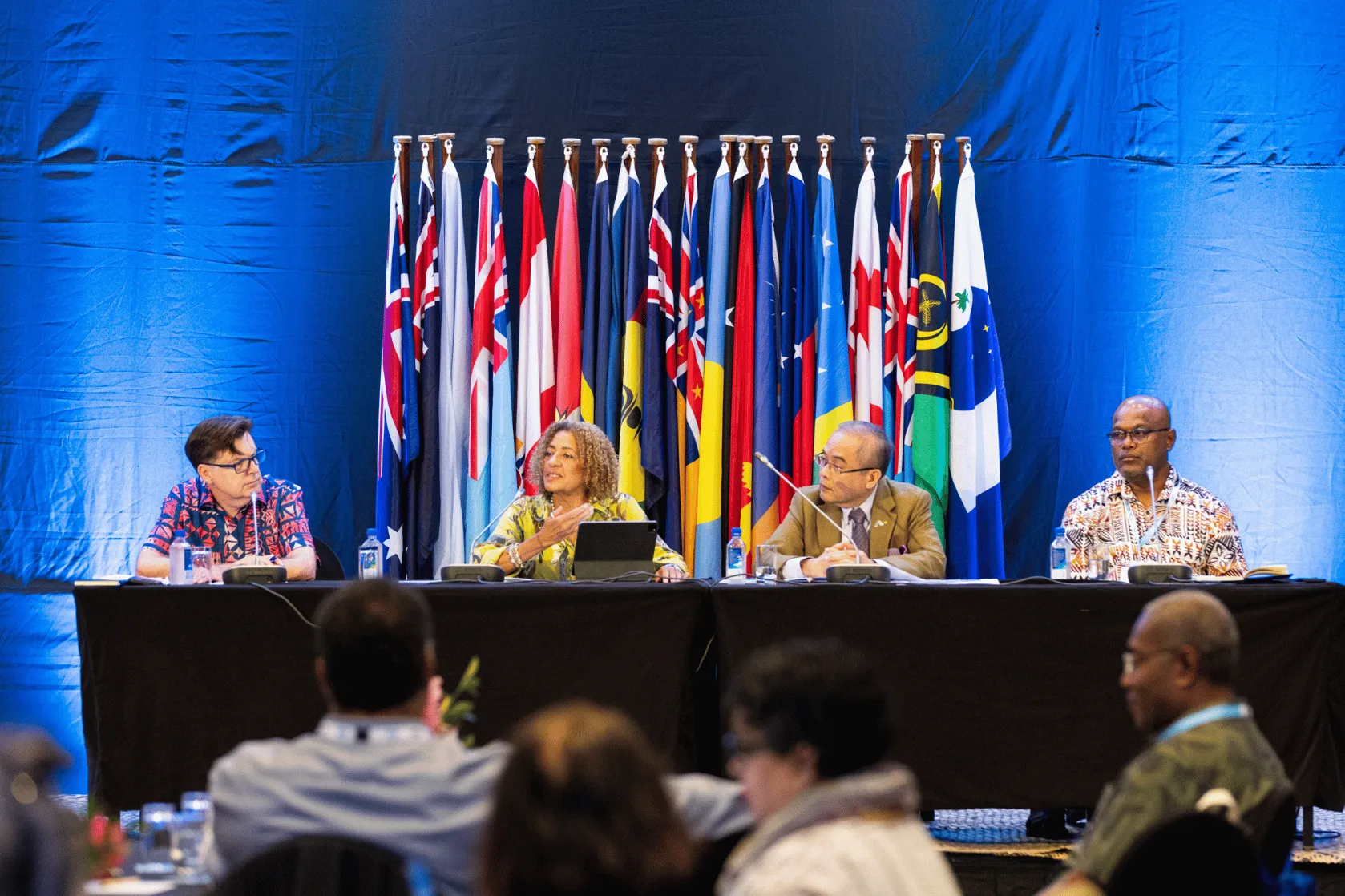
Assistant Secretary General, Foreign and Community Relations at the CARICOM Secretariat, Elizabeth Solomon; Secretary-General of the ASEAN Inter-Parliamentary Assembly, His Excellency Dr Chem Widhya; and Deputy Secretary General – Strategic Policy and Programming at the Pacific Islands Forum, Esala Nayasi, with (far left) moderator Professor Dave Peebles. Photo: Pacific Security College
Leaders from three intergovernmental organisations have emphasised the need for strong cooperation to uphold international law and respond to growing geopolitical uncertainty and the impacts of climate change.
Speaking at the 2026 Pacific Peace and Security Dialogue, a panel of representatives from ASEAN, the Caribbean Community (CARICOM) and the Pacific Islands Forum discussed the role such organisations can play in the global order and the importance of working together to address shared challenges.
‘Regional cooperation in the Pacific and beyond’ featured Secretary-General of the ASEAN Inter-Parliamentary Assembly, His Excellency Dr Chem Widhya; Assistant Secretary General, Foreign and Community Relations at the CARICOM Secretariat, Elizabeth Solomon; and Deputy Secretary General – Strategic Policy and Programming at the Pacific Islands Forum, Esala Nayasi. It was moderated by Professor Dave Peebles, Director of the Pacific Security College.
Dr Widhya said it was important for regional organisations to work together, particularly to ensure the rule of law and in the light of challenges such as reduced financing to the United Nations.
“I sense it as a duty that regional organisations have to band together and to embrace each other in order to save our common house, the planet,” he said.
Dr Widhya said an issue for the international community now was deciding whether to choose “right is might or might is right” and how this impacted the security of smaller states.
“Smaller states that do not have big armies, they do not have missiles and nuclear weapons, so therefore they would embrace right is might, because when ‘right’ rule, then there is a sense of equity before law, before justice. That would be the framework, [it] would be guaranteeing the safety of the citizens, social harmony, and long-term prosperity,” he said.
“We know that when ‘might is right’, the big [states] take all, at all costs. This leaves the door open for many precedences near and far; when the bigger feel hungry and eat the smaller ones.”
Ms Solomon shared Dr Chem’s concerns over growing geopolitical pressures and raised the various ways they have been felt in the Caribbean.
“We have also had in the region, for the first time, military presence, like physical military presence of large warships, the bombing of boats out of the water in international waters. So, there is a complete attack on international rule of law,” she said.
“International rule of law is based on trust between states and upholding agreements made donkeys years ago, and that we are having real challenges dealing with and have no pushback really, except to rally around and to become more visible within the international, multilateral spaces and more coordinated with CARICOM.”
Ms Solomon highlighted the election of two CARICOM members as non-permanent members of the United Nations Security Council: Guyana, which concluded its term in December 2025 and held the presidency in February 2024 and June 2025, and Trinidad and Tobago, which has secured a seat on the council from 2027 to 2028 and will serve as president in March 2027.
“So, we punch above our weight, as you do in the Pacific,” she said.
Ms Solomon said a major issue for their region was addressing the impacts of climate change, particularly accessing financing and managing loss and damage.
“The hurricanes have become so profound that the last one was a category five plus. We just simply don’t have the capacity to build to mitigate against that, and the debt that that causes any member state to recover from is just incredible,” she said.
Mr Nayasi agreed that access to climate finance continued to be an issue for Pacific Island countries.
“There’s a lot of regional initiatives that we’ve also been able to advance…but obviously we are limited by resources, and it continues to be a challenge in terms of access. But as a way to mitigate that, leaders have agreed on the establishment of the Pacific Resilience Facility, one that is owned by the Pacific, one that reflects our values, one that also defines the way that we would want to deal with the issue,” he said.
Mr Nayasi acknowledged initiatives championed by the Pacific, including the International Court of Justice advisory opinion and the recent UN General Assembly resolution. He said COP31 would be an opportunity for the Pacific to continue to advocate for its priorities.
“There’s a lot that we have achieved in this area, but at the same time, there’s a lot that we still need to address,” he said.
Dr Widhya said ASEAN members were also affected by the impacts of climate change and sea level rise.
“On one side we have the rise of the sea, so…Indonesia is building now more than 1000 kilometres [of] wall in the north of Indonesia, but you see also cities sinking; Bangkok is sinking, Jakarta is sinking, Ho Chi Minh City is sinking,” he said.
Dr Widhya highlighted the link to food security, as witnessed in Vietnam where salt water was coming into the land and destroying crops, and energy security. He said ASEAN had worked to coordinate energy and food policy to address the issues across the region.
“When there’s no more ice, there’s no more water, we will see a lot of arid terrain. Food will become scarce. Potable water will become very scarce. So, we have to be very alert,” he said.
“We have to be very proactive and try to come together in order to try to save the world.”
The panellists also discussed free movement agreements within and beyond their respective regions.
Ms Solomon said free movement had been “elusive” for CARICOM, but some members (Barbados, Belize, Dominica, and Saint Vincent and the Grenadines) had initiated arrangements to address the labour challenges associated with ageing populations.
“The issues that the member states leaders have been addressing is the comparative capacity to provide basic social services equally in all of the member states, but there have also been some moral issues. Some member states don’t want to recognise, for instance, same-sex marriage, so those are details that slowly have to be worked out,” she said.
“The exercise of the four that have decided to go, it has really helped to show that it’s not a scary thing. It’s not thousands of people banging on your door and demanding free health care. It’s actually quite a slow [process], people adjusting and wanting to move because they want to work and because they want to experience their neighbours.”
Dr Widhya said the ASEAN model encouraged the free movement of skilled labour.
“We have also strived to have within ASEAN, a pool of excellence in education, in order that the graduates could find jobs in all ASEAN member states without any discrimination. So, the pool of excellence in education is extremely important to us.”
Mr Nayasi said it was acknowledged at several levels, including by the region’s economic ministers, that the free movement of people was a critical step to economic integration.
“How do we then begin to look at pathways and ensuring that our people are able to live better lives through some of the opportunities that we provide?” he said.
“The issue that we have now, particularly for some of our countries, is probably not deliberate, but the cooperation between the ASEAN region and in the Pacific, there’s inflow of a lot of labourers from the ASEAN region, feeding into our labour force challenges. So, there’s a need for us to also begin to think about opportunities that we have across the region.”