Pacific youth leaders call for more mental health services as region tackles drug crisis
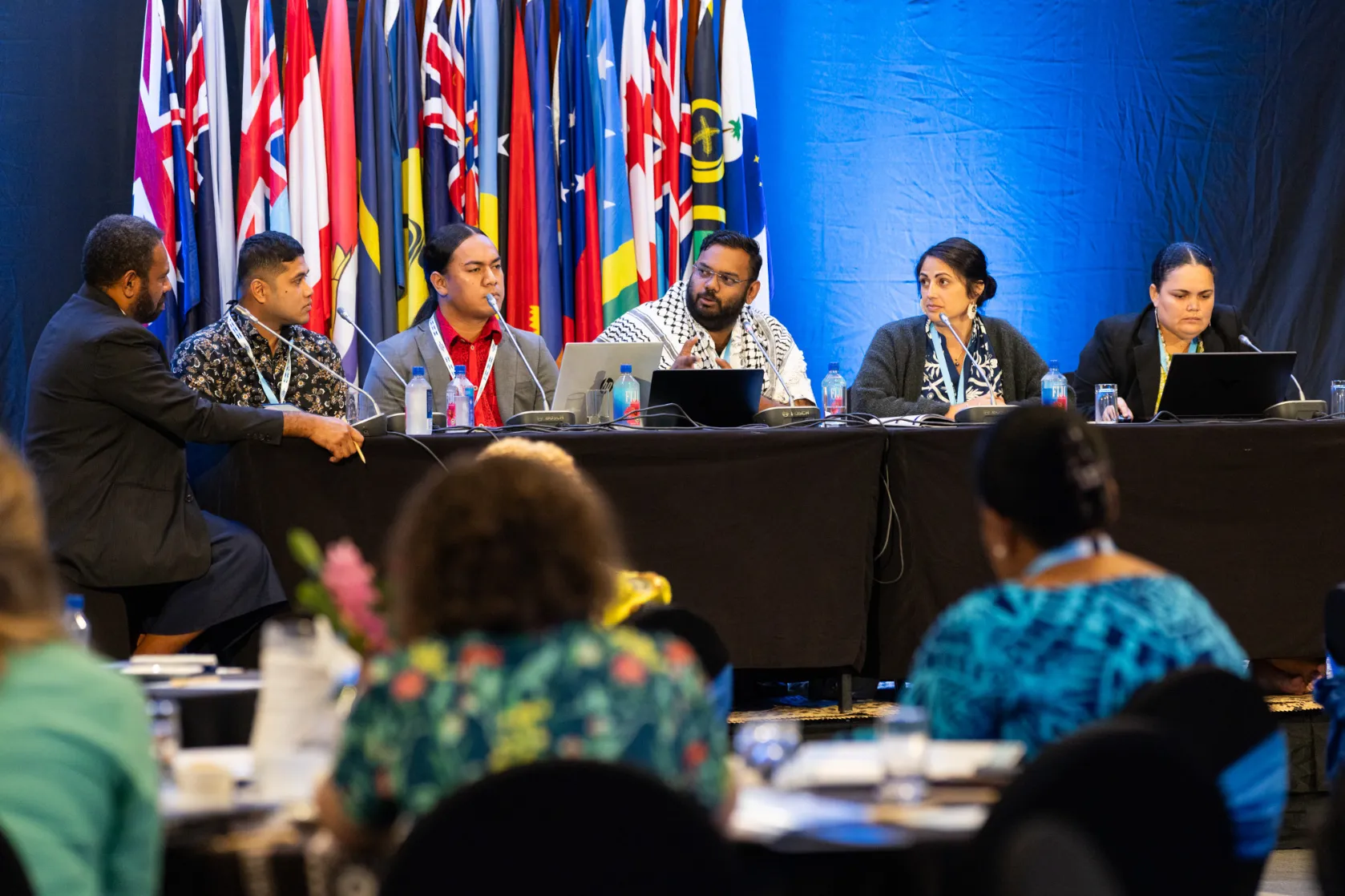
Mori-m Mahoney Mori, ‘Isitolo Siale, Abdul Shaheed, Vehia Wheeler and Olivia Baro speak at the Pacific Peace and Security Dialogue, with moderator Dr Romulo Nayacalevu. Photo: Pacific Security College
Pacific youth advocates have called for increased mental health services to support young people, particularly those affected by the region’s drug crisis.
Speaking at the Pacific Peace and Security Dialogue, a panel of young Pacific thinkers discussed pressing security issues facing the region, including the drug and HIV crisis and climate change, and their impact on youth.
‘Looking ahead: today’s youth on a secure future for the Blue Pacific’ featured Pacific Youth Council Chairperson Mori-m Mahoney Mori; President of the University of the South Pacific Students’ Association ‘Isitolo Siale; Abdul Shaheed from Pacific Islands Students Fighting Climate Change (PISFCC); Environmental and Cultural Consultant Vehia Wheeler; and Pacific Conference of Churches Youth Minister Coordinator Olivia Baro.
The panellists raised the importance of addressing the social and economic drivers behind rising drug use in the region, as well as the need for proactive steps to strengthen mental health support and expand opportunities for young people.
Mr Shaheed highlighted the initial “knee-jerk” reactions of governments as the crisis emerged in the region.
“The perspective with which we developed programs was that this is a maritime issue, there’s a border security issue, that this is a criminal activity. We did not look at the social factors that led us to this stage,” he said.
“For me, the drug crisis is not necessarily only a maritime or border issue, it’s a human security issue. It is about the fact that there are not enough economic opportunities for young people who then get very quickly ensnared with the bad actors…coming into the region, using the region as transit points, propagating the use of drugs.
“Until we look at this as a social problem, not as a political or legal problem only, and not criminalising everything that goes wrong with our social issues, we will not protect human beings; we will not protect Pacific Islanders.”
Ms Wheeler agreed the region should strive for more economic equality in terms of jobs and social services.
“I’m wondering if…these stark inequalities are pushing people to drug use. I think we should work towards a holistic means of creating a better society, more access to basic needs, basic services, and see how our societies can improve from there.”
Several of the panellists discussed the urgent need for more mental health support and facilities, including as a preventative measure.
Mr Siale, from Tonga, said governments must prioritise mental health.
“We tend to focus more on the actual crime itself, instead of focusing on the root causes,” Mr Siale said.
“Why are people turning to drugs? It encompasses a lot of social issues [and] inequality in our communities, in our countries.
“Our communities are not supportive of opportunities for people to be open and to be able to share their struggles mentally and emotionally. It is very important for our government to put more emphasis on creating safe spaces for people, not just young people, people of all ages.”
Mr Mori raised the high rates of suicide among young people in the Federated States of Micronesia, and the cycle between mental health, drug use and domestic violence. He said it was a common story across the region, but that some countries weren’t equipped to provide the necessary support.
“There are some countries that just don’t have mental health facilities,” he said.
He said the increasing detection of drug smuggling vessels caught in the region suggested the crisis was only going to increase.
“We must recognise that we have no regional facility to respond to this issue. There’s none, but there’s hope. Because we are very capable of coming together and establishing institutions and facilities to protect our tuna. I think we can do the same for our people.”
Mrs Baro said the Pacific Conference of Churches had partnered with other stakeholders, including the Ministry of Policing and civil society organisations, on a national pastoral response in Fiji, and was focused on the human and social aspect of the crisis.
She said collaboration was essential.
“The whole of society, whole of government and whole of community must address this together. We must paddle the waka together,” she said.
“If people are doing different paddling, we’ll go forward, we’ll go backwards, sideways, and then we overturn, which is something that we wouldn’t want, given the risk that we are facing.”
The panel also explored other security issues facing the region including climate change and the Pacific’s nuclear legacy.
Mr Shaeed, Engagement and Outreach Lead at PISFCC, which spearheaded the campaign to seek an advisory opinion from the International Court of Justice on states’ obligations regarding climate change, said the resolution at the United Nations General Assembly in May was a step to operationalising the ICJ’s ruling.
He said it gave the region another tool in its efforts to drive global climate action, but also urged the Pacific countries to remain accountable for their obligations.
“We no longer go into COP begging for sympathy and empathy. We go into COP telling countries ‘you have a responsibility’, but that responsibility…does not only lie on states who are causing this harm. It lies on us in the region also. How many of us in the region have codified a right to a healthy environment for our people?
“We need to lead the world as frontline communities, but we also need to show that leadership back home.”
Ms Wheeler said Pacific youth should strive to maintain their agency and voice in addressing environmental and security issues in the region.
“In French Polynesia, we experienced 193 nuclear explosions from 1966 to 1996 and today we continue to face ongoing environmental impacts, ongoing health impacts,” she said.
“We have to make sure that we have our own agency when we’re talking about security, and that we’re building up our own security before privileging others and outside security.”