Pacific experts call for regional response to combat rise in transnational crime
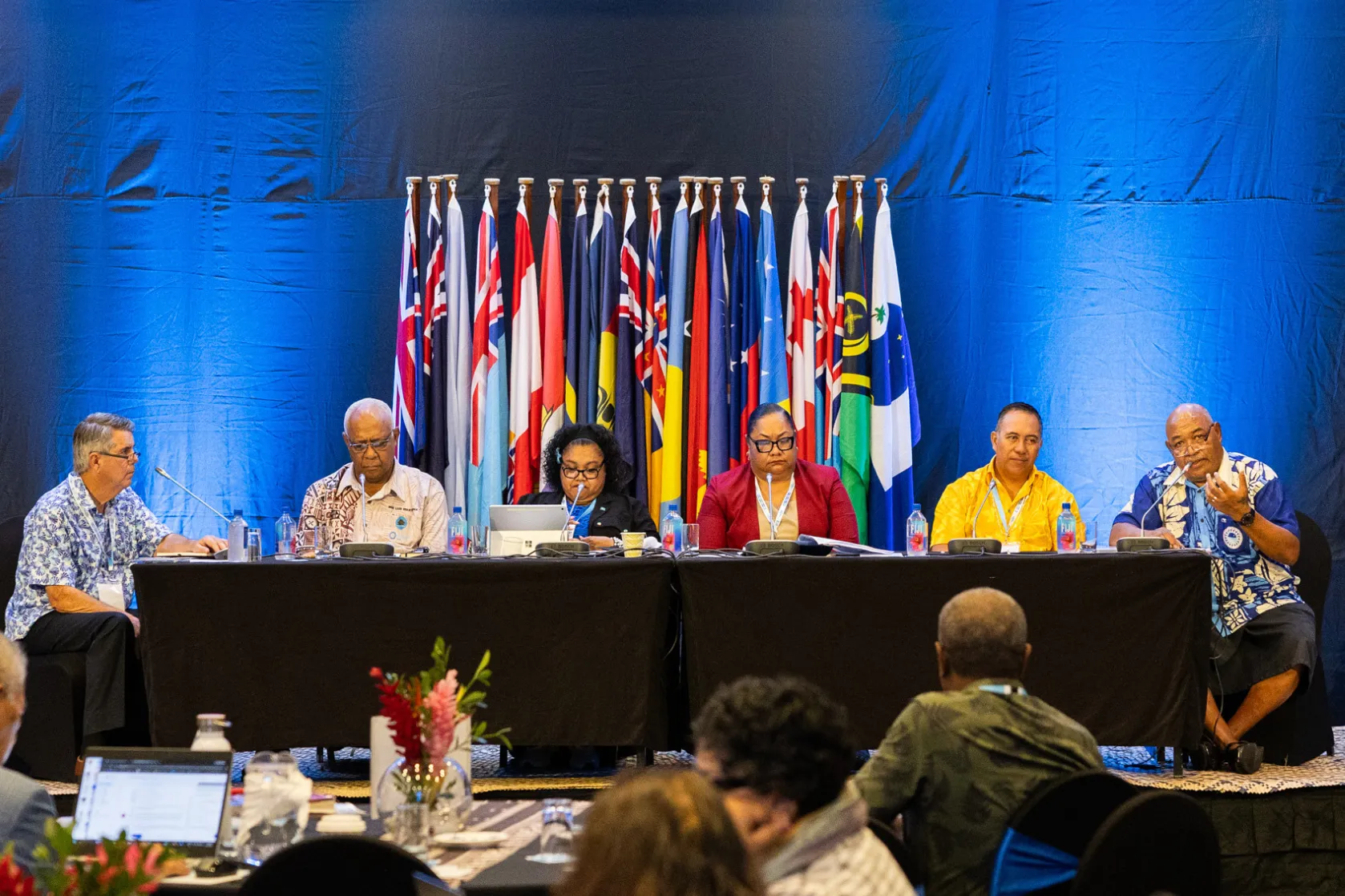
Moderator Ross Ardern with Ratu Viliame Seruvakula, the Hon Jennifer S Olegeriil, Acting Chief Superintendent Selosia S Fatukala-Satini, Bob Williams, and Berenado Daveta. Photo: Pacific Security College
Community and regional responses are essential to combat the rise in transnational crime in the Pacific, particularly the drug crisis, experts have warned.
Speaking at the 2026 Pacific Peace and Security Dialogue, panellists from law enforcement, justice, health and community backgrounds said transnational crime was no longer an emerging challenge, but an established threat in the region.
The Regional and community cooperation to fight transnational organised crime included Palau’s Minister of Justice, the Hon Jennifer S Olegeriil; Fiji’s Permanent Secretary for Policing and Communications, Mr Berenado Daveta; Fiji’s Chairman of the Great Council of Chiefs, Ratu Viliame Seruvakula; Cook Islands’ Secretary of Health, Mr Bob Williams; and Tonga Police’s Commander for National Crime and Investigation, Acting Chief Superintendent Selosia S Fatukala-Satini.
Minister Olegeriil said that in Palau, transnational crime was becoming more sophisticated and more connected to the wider region. She acknowledged Palau’s location provided important connections with Asia through tourism, trade and investment – but while this was valuable for the economy, it also create opportunities and vulnerabilities that could be exploited by criminal networks.
“We’re dealing with concerns around illicit drug trafficking, money laundering, cyber-enabled scams and other criminal activities that move across borders very quickly. Minister Olegeriil said.
“The same systems that support legitimate movement of people and commerce can also be used for illicit purposes.
“What’s equally important to recognise is that the impact is not only on law enforcement – we see the effects up north in our public health systems, our family wellbeing, our community safety and our economic confidence and sustainability.
“For small island states, even relatively limited criminal activity can place significant pressure on institutions and communities.”
Acting Chief Superintendent Fatukala-Satini confirmed the broadening reach of overseas criminal networks.
“Tonga has shifted from local to transnational crime. It’s now coordinated across the countries – they use digital crime because it’s faster, global and hard to trace,” she said.
She said the biggest challenges police were dealing with included capability constraints in digital forensics, forensic accounting and the capacity to maintain surveillance along maritime routes due to Tonga’s dispersed island geography.
“However, these challenges are not faced in isolation. Strong partnership remains central to bridging these capability gaps and enhancing operational effectiveness.
“No single country can effectively respond to this threat alone.”
Secretary Williams also advocated for a united approach to tackling the security threat presented by criminal networks, adding that illicit operations target vulnerabilities in local communities.
“COVID-19 taught us that health or even law enforcement addressing transnational organised crime cannot respond solely. We have to collectively come together to be able to respond effectively to eliminate these emergencies that are happening across our nations,” he said.
“Drug operations and smugglers rarely exploit healthy or resilient communities where police and border officials are well-resourced, paid well and are trustworthy. They infiltrate communities where there is economic and social stress, and where health and law enforcement architecture are fragmented.
“Any regional transnational organised crime harm reduction protocols should explicitly include community-based approaches as a recognised and deliberately well-resourced delivery channels.”
Ratu Viliame said the Great Council of Chiefs was greatly concerned by drug-related crime and HIV, in particular. He said Fiji’s traditional community structures had been stress tested, first by the impacts of globalisation and then the COVID-19 pandemic.
“The link between holding the structures together is accountable, forward-looking leadership,” he said.
“The traditional leaders realise that we need to take control, and the only way we believe we could contribute in moving this forward is to reform that structure.”
Permanent Secretary Daveta emphasised the importance of empowering communities to play a role in combating transnational crime.
“We want to drive the pride of citizenship, of ownership, into the people, so this vigilance becomes the personal responsibility of everyone,” he said.
Fiji Police has carried out several successful drug busts with the support of military resources, which enabled police to tackle normally inaccessible areas in the forests, mountains and oceans, Permanent Secretary Daveta said. He said police were coordinating with other departments to take a more holistic approach.
“We are setting up a joint operation centre whereby all stakeholders that deal with transnational crimes, plus HIV, will work together. This will include customs, health, immigration, police, the military and any other ministries that will be involved.”
Secretary Williams compared the necessary regional approach to a choir.
“I can see all of us having to be a bigger choir, singing all four parts in harmony … coming together to a sing one Pacific national anthem to defend our sovereignty and protect our borders.”