Pacific leaders advocate for regional cooperation against a backdrop of fuel crisis
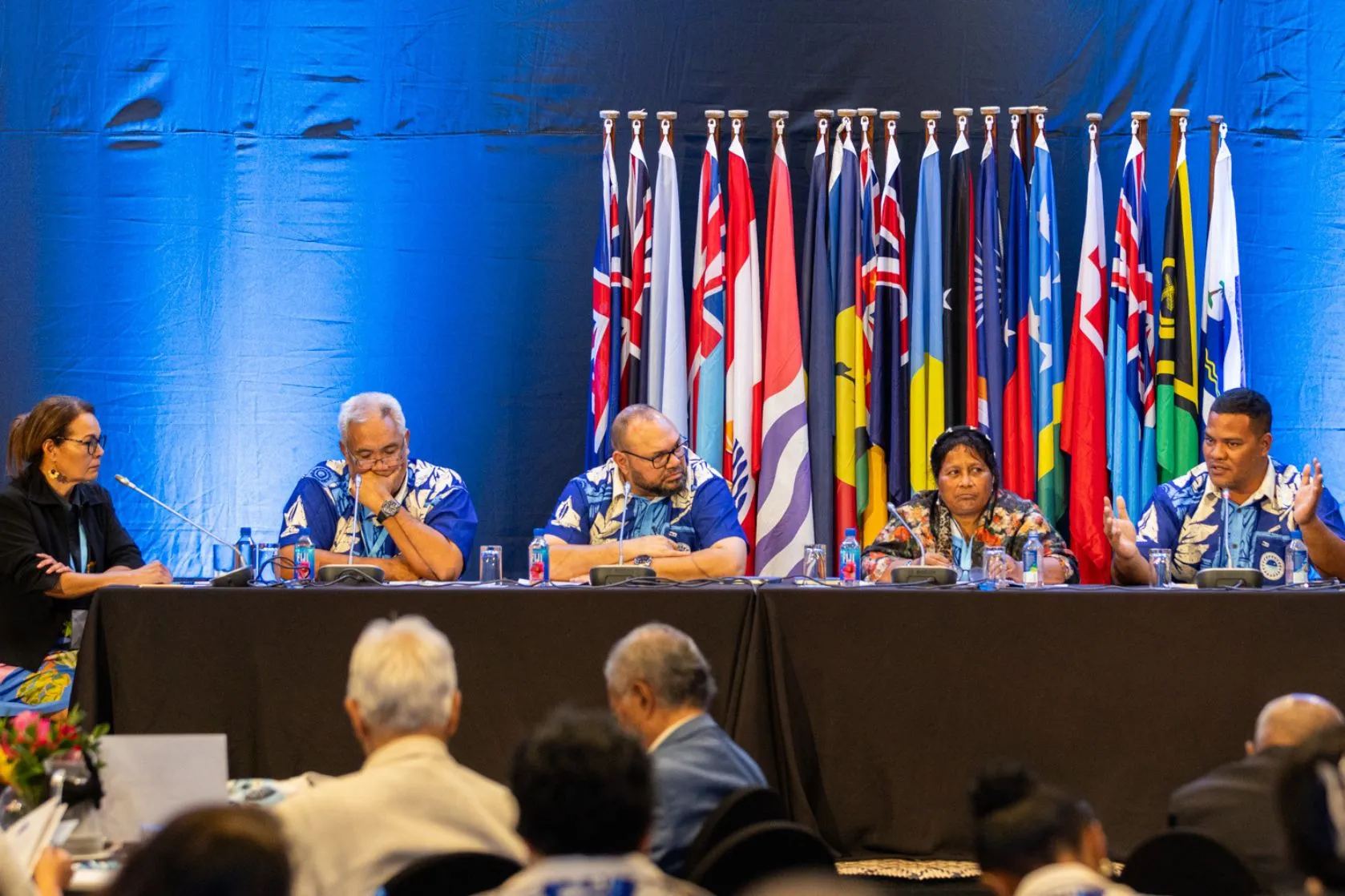
Pacific Leaders speaking on economic security at the Pacific Peace and Security Dialogue. Photo: Pacific Security College
The fuel crisis, inflation and the rising cost of living have underscored the importance of national and regional cooperation to build economic resilience, leaders speaking at the 2026 Pacific Peace and Security Dialogue said.
The Leaders on economic security panel featured Cook Islands’ Minister for Foreign Affairs, the Hon Tingika Elikana; Papua New Guinea’s Minister for Finance, the Hon Thomas Opa; Nauru’s Minister for Women’s and Social Development Affairs, the Hon Charmaine Scotty; and Tuvalu’s Minister for Transport, Energy, Communication and Innovation, the Hon Simon Kofe.
Minister Opa cited the global fuel crisis – created by the closure of the Strait of Hormuz – as an issue affecting economic security across the Pacific. Those who reside on Papua New Guinea’s more remote islands are particularly impacted.
“Some have to travel a long distance from the mainland to some of the scattered islands across PNG,” he said.
“The increase in fuel prices has really affected not only the people on the mainland that will now buy more fuel at the bowser, it also affects business, and if the business is not growing, they cannot make profit, they cannot employ people – so it has broader implications on the wellbeing of people. This is a concern that affects Papua New Guinea.”
While PNG has instated a fuel subsidy to alleviate pressure, it is not sustainable long term, Minister Opa said. He noted that as a small producer of oil and gas, PNG is also looking at ways to contribute to smaller Pacific Island states.
“Our Prime Minister in the recent Pacific Energy and Transport meeting in Port Moresby indicated Papua New Guinea’s intention to build smaller refineries to not only support fuel security in storage tanks and fuel security in our country, but also how we can contribute to our smaller Pacific island countries,” he said.
Minister Kofe said the fuel crisis was “a wake-up call” when it comes to transitioning to low or zero carbon.
“We do a lot of advocacy on the international stage, but what are we doing on the local level to achieve that transition? It’s no longer just an environmental issue, it’s now become a security issue for us.”
Minister Elikana said the Cook Islands’ economy had grown thanks to 15 years of unbroken political stability, with tourism being the nation’s most prominent income stream.
“None of that stability comes from military capacity,” he said, noting the value of extending the definition of security beyond defence capabilities.
“If we take what’s happening around the world with the use of military power and might, then we can’t really stand up to these people. But what we have is economic stability and the need to stabilise for the resilience and further development of our countries.”
Minister Scotty emphasised that economic resilience for the Pacific depends on regional cooperation.
“Streamlined regional cooperation can reduce costs and create new opportunities for our people,” she said.
“The Pacific’s greatest resource is not beneath our oceans or on our lands. It is our people – educating them, developing their skills, providing them with leadership, empowering our youth – must remain central to our economic agenda.”
Ahead of the 55th Pacific Islands Forum Leaders’ Meeting in Palau in August, Minister Scotty urged Leaders to focus on long-term resilience as well as immediate challenges.
“Economic growth must be inclusive, sustainable and capable of withstanding future shocks,” she said.
“As leaders, we have a responsibility to ensure that every person knows they are protected, every community knows they are valued, and every voice knows it can be heard.”
Minister Scotty stressed the need to prioritise women’s economic empowerment.
“Women think empowerment is not simply about increasing income, it is about increasing choice, creating independence, dignity, and participation in decision making nationally,” she said.
“Governments must create enabling environments where women can fully participate in their economies – this includes supportive policies, access to education and training, affordable childcare solutions and pathways in leadership positions.
“When women succeed economically, our families benefit, communities benefit, and nations and our men benefit.”
Minister Kofe also spoke of the importance of economic independence and the need for smaller countries to innovate.
“We spend a lot of time in Tuvalu talking about the limitations, how small we are, how vulnerable we are to the impact of climate change. But many of these realities are things that we cannot change,” he said.
“It’s important that when we are faced with those limitations that we are pushed to innovate and then to begin to think outside of the box as to how we find solutions.
Minister Kofe emphasised the enormous potential of the digital sector, which is not constrained by distance. He said remote work, content creation and digital entrepreneurship were streams that should be tapped into. He highlighted the way Tuvalu had leveraged the country’s ‘.tv’ web domain – which is also associated with television and online streaming – as a revenue stream.
“Economic resilience is not about wishing for a different hand, it is about making the most of what we have,” he said.
“That’s the shift that needs to take place for us in the islands, because from there, you create things, you build systems, you find new ways of generating revenue.”
About the Pacific Peace and Security Dialogue
Set against the backdrop of the Boe Declaration on Regional Security, the 2050 Strategy for the Blue Pacific Continent, and the Blue Pacific Ocean of Peace Declaration, the Pacific Peace and Security Dialogue is the region’s largest gathering of the security community from across Forum Island Countries. It brings together a diverse group of stakeholders, reflecting the expanded concept of security as defined by the Boe Declaration. Presented by 13 organisations, including the Pacific Security College, the conference provides expert updates and insights on key issues shaping the region’s future.