Rapidly evolving technology poses opportunities and threats for Pacific communities
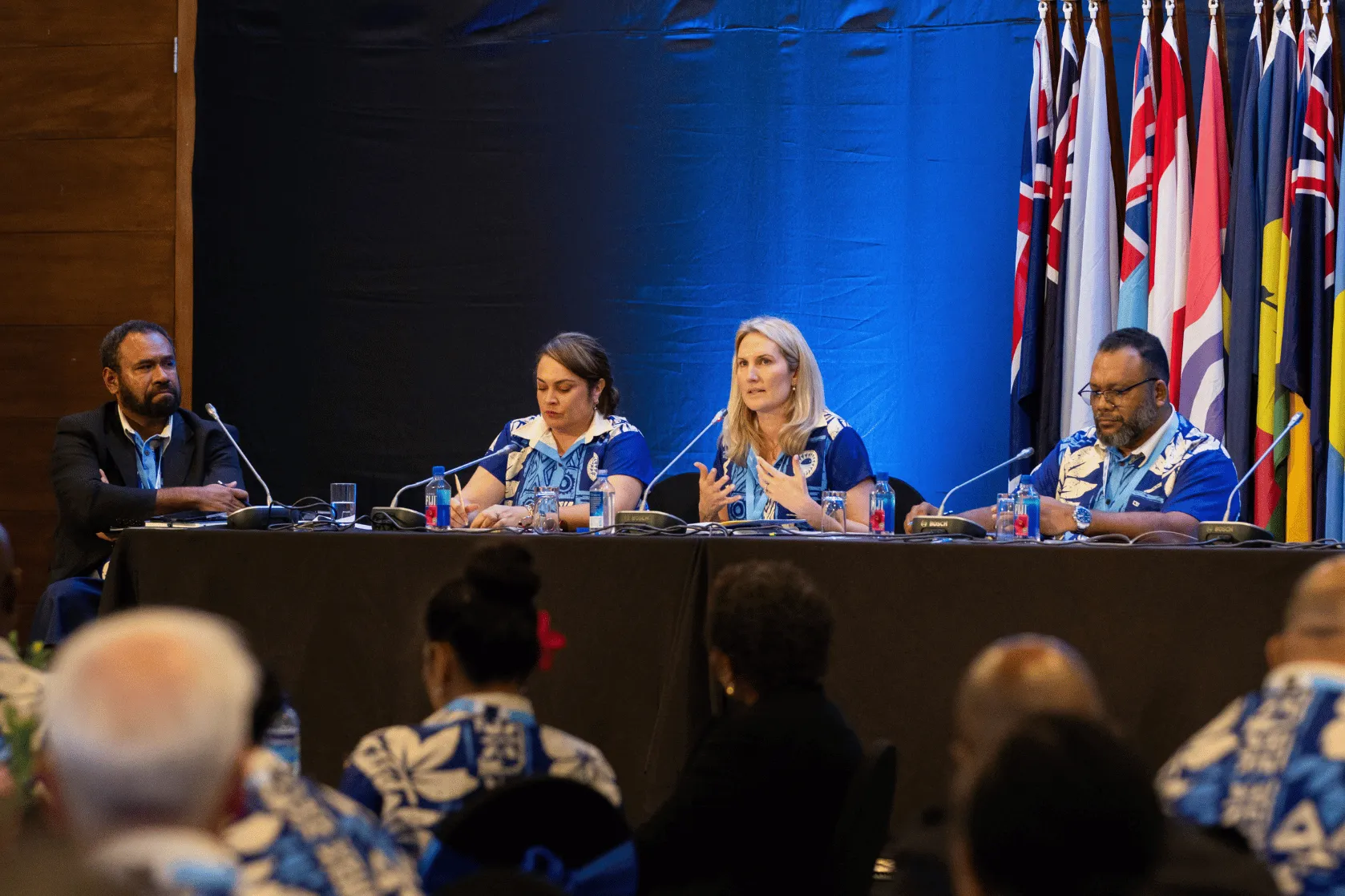
Moderator Romulo Nayacalevu with Kiribati’s Minister for Women, Youth, Sport and Social Affairs, the Honourable Ruth Cross Kwansing; Australia’s Ambassador for Cyber Affairs and Critical Technology, Ambassador Jessica Hunter; and President of the Media Council of Papua New Guinea, Neville Choi. Photo: Pacific Security College
As artificial intelligence (AI) and digital technologies spread rapidly across the Pacific, leaders are warning that the same tools creating new opportunities for youth, education and cultural preservation, also increase the risks of misinformation, online harm and social division.
Speakers on the Society, Peace and Security panel at the 2026 Pacific Peace and Security Dialogue explored the rapidly evolving cyber domain and escalating cybersecurity threats facing the region. The panel featured Kiribati’s Minister for Women, Youth, Sport and Social Affairs, the Honourable Ruth Cross Kwansing; Australia’s Ambassador for Cyber Affairs and Critical Technology, Ambassador Jessica Hunter; and President of the Media Council of Papua New Guinea, Neville Choi.
Minister Cross Kwansing said social media, AI and new technologies were introducing opportunities but also threats to Pacific societies, such as the prevalence of misinformation and the impact on youth mental health.
“The great paradox of what’s happening in the digital world is that what is bringing our best solutions and the greatest advancements of technology is also creating the biggest problems for us,” she said.
“We realise that the threat and the solution are sitting in pretty much the same device.”
Minister Cross Kwansing said a recent campaign led by Miss Kiribati to raise awareness of the prevention of teenage pregnancies was an example of the power of social media.
“In Kiribati, our youth are using social media in very powerful ways, and one of the campaigns that came out recently showed us just how powerful and viral this platform can really be,” she said.
However, she also raised concerns about the dangers that put communities at risk, particularly if users are not required to verify their accounts.
“Without this mandatory verification, it means that you can create a fake account, you can circulate things online that you shouldn’t be circulating, you can be a predator on young children, you can put up scams, and no one will ever catch you, all because you can hide behind a fake profile and a fake email,” Minister Cross Kwansing said.
“It really is a lawless environment when there’s no verification, and with that lawlessness, we see the further pervasive impacts that are reaching our communities and our Pacific communities.”
Sharing experiences from Australia, Ambassador Hunter emphasised the need for governments to mitigate the harms of the digital world on children and youth. She acknowledged the speed at which technology was shifting, and that governments and industry had a responsibility to move at the same pace to protect people.
“I see a shift in scale of connectivity, which brings communities together, brings generations in families together, brings remote villages into a digital world that gives them a digital voice. That scale is impressive and important, but with that I also see the scale of harm shift and change,” she said.
“We’ve seen seven out of 10 children who have received online abuse or have been exposed to material that they should not have been exposed to, often encouraged through AI assistant or AI companions.”
Ambassador Hunter outlined Australia’s approach to online safety – prevention, including building digital literacy; protection; and systemic change – and discussed the social media ban, which restricts access for people under 16 years of age. She said the motivation for the restriction was to make companies responsible for safety standards; to shift the social conversation about youth and social media use; and to ensure young people build digital skills before engaging online.
“Australia did make a very bold leadership decision; the first in the world to undertake a social media age restriction,” Ambassador Hunter said.
“None of our governments want to remove capability from our youth, because we want innovation, we want them to feel connected, we want them to be producers of digital solutions, but we need to help them understand how to engage it in a safe way.”
The panel also explored how ensuring Pacific values guide technological development could help the region navigate the digital age.
Mr Choi discussed the challenges of developing Papua New Guinea’s AI framework, including the lack of an appropriate AI frontier template that can be applied in PNG’s context, given the language and cultural diversity. He said PNG and other countries in the region had an opportunity to build their own technology,
“I would like to think that even though there are frontier AI models that are developed by bigger countries, that we have the knowledge and the technology and the innovation to build our own tools that are rested on Pacific values, that are rested on Pacific culture, and that are rested and supported by Pacific languages,” he said.
“We can’t keep playing by other people’s rules. We need to play by our own rules in the Pacific, and I think truth, information, culture, tradition, honesty, and accountability. Those are values that we still hold true.”