Strengthening trust and cooperation key to addressing regional challenges, leaders stress
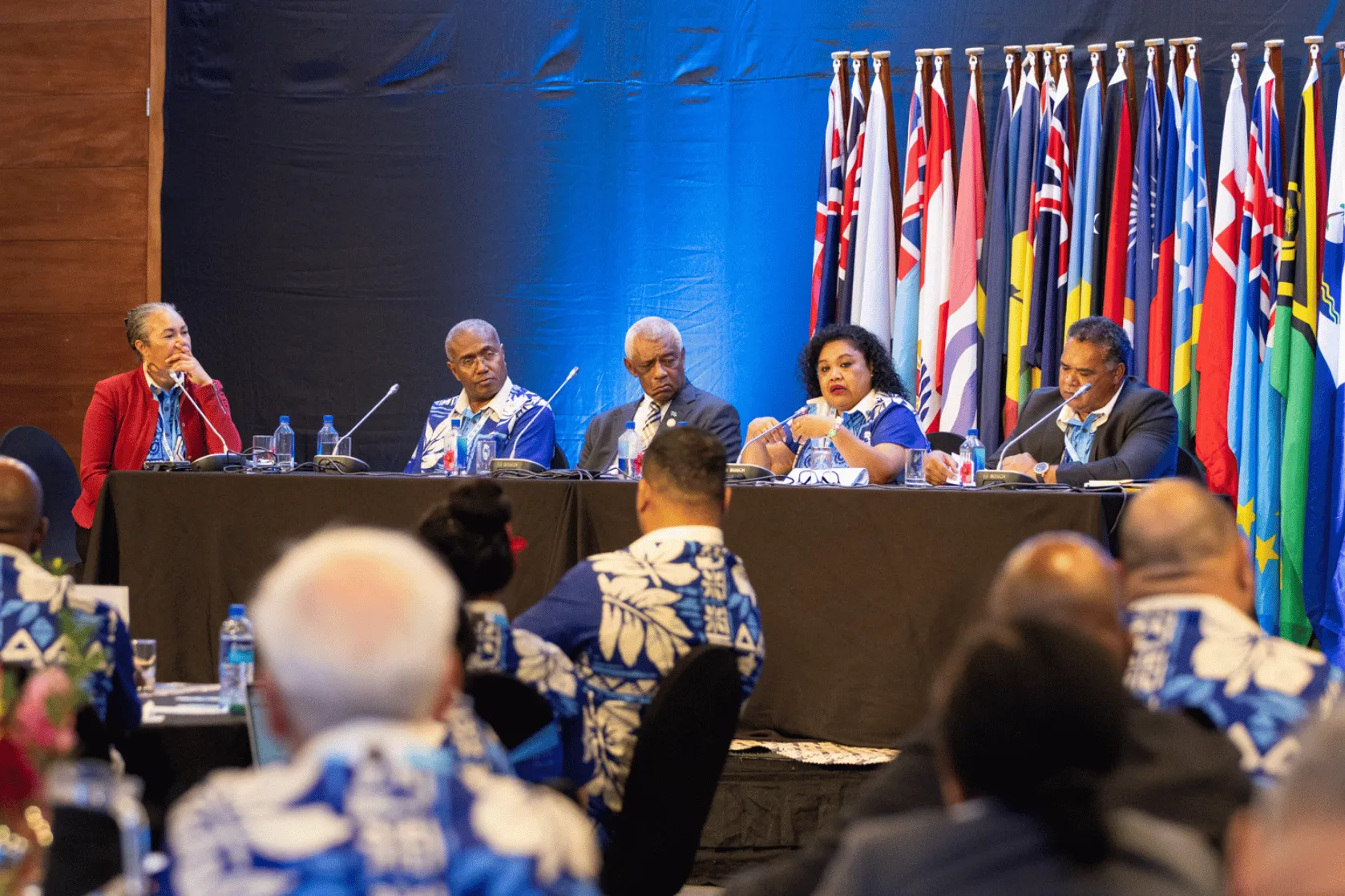
The Leaders on challenges and opportunity panel featuring the Hon Peter Kenilorea Jr, the Hon Pio Tikoduadua, the Hon Jennifer S Olegeriil and the Hon Richie Mautama, moderated by Dr Anna Naupa. Photo: Pacific Security College
A comprehensive approach is needed to address the interconnected challenges facing the region, Pacific political leaders said during the opening panel at the Pacific Peace and Security Dialogue.
Ministers from Fiji, Niue, Palau and Solomon Islands discussed pressing issues such as climate change, transnational crime, and economic vulnerabilities during the Leaders on challenges and opportunity panel on the first day of the Dialogue.
The panel featured the Hon Pio Tikoduadua, Minister for Defence and Veteran Affairs, Fiji; the Hon Peter Kenilorea Jr, Minister for National Planning and Development Coordination, Solomon Islands; the Hon Richie Mautama, Minister for Home Affairs; Minister for Police, Corrections and National Disaster Management, Niue; and the Hon Jennifer S Olegeriil, Minister of Justice, Palau.
The speakers highlighted the importance of youth engagement, public trust and practical implementation of policies, as well as the need to balance national interests with collective regional action.
Minister Mautama raised the broad nature of threats and challenges facing Niue – many of which also impact the entire region, such as extreme weather events and climate change and their effects on entire systems, energy security, and transnational crime, including drug trafficking and cyber threats.
“The biggest challenge is not just one single threat, but rather a combination of issues that together create a profound sense of unease,” he said.
“We are operating in a more uncertain environment, where geopolitical pressures are rising, global systems are under strain, and external shocks are reaching small states faster and with greater impact than ever before. For us, the way we navigate this is to stay anchored in a specific understanding of security, one that is broad, inclusive and centred to our people, our values, and trusting in our own systems.
“The question that keeps me awake at night is whether our systems are robust enough to handle multiple shocks simultaneously, and complex security environments as well.
“For Niue, security is not abstract, it is about everyday safety, wellbeing, and whether our systems are working for our people. So, my immediate focus is on getting the basics right first, community safety, community safety at home.”
Minister Olegeriil stressed the importance of regional cooperation in tackling the issues facing the region, particularly transnational crime and related challenges such as drug trafficking, human trafficking, and online gambling.
“Some things are just bigger than each one of us, and it’ll take all of us talking about strengthening our intel-sharing networks, talking about strengthening our collective border protection efforts and measures, and leveraging partnerships to be able to provide regional funding to be able to address all those other areas that are being impacted,” she said.
“We need to be combating this together as a region, so there’s real value and real importance in the whole concept of a unified response.”
She said Palau was excited to host the upcoming Pacific Islands Forum Leaders’ Meeting later this year and provide an opportunity for talanoa on challenges and the opportunities for regional responses.
“We want to be able to set a setting and environment where the discussions between leaders there are robust…and ensure an agenda that will sufficiently address the many different challenges the Pacific, as individual nations, as well as a region, are facing.”
Reflecting on the Solomon Islands government’s approach to security, Minister Kenilorea Jr said that security and development must be viewed as “two sides of the same coin”, and raised the connection between national and regional security.
“We have learned that it’s so important for us to ensure that our security is one that ensures our own sovereign understanding of it, but at the same time we also understand the regional implications of what happens in a country,” he said.
“In a world that is quite in a bit of turmoil at the moment globally, I think it falls back to us in the region that we need to be stronger, we need to stand together, and we need to say who we are much more louder and clearly in terms of a myriad of issues.”
Minister Kenilorea Jr acknowledged the young population of Solomon Islands and the challenge of youth unemployment.
“What is their future going to be like in five years’ time, 10 years’ time? What will be the opportunities that we can create for them?
“It’s so important for us not to forget that the human resource is really our asset. Some of us in the Solomons, perhaps, like to think that we have the logging and the gold, and that is important too. But I think the human asset part of it is something that we need to really look after carefully, because as we have seen in the Solomons, it can also explode if we don’t look after that.”
In discussing opportunities for stronger youth engagement in the region, Minister Tikoduadua said it was important to make sure the voices of young people were heard.
“I know in Fiji the youth are very vocal, politically, socially, economically, and it is something that really needs to be encouraged, because essentially what you’re trying to do is to build confidence in the next generation. We’re trying to leave the Pacific in good hands.”
The panel also discussed the importance of public trust and the rule of law in supporting solutions and action to address security issues.
Minister Tikoduadua said Fiji had experienced trust issues across its government and some of its national security and defence initiatives.
“We can have police sources, you can have the military, you can have a good judiciary, you can have all the right technology, but what about the people? Do they trust us to look after them, and if they feel that the system is weak, that adds to our problem,” he said.
“One of the things that I’m always concerned about is respect for the rule of law; that the government and its institutions that look after security must always act within the law and must always follow the law first when they are instituting the law.
“Trust is important. If we have everything and our own people do not trust us in our own countries, then really it’s a bit of a useless exercise.”
Minister Olegeriil said public trust was critical to both individual efforts, and collective law enforcement and security responses.
“The work that we do is only as good as how the community perceives the integrity of our actions and our decisions.”