What the Pacific Pre-COP did and did not deliver


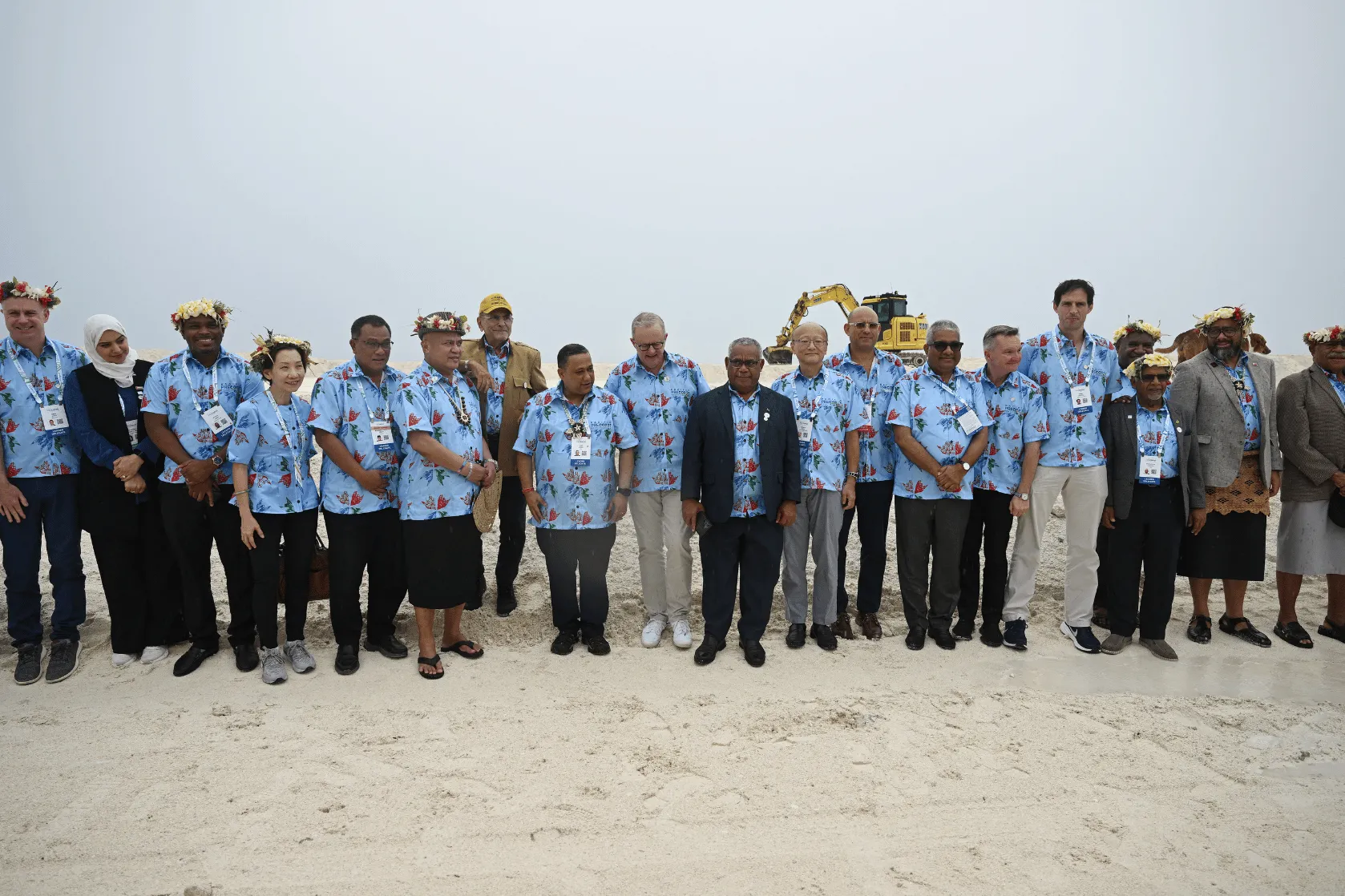
Leaders visit a land reclamation site in Funafuti, Tuvalu during the PreCOP-31 Summit. Photo: Saeed Khan/Pool/AFP
The Pacific Pre-COP delivered some key policy wins ahead of next month’s climate negotiations in Türkiye, and there are further opportunities to shape the region’s climate response, write Dr Akka Rimon and Dr Hugo Temby.
Now the dust has begun to settle on last week’s Pre-COP meetings in Fiji and Tuvalu, it’s clear some important questions have gone unasked in much media coverage. In particular, what were the achievements? And what remains unresolved?
Hosting major climate talks involving thousands of attendees over two Pacific Island Countries, four days, and at least one rain event, was never going to be smooth sailing.
Indeed, media headlines like “pre-COP flop” castigated organisers, especially Australia, for failing to attract “more than two world leaders”.
Palau President and current Pacific Islands Forum Chair Surangel Whipps Jr acknowledged the commentary during an address at the Australian National University this week.
“It is true that some of the world’s largest industrialised nations and its largest emitters and polluters were not present at this Pre-COP, but the big ocean states were,” he said.
“The nations stewarding planetary systems fundamental to our collective future were there, and more importantly, we came organised, we came prepared, and we came with solutions.”
Glossing over the 12 Pacific leaders and scores of senior ministers from further afield who did attend also trivialises the Pre-COP’s policy outcomes.
The event’s forward-leaning Taku Pakasoa Declaration, meaning ‘strength in unity’ in Tuvaluan, demands urgent action to protect the Paris Agreement’s 1.5°C goal — vital to Pacific survival — through a “just, orderly and equitable” transition away from fossil fuels, informed by the “best available” climate science.
The language on fossil fuels is notable given the subject was omitted from the declaration from COP30 in Belém.
To assist Pacific countries to mitigate and adapt to climate change, the declaration also calls for substantially more climate finance, reforms to the climate finance architecture, and contributions to the recently established Pacific Resilience Facility, a Pacific-owned climate fund that will focus on local climate responses.
Leaders also stressed that oceans and climate change are interconnected and require a holistic policy response. As custodians of the world’s largest and deepest ocean, leaders reinforced the critical role of the ocean in regulating the climate system, and the commitment to ensuring its protection as an integral part of the Blue Continent’s livelihood, economy and identity.
Several more practical initiatives were also announced, including new Australian funding for the Pacific’s renewable energy transition and the Global Rooftop Solar Pledge, which aims for 300 million rooftop solar systems worldwide by 2030.
But the Pacific Pre-COP was never just about the policy, or even the politics.
The overriding aim of the joint organisers was to “bring the world to the Pacific” and, in so doing, highlight the region’s urgent climate challenges and local climate solutions for a global audience.
For Tuvalu’s Minister for Climate Change and the Environment, Dr Maina Vakafua Talia, the hope was to “bring global decision-makers to the frontlines of climate change and … show both the impacts we face and the practical work under way to protect our communities”.
Weighed against these more existential aims, the easy narratives of Australian overreach begin to look trite.
Certainly, Pacific leaders framed the gathering as a moral achievement. The co-hosts themselves were clear on this point, with Fijian climate minister Lynda Tabuya noting:
“We’re very proud of what we have achieved this week. So many of these achievements are rooted in Indigenous knowledge, traditions of our custodianship working together with climate science.
“But,” she added, “Our work is not done. We have set the stage to COP31, but now we look ahead to Türkiye.”
Yet despite the Pre-COP’s political and policy wins, and the welcome effort to help set a progressive agenda for Türkiye, some urgent climate policy concerns featured less prominently than they could have.
Notably, there appears to have been limited consideration of the implications of the International Court of Justice’s Advisory Opinion on climate change — arguably the most consequential legal development for the Pacific’s climate justice agenda in a decade.
The opinion, which originated in a Pacific classroom and advanced through the leadership of Vanuatu and the support of other Pacific nations before culminating in its adoption by the United Nations General Assembly, has yet to be meaningfully integrated into the COP process or Pacific regional governance frameworks. It was a benchmark that deserved meaningful consideration in the Pacific Pre-COP.
This development is particularly significant given the substantial efforts under way to advance the implementation, financing and integration of the Pacific Framework for Climate Mobility, led by Pacific peoples and grounded in their wisdom, culture, and lived realities.
By affirming that all states bear an obligation to prevent climate change-related harm, the opinion contributes a vital legal foundation linking climate mobility, loss and damage, and state responsibility to international climate action, while also advancing broader principles of climate justice including questions of statehood, sovereignty, and the protection of climate exposed communities.
Against this backdrop, the opinion’s normative and operational implications could reinforce efforts to advance issues of paramount importance to the Pacific through its COP priorities, thereby strengthening global political commitment and climate action.
Another angle that went underexplored in much media coverage of the meeting was the question of Australia’s significant fossil fuel exports.
In the days before the meeting, the NSW Independent Planning Commission announced it had approved the continuation and expansion of the massive Hunter Valley Operations project, one of the largest coal expansions in NSW history.
Yet Pacific ministers have been clear about their expectations regarding Australia’s conflicting industrial and climate policy goals.
Scrutiny of Australia’s climate record will only increase as the country assumes its role of president of the COP31 negotiations. Within the decade, Australian fossil fuels also face declining demand from Australia’s Paris-aligned trading partners.
The final aspect of the meeting that warranted more attention is the importance — and difficulty — of delivery.
Energy is a case in point. The Pacific leads the world in its renewable energy ambition, which is increasingly understood as a driver for Pacific energy sovereignty. Yet the effective delivery (and ongoing reliability) of cleaner, cheaper energy technologies needs an equitable and inclusive approach.
As always, the challenge — for Pacific governments, businesses, and communities — is to translate the climate policies made in Nadi, Antalya and elsewhere into concrete actions that build Pacific peoples’ dignity, security and prosperity.
Dr Akka Rimon is a Research and Engagement Fellow at the Pacific Security College.
Dr Hugo Temby is a Research Fellow at the Pacific Security College.
Correction: An earlier version of this article incorrectly stated the number of Pacific leaders in attendance at Pre-COP. Twelve Pacific leaders were present.
Views expressed via the Pacific Wayfinder blog are not necessarily those of the Pacific Security College. Read our publishing policy.