New paper proposes turning the Ocean of Peace Declaration into a regional treaty
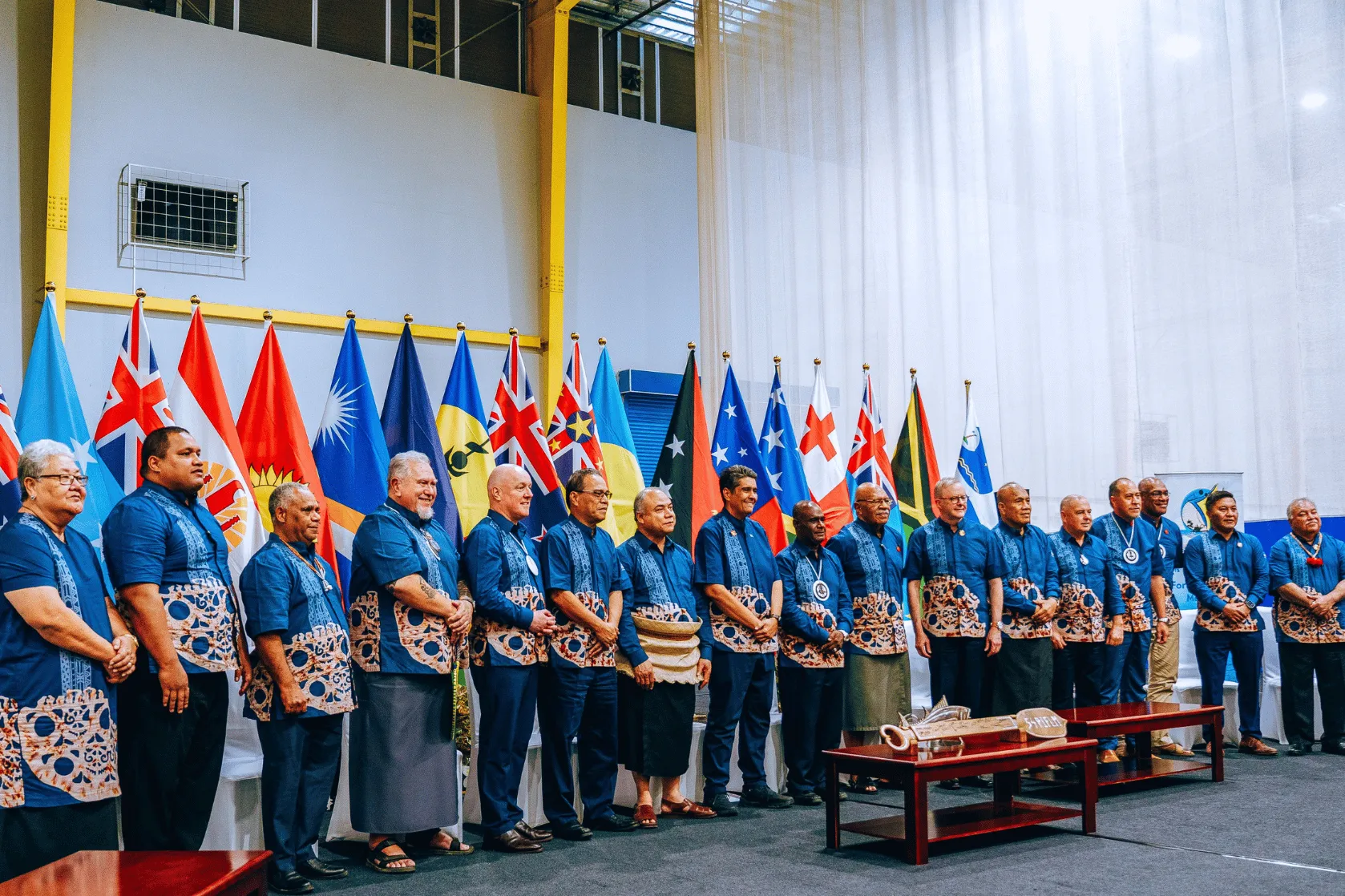
Leaders at the Ocean of Peace Commemorative Ceremony at the 54th Pacific Islands Forum Leaders’ Meeting in Honiara, Solomon Islands. Photo: Pacific Security College
Evolving the Blue Pacific Ocean of Peace Declaration into a regional peace and security treaty could provide predictability in a period of increasing geostrategic competition, a new policy paper published by the Pacific Security College suggests.
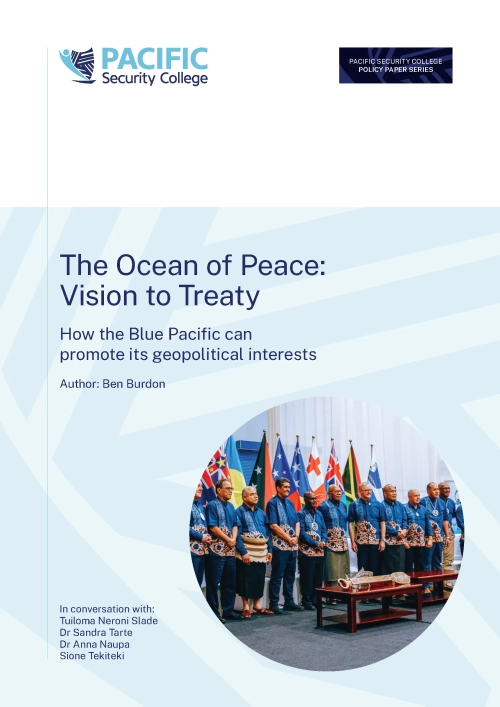
The Ocean of Peace: Vision to Treaty weighs the benefits and risks of turning the Ocean of Peace Declaration, endorsed by Pacific leaders in 2025, into a legally binding agreement. The paper proposes negotiating a new regional peace and security treaty as a Protocol to the Treaty of Rarotonga.
Author Ben Burdon said that, amid growing geopolitical tensions, it was useful to reflect on how the Pacific could maximise its agency and authority in its own interests.
“The Pacific’s strategic vision is made clear in the Blue Pacific Ocean of Peace Declaration,” Mr Burdon said.
“Embedding the Ocean of Peace and Pacific values and norms into international law and practice, as has been done with nuclear weapons, fishing and climate change, is a potential next step.
“Negotiating a new treaty as a protocol to Rarotonga would turn a respected nuclear-free zone into a legally binding regional peace and security system – one built and owned by the Pacific.”
The protocol proposed in the paper – dubbed ‘Rarotonga II’ – includes principles such as establishing the Pacific as a Zone of Peace, recognising climate security as a peace obligation, and providing a mechanism for external partners to formally commit to Pacific peace and security law and practice.
“Rarotonga II would introduce prior consultation, transparency and collective discussion. It would reduce surprise and mistrust between Pacific countries and external powers, while strengthening regionalism,” Mr Burdon said.
In 2027, China is expected to acquire the capability to retake Taiwan militarily. While capacity does not equate intent, Mr Burdon’s paper notes that the Pacific’s strategic geography would be critical for military access and denial.
“While a regional peace and security treaty is not without risk, the strategic guardrails set out in such an agreement could help the Pacific manage the difficult geopolitical environment ahead,” Mr Burdon said.
Professor Dave Peebles, Director of the Pacific Security College, said the paper’s publication comes at a time of growing uncertainty across the region.
“The Pacific’s capacity to come together in pursuit of common goals remains one of its greatest strengths – and one that carries particular weight in an increasingly contested strategic environment,” Professor Peebles said.
“The proposal will undoubtedly generate both support and critique. That’s its value, when the topic is so important and the stakes are so high.
“Policy papers published by the College are designed to prompt careful reflection and constructive debate, and to create space for diverse perspectives on the region’s most pressing issues.”
The Ocean of Peace: Vision to Treaty includes insights from four regional experts with backgrounds spanning international law, diplomacy, politics, academia and governance: Tuiloma Neroni Slade, Dr Sandra Tarte, Dr Anna Naupa and Sione Tekiteki.
Tuiloma, former Secretary General of the Pacific Islands Forum, observed that Mr Burdon’s account of the sensitivities involved in developing a new protocol to the Treaty of Rarotonga was both realistic and perceptive.
“I broadly agree with his assessment of both the possible benefits and the attendant risks, particularly the danger of destabilising existing security relationships, fragmenting Pacific unity, and inviting geopolitical backlash,” he said.
Tuiloma acknowledged the challenges of making and revising treaties and suggested that rather than reopening the Treaty of Rarotonga, it could be more practical to strengthen implementation of the existing text.
“The Pacific is strongest when it acts collectively. Whatever form the next steps for the Ocean of Peace may take, they will need to be guided by unity and deepened regionalism.”
Dr Tarte, from the University of the South Pacific, recognised the clear pathway set out by the paper for codifying key principles of the Ocean of Peace, while bolstering the key role the Treaty of Rarotonga plays in the Pacific’s security architecture.
“It significantly advances thinking around how to manage inter-state tensions and external engagement, thereby promoting greater transparency in security matters and reaffirming the rules-based order,” Dr Tarte said.
Dr Tarte acknowledged that the Ocean of Peace Declaration has provided a pivotal platform for advocating Pacific priorities on the global stage.
“It is time to take the next step and, as this discussion paper explores, to ‘turn vision into law’,” Dr Tarte said.
Dr Naupa, from the Pacific Security College, welcomed Mr Burdon’s pragmatism in leveraging the 40-year-old Treaty of Rarotonga and his consideration of what Pacific deterrence options look like in today’s world.
She emphasised the importance of inclusive consultation and grassroots-driven processes in any future regional peace and security decisions.
“State-led security strategies must be Pacific peoples-centred and address historical legacies,” Dr Naupa said.
“Designing a regional deterrence model needs to consider how these long-standing elements of Pacific regional policy would be integrated into the preventative diplomacy model proposed by Burdon.”
Mr Tekiteki, from the Auckland University of Technology Law School, said an Ocean of Peace protocol would be an attempt to institutionalise and safeguard Pacific agency.
“The idea of an Ocean of Peace treaty framed as a protocol to the Treaty of Rarotonga is compelling, particularly in its attempt to move the Pacific beyond the largely normative framing of the Blue Pacific Continent towards something more concrete and grounded in legal order,” he said.
“Deeper regional security coordination may strengthen solidarity and collectively position the region against intensifying geopolitical competition.”
About the Pacific Security College policy paper series
The Pacific Security College’s policy paper series aims to contribute a diversity of views and ideas to regional conversations about the journey to 2050. The views expressed in the Pacific Security College policy papers are those of the authors alone and do not necessarily reflect the official positions of the College.