Fiji’s Online Safety Act and the risks to journalism
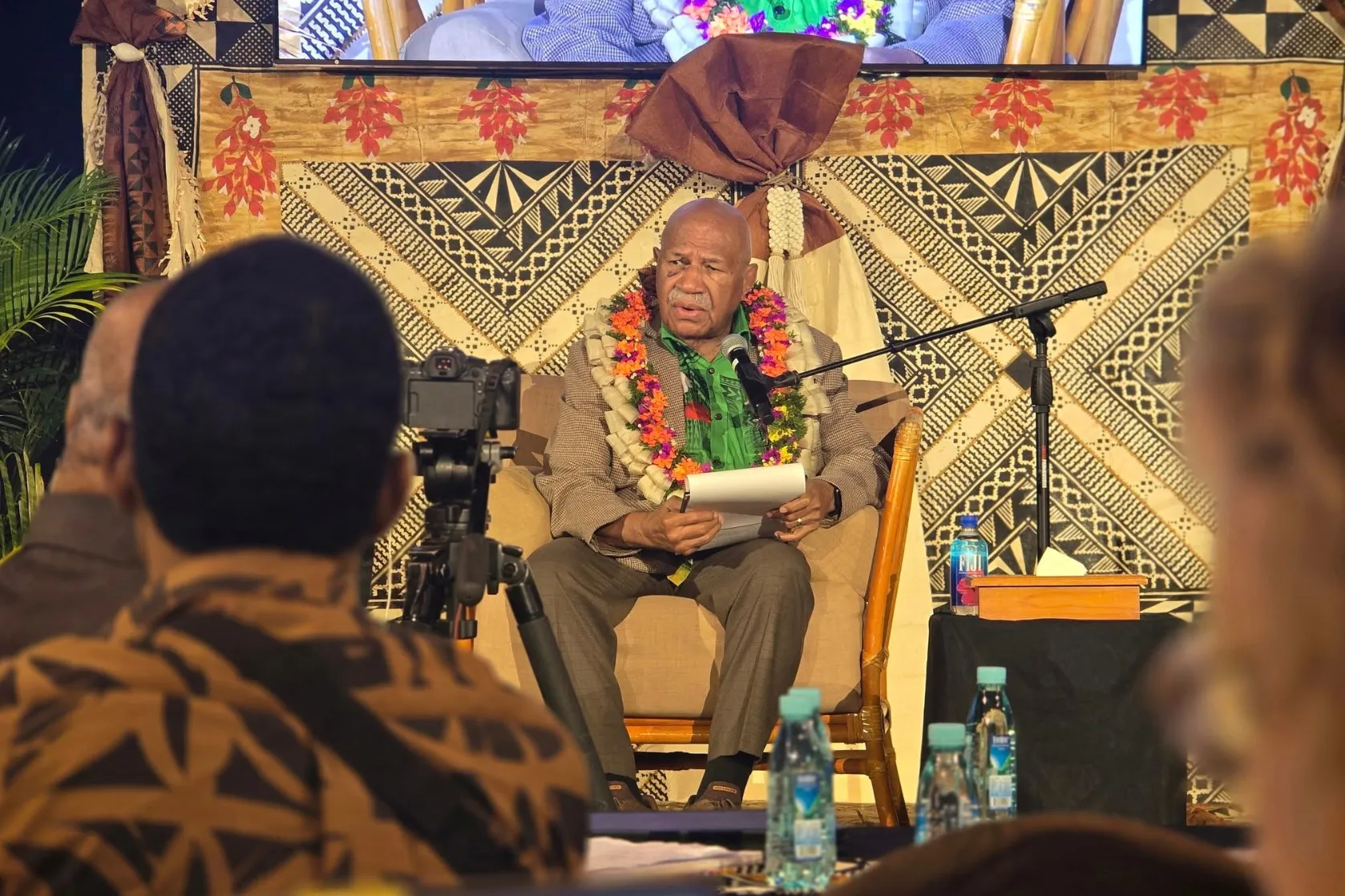
Fiji Prime Minister Sitiveni Rabuka speaks at the Pacific Media Summit held in Savusavu, Fiji, in September. Photo: PINA PACNEWS
Fiji’s Online Safety Act raises important questions for journalism, but also freedom of expression more broadly. The current review of the Act presents an opportunity to better safeguard the media’s democratic role, writes Associate Professor Shailendra Singh.
In his address at last month’s Pacific Media Summit, Prime Minister Sitiveni Rabuka highlighted his government’s repeal of Fiji’s Media Industry Development Act 2010, saying that it was in the interest of democracy.
While the Rabuka Government has been rightly recognised for scrapping that Act in 2023, another piece of legislation with potential significant implications for journalism remains in force: the Online Safety Act 2018.
Like the Media Act, the Online Safety Act was enacted under the FijiFirst Government and gives the state a role in regulating expression.
The Online Safety Act was tabled in Parliament in 2018 in response to escalating social media abuse, but was controversial from the outset, especially the breadth of its provisions.
The backlash was such that the entire opposition voted against it, arguing that it undermined democracy. Rights groups were similarly alarmed, describing the Act as a “Trojan horse” for censorship.
However, because much of the attention focused on the draconian Media Act, and relatively few people were being charged under the Online Safety Act, the latter escaped sustained scrutiny.
That changed in 2025, as the unabated abuse of digital platforms and a spate of charges laid under Section 24 of the Act, which criminalises the posting of electronic communication that causes harm, brought it back into the spotlight.
Currently, the Act is under review and Information Minister Lynda Tabuya, under whose ministry the Act falls, has told Parliament to expect stronger legislation by the end of this year.
To some extent, Tabuya’s call for tougher laws is understandable. The misuse of social media platforms is a global problem, but the threat is considered greater in fragile democracies with multiethnic societies, such as Fiji.
The Online Safety Commission received 1,609 complaints in 2025 alone, with more than 50% involving cyberbullying, harassment and defamation.
More broadly, policymakers have warned that online misconduct poses a serious national security threat.
In March 2026, Tabuya flagged the increased prevalence of misinformation and disinformation, stating, “A single lie can divide a nation”. Likewise, Fiji’s National Security Strategy 2025-2029 warned the malicious use of emerging technologies for misinformation and disinformation posed a threat and could “undermine the credibility of national leaders and erode public trust in governance structures”.
Even before the proliferation of social networking platforms, there were concerns in Fiji about the mainstream media’s alleged role in fomenting societal conflict, with some analysis even suggesting that the media acted as a catalyst in the 2000 and 2006 coups.
The increase in digital penetration has added a new dimension to these security challenges.
Young people particularly, the most avid consumers of online networks, risk exposure to disparaging and damaging online discourses, including racism and hate speech.
While these trends are serious and require a firm response, they do not negate legitimate concerns about the flaws in the Online Safety Act.
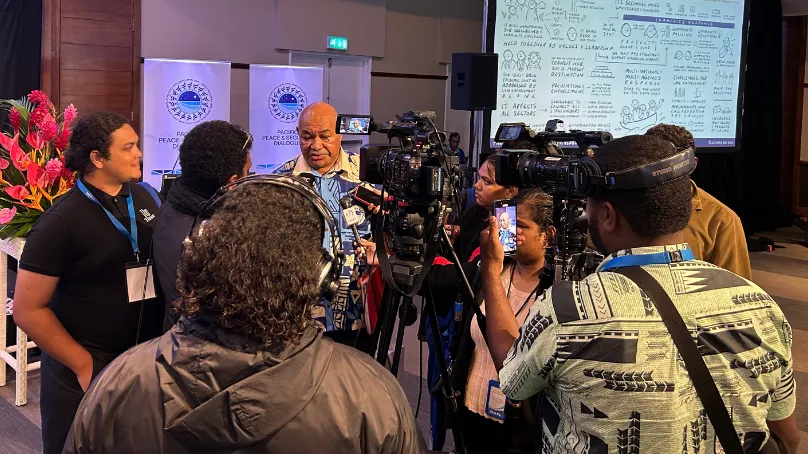
Local journalists conduct an interview at the Pacific Peace and Security Dialogue in Suva in June. Photo: Pacific Security College
Implications for media and press freedom
While the aim of the Act is not specifically to regulate media — Section 4 stipulates the law applies to the “whole of Fiji” — media are, nonetheless, caught in its crossfire.
The Act contains no protections for the practice of journalism. Professional journalists using social media platforms in the public interest are lumped with ordinary citizens who may be using them with malicious intent.
This renders journalists and media organisations particularly vulnerable to the Act due to the broad provisions of “electronic communication” that causes “harm” (defined in the Act as “serious emotional distress”), as most of their work is published online and can require critiquing the actions of private individuals and public officials.
The Act also does not differentiate between public and private individuals. In general, public figures such as politicians enjoy a lower level of privacy compared to private citizens. The scrutiny can extend to their private lives should they overlap with, or endanger the fulfillment of, their public duties. Under the Online Safety Act, media could be held culpable if their reporting causes individuals “serious emotional distress”, which could be a consequence of, for example, news coverage of actual or alleged wrongdoing.
Then there’s Section 2’s treatment of electronic communication as “any information, whether truthful or untruthful…”. This suggests journalists publishing legitimate and verified information in the course of their professional duties could face the same criminal liability as bad actors posting untruthful content with malicious intent.
Section 6 raises concerns about the independence of the Online Safety Commission, including the Ministerial-appointed Commissioner, which introduces the risk of a political appointment.
Indeed, the appointment of Anne Dunn as the first Commissioner by the then Communications Minister Aiyaz Sayed-Khaiyum was controversial for this very reason. Dunn contested Fiji’s 2018 election under Sayed-Khaiyum’s FijiFirst Party.
The potential conflict of interest could render the Commission vulnerable to political pressure, and have consequences for the Commissioner’s role as an independent and unbiased authority.
The Act does outline seven factors the courts may use to determine whether an offence has occurred, including: the extremity of the content; the age and characteristics of the victim; whether the posting was anonymous; the repetitiveness and extent of circulation; and its truth or falsity, along with the context in which it appeared.
However, it does not provide specific defences based on public interest, truth, reasonable error, or the absence of malice.
An opportunity for reform
The fact that no journalist or media organisation has been charged under the Act in the eight years since its inception is of little consolation. No journalist or media organisation was charged under the now-repealed Media Act, but we are all aware of that legislation’s deleterious effect on the media sector as a deterrent to robust journalism and a catalyst for self-censorship.
Some criticisms of the Online Safety Act — including its open-ended provisions, the Minister’s role in appointing the Commissioner, and the potentially chilling effect on freedom of expression — are uncannily similar to those expressed about the Media Act.
Against this backdrop, Rabuka’s remarks at the Pacific Media Summit are pertinent. The Prime Minister emphasised that the media are “not a threat to democracy” but a “part of” it.
The reviewers of the Online Safety Act would do well to heed his words, as well as those of Rabuka’s Deputy, Manoa Kamikamica, at the same event. Kamikamica stated that while this government was committed to media freedom, there was no guarantee future governments would share the same mindset.
In other words, the weaponisation of the Online Safety Act might not be a present danger, but it cannot be ruled out as a future one.
Associate Professor Shailendra Singh is the Head of Journalism at the University of the South Pacific. His views are his own and do not necessarily reflect the views of his employer.
Views expressed via the Pacific Wayfinder blog are not necessarily those of the Pacific Security College. Read our publishing policy.