How El Niño can deepen existing security challenges in the Pacific


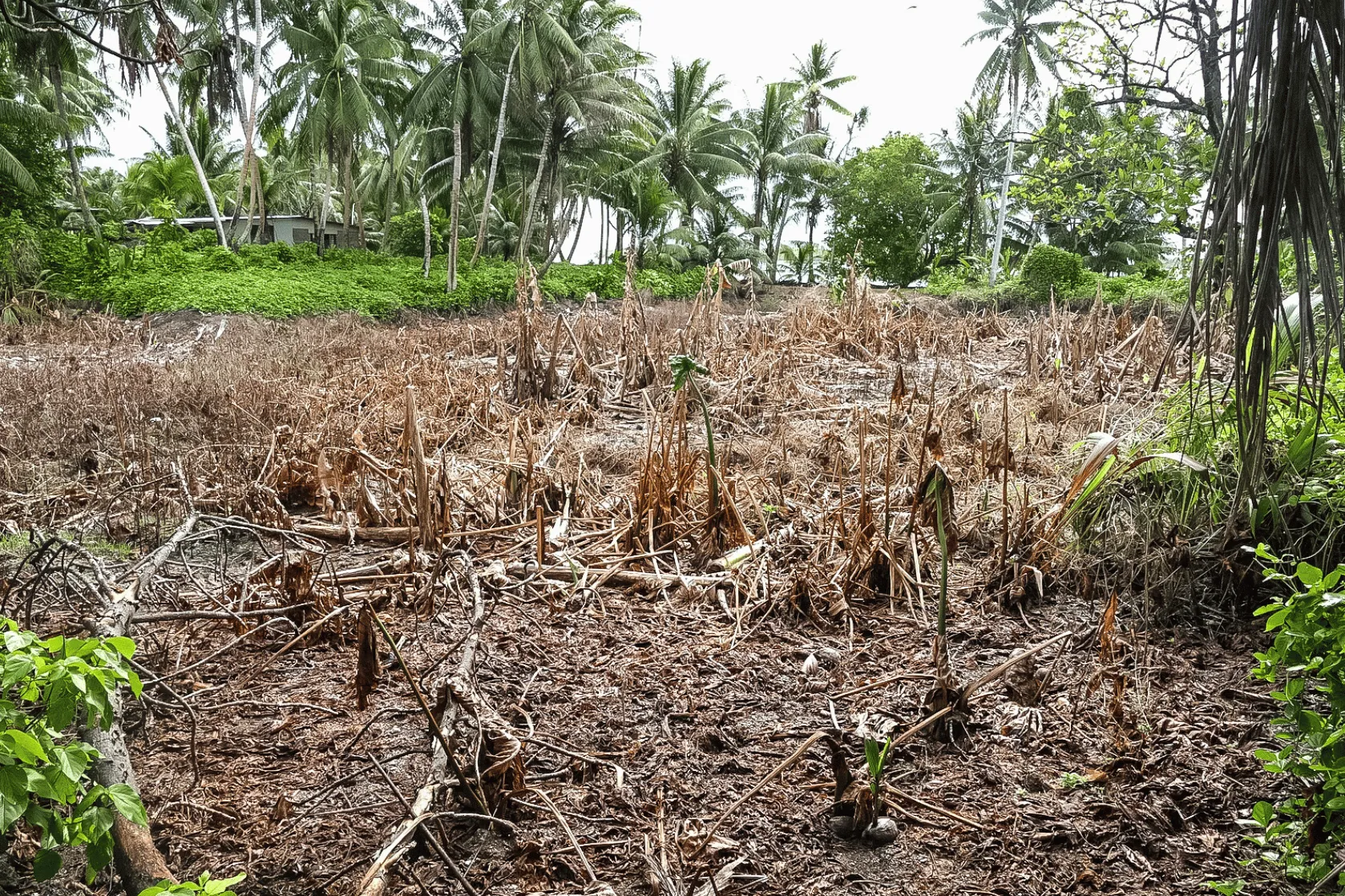
Cyclone Pam compounded the impacts already being felt from the 2015-16 El Niño. On Tuvalu’s Nui Island, crops were destroyed by salt water. Photo: United Nations Development Programme/Flickr (CC BY-NC-ND 2.0)
Like climate change more broadly, El Niño phenomena rarely act as direct sources of insecurity. Instead, they interact with existing economic, social and governance pressures, amplifying pre-existing vulnerabilities, write Jamie Tarawa and Will Carter.
As the world and Pacific brace for an expected “very strong” El Niño, the region faces challenges. The likelihood of significant climate disruption is increasingly clear, yet it remains difficult to predict where the most severe impacts will be felt.
The lessons from recent events caution that there is no single Pacific experience of El Niño, and that the region should expect a shifting geography of risk as human security, essential services and state capacity come under pressure.
What can be learned from past El Niño-induced climate insecurity?
The El Niño in 2015-16 followed a recognisable Pacific pattern. Papua New Guinea experienced drought, frost and crop losses, with an estimated two million people affected by critical food and water shortages. Conditions in Vanuatu worsened pressures on food gardens and water systems. Fiji, Samoa, Tonga and FSM also experienced drought, while the Marshall Islands declared an emergency. Water rationing, saline groundwater, sanitation risks, food-price pressure and costly relief followed across the region.
Yet even this ‘classic’ El Niño event, which typically leads to warming oceans in the eastern equatorial Pacific, was not uniform. Sea levels fell across much of Micronesia, exposing reefs and adding to bleaching stress, while the central Pacific experienced higher seas, inundation and erosion.
Cyclones Pam in Vanuatu, Winston in Fiji and Maysak in FSM compounded losses during the same El Niño-related impacts, illustrating how these hazards can interact and accumulate. These cyclones added to existing demands on communities, infrastructure and public services.
The 2023-24 event reinforced just how difficult El Niño impacts can be to anticipate.
Despite being a strong oceanic event, its atmospheric expression was unusual.
Some countries were in drought, while others experienced flooding and excess rainfall. Kiribati, for example, recorded above-normal rainfall, while other parts of the same region faced water shortages. More than 21,000 people needed urgent water and food assistance as a result of drought in Pohnpei, Yap and Chuuk. And in the Marshall Islands, more than 5,200 people across 15 atolls or islands were affected when storm surges flooded northern islands.
What do previous El Niño events tell us?
The first lesson is that El Niño redistributes security pressure and creates a shifting, uneven geography of risk. The experiences of the 2015-16 and 2023-24 events suggest there is no single Pacific experience of El Niño. A stronger El Niño increases the likelihood of significant climate anomalies but does not specify their location or character. General preparedness and adaptive management are important.
Secondly, important security risks lie in how pressures cascade and interact between systems. A drought may begin as a water problem, but quickly become an energy, food or fiscal challenge. Empty tanks force desalination; desalination needs power and maintenance; power needs fuel; fuel must arrive through distant ports; and high operating costs compete with health and education budgets. Crop losses increase reliance on imported foods.
Yet these cascading pressures do not have uniform consequences. Their significance depends on the conditions already in play, including economic pressures, existing inequity, political dynamics, social cohesion and the legacies of previous shocks.
A third lesson is the way in which climate impacts and security pressures can surface on different timelines. By the time an El Niño has officially weakened, some of its most consequential impacts may only be beginning to emerge. The impact of agricultural losses may later be felt as pressure on household income and food prices. Fiscal costs also accumulate as governments subsidise utilities, import supplies, support affected communities and defer other spending.
The official end of an El Niño can come before the most difficult period for households, ministries and national budgets.
A more complicated 2026-27 map
The United States’ National Oceanic and Atmospheric Administration puts the chance of a strong El Niño emerging later this year and persisting into early 2027 at 90 per cent. What is less certain is where the impacts will be felt hardest in the Pacific, and how these will interact with the current strategic context.
The Pacific enters this period against a backdrop of geopolitical uncertainty, rising costs and constrained public finances. Recent disruptions due to the Strait of Hormuz, for example, offer a reminder of how quickly events far afield can create localised pressures.
Some parts of the region are still recovering from previous shocks. In Solomon Islands, communities and government agencies are grappling to manage recovery needs associated with Cyclone Maila. Acute water and food security challenges persist, with many internally displaced, and the broader economy is vulnerable to higher fuel costs and future climate shocks.
The political calendar also raises the stakes. Citizens of Fiji, FSM and Papua New Guinea will head to the ballot box over the next 12 months. Disruptions to transport, power, water or service delivery may place additional pressure on institutions already managing politically sensitive periods, and where public confidence and government responsiveness are of utmost salience. Evidence suggests that hazards can disrupt campaigning, voter access, polling and counting.
If previous El Niño events taught us that risk emerges unevenly and cascades across interconnected systems, the lesson for 2026-27 may be that risks are also increasingly likely to converge.
Where do these lessons leave us?
If climate shocks increasingly interact with food systems, livelihoods, energy security, fiscal pressures, politics and social cohesion, as the forthcoming El Niño may well demonstrate, then investments designed to build resilience should account for, and aim to prevent, these intersecting impacts.
The Pacific Resilience Facility (PRF) presents an opportunity to think and act beyond traditional models of disaster preparedness and recovery.
Pre-COP31 in Fiji and Tuvalu, and the launch and capitalisation of the PRF, coincide with this live stress test. The opportunity and challenge for Pacific leaders, among many demands, is whether national systems can act on uncertain but actionable forecasts, and whether regional institutions can support different emergencies simultaneously.
A serious security posture could track where pressure is accumulating, identify dependencies and vulnerabilities through which disruption might cascade across sectors, and recognise that climate hazards and security pressures often operate on different timelines, requiring support long after the initial shock has passed.
The impending El Niño will not be the last. Opportunity lies in ensuring the Pacific emerges better prepared for a future in which climate-related security risks are becoming more frequent, complex and consequential.
Jamie Tarawa is the UNDP Climate Security Advisor to the Pacific Islands Forum Secretariat, seconded via the UN Climate Security Mechanism.
Will Carter is a climate adaptation and aid worker with more than 16 years of experience in both fragile and climate-vulnerable settings.
Views expressed via the Pacific Wayfinder blog are not necessarily those of the Pacific Security College. Read our publishing policy.
- Themes:
- Climate change