Security, climate and regional architecture top PIFLM agenda, but economic development must stay in focus

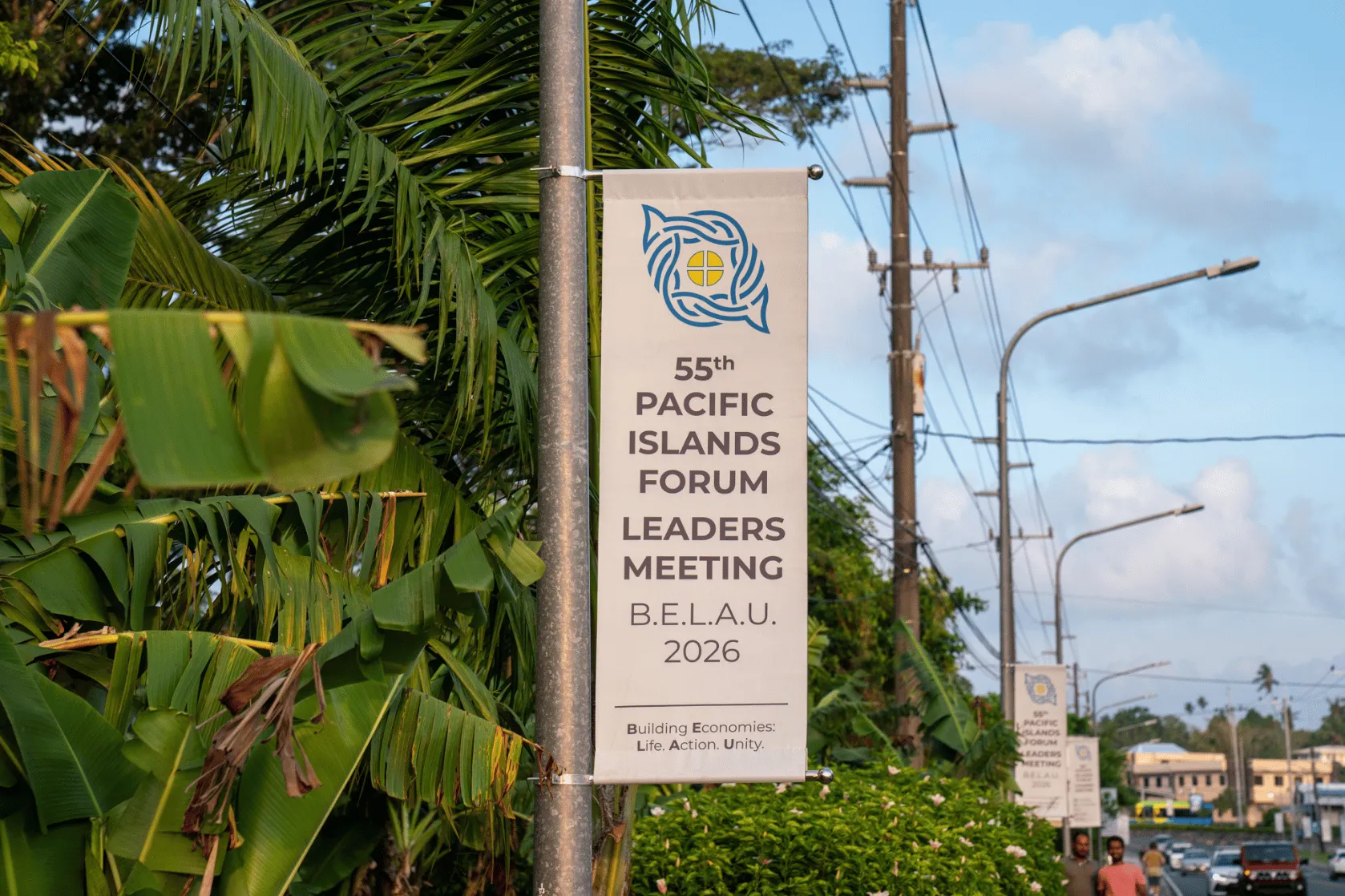
Pacific Leaders are meeting in Palau this week for the 55th Pacific Islands Forum Leaders’ Meeting. Photo: Pacific Security College
As Pacific Leaders gather amid growing regional security challenges, attention will inevitably focus on geopolitics, climate change, and regional architecture. Yet a secure and resilient Pacific also depends on sustained economic development, write Joel Nilon and Viliame Bovoro.
The 55th Pacific Islands Forum Leaders’ Meeting takes place in Palau this week, at a time when the region has been hampered by a fuel crisis, increased transnational crime, ongoing climate change impacts, a developing El Niño system, and a Chinese missile test that has once again put pressure on regional unity.
It also appears the Leaders of Kiribati, Fiji, Samoa, New Caledonia and Vanuatu will not attend this year’s gathering, while Solomon Islands Prime Minister Matthew Wale arrived in Palau earlier in the week, but promptly returned home to deal with a looming motion of no confidence.
These absences have inevitably generated speculation about geopolitical influence, particularly amid heightened China-Taiwan tensions, although the governments concerned have provided explanations as to their leaders’ absences.
Against this backdrop, Leaders will preside over a packed agenda, with the regional architecture, security and climate change likely to command much of the focus.
Yet while there will be significant political and media attention on these issues this week, there is a need for leaders to ensure that their own focus and energy extend to other no less important but perhaps less prominent issues – particularly economic development.
With that said, what is in store for the week ahead?
Regional architecture
As per the past four Forum meetings, Leaders appear set to consider the ongoing and protracted Review of Regional Architecture, which at its essence is designed to ensure the Pacific’s regional agencies, systems and processes deliver on the 2050 Strategy for the Blue Pacific Continent.
These architecture discussions will include a focus on a ‘partnership mechanism’ that will place dialogue partners such as China, the United States, United Kingdom, France and Japan into tiers. The proposed mechanism would differentiate dialogue partners according to the breadth and nature of their alignment with the Forum’s strategic interests.
This will no doubt be of great interest to the many countries with formal relationships with the Forum, who can look forward to being ‘tiered’.
Regional security
There are also several regional security matters on the table this year.
A Peace and Security Action Plan – consolidating existing security commitments such as the Boe Declaration and the Ocean of Peace Declaration and translating their intent into a concrete set of actions – is expected to be discussed by Leaders.
Leaders are also expected to consider an approach to a more coordinated regional response to transnational crime, known as Waqa Moana. Discussed by Pacific Police Ministers earlier in the year, Leaders will likely consider the concept before it is developed further in the year ahead.
Proposals to strengthen the governance of the regional security architecture, including bringing regional gatherings such as the recently convened Pacific Police Ministers meeting under closer Forum oversight, will also be up for discussion. This is to bring greater cohesion to the regional security landscape, especially given the numerous structures and meetings that operate outside of Forum oversight.
And there will, of course, be ongoing discussions on a proposed Forum statement in response to the Chinese missile test conducted on 6 July. Whether Leaders can reach consensus on its wording remains to be seen, particularly as some members reportedly favour broadening the statement to address all missile testing in the region. Either way, the process is likely to serve as another geopolitical stress test of regional solidarity and unity.
Climate change
Climate-related initiatives remain a priority for the region, including progress on the capitalisation and setup of the Pacific Resilience Facility, which has so far attracted pledges of US$173 million, as well as COP31, including preparations for the Pacific Pre-COP meetings scheduled for early October.
In addition, Leaders will consider a statement on climate change, urging renewed commitment to addressing the causes of climate change, especially considering new reporting that indicates the world will almost certainly exceed the 1.5 degrees Celsius temperature target.
Economic development
In addition to a leader-level engagement with the Asian Development Bank on economic development, there is a concept for a regional energy commissioner and issues surrounding climate finance access to be tabled this year. It should also be assumed that a degree of reporting on regional economic frameworks, such as the Pacific Roadmap for Economic Development and the East New Britain Initiative, will also occur.
Yet, despite this extensive economic agenda, which aligns with the meeting’s theme of ‘Building Economies: Life. Action. Unity’, much political and media attention will be on geopolitical, security and climate related issues.
But a focus on economic development remains critical.
As the 2026 Pacific Security Outlook Report highlights, the region remains exposed to climate change, supply chain shocks, and a wide array of demographic trends – including outward migration and brain drain.
As a result, many Pacific Island countries have limited fiscal space, deep public debt, and slowing economic and private sector activity.
This in turn leads to a deepening reliance on partners for budget and development support for many Forum members.
Economic development, driven nationally and regionally, is critical to addressing these cascading and interrelated challenges.
While issues arising from geopolitical competition, including the statement on the Chinese missile test, are likely to feature prominently in discussions this week, Leaders should remain focused on issues that are most consequential to the Pacific’s long-term future. Alongside climate change, economic development should be at the top of the regional agenda this week.
Building a resilient, secure region
This 55th Pacific Islands Forum Leaders’ Meeting represents the organisation’s emerald anniversary – a milestone that gives cause for reflection on the past, present and future.
As Leaders preside over another packed agenda this week, it is vital that appropriate weight be given to all critical issues. Geopolitical competition, regional security and climate change may command significant political and media attention, but economic development is no less important to the Pacific’s long-term peace, security and prosperity.
Ensuring that it receives sustained political attention alongside these seemingly more prominent issues this week will be critical to building resilient economies and a more self-reliant and secure region.
Joel Nilon is Senior Pacific Fellow at the Pacific Security College at the Australian National University.
Viliame Bovoro is Director of the Pacific Fusion Centre.
Views expressed via the Pacific Wayfinder blog are not necessarily those of the Pacific Security College. Read our publishing policy.